What's inside
As an Amazon Associate I earn from qualifying purchases. This post may contain affiliate links at no extra cost to you.
Installing a screw one-handed is easy only when the screw starts cleanly. The trouble begins with long screws, overhead work, soft framing lumber, or a driver that spins hard enough to throw the fastener sideways. A magnetic screw-holding bit can solve much of that, but different designs hold screws in very different ways.
For most DIY work, the best choice is an impact-rated magnetic bit holder with a strong magnet, a short overall length, and a locking collar or sleeve only if you regularly work overhead. A basic magnetic holder is cheaper and faster to use. A sleeve-style holder costs more and can be awkward in tight spaces, but it gives better control when the screw is long or the work is above shoulder height.
As an Amazon Associate we earn from qualifying purchases at no extra cost to you.


Our Top Picks
 BOSCH SDSKTD34 34-Piece Impact Tough Screwdriving Bit SetVarious in10 x 9.25 x 1.69 inches1.96 poundsCheck on Amazon


How magnetic bit holders work
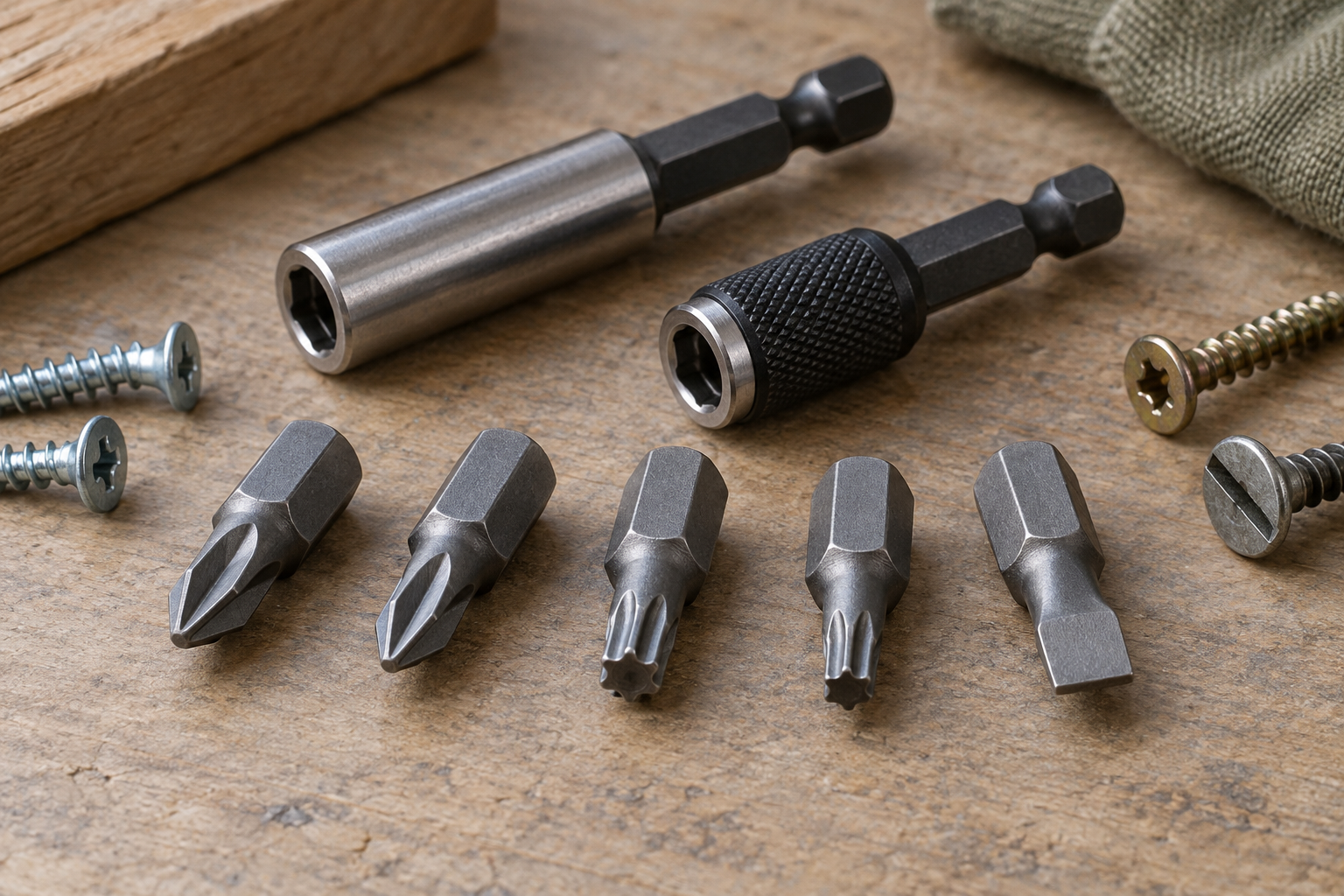
A magnetic bit holder has a hex shank that fits the drill or impact driver, a magnet behind the bit, and usually a 1/4-inch hex socket for interchangeable driver bits. The magnet attracts the screw head and keeps it aligned with the bit while you position the fastener.
The magnet does not replace pressure on the screw. It mainly prevents the screw from falling away before the threads engage. Once the screw starts, keep the driver straight and apply moderate forward pressure. If the bit slips out of the recess, the issue is usually poor alignment, a worn bit, or excessive speed—not a weak magnet alone.
For a normal wood screw, a magnetic holder works well when the screw is no more than a few inches long. With 3-inch construction screws, the screw can wobble because its unthreaded shaft acts like a lever. That is when a sleeve or retaining collar becomes more useful.
Magnetic bit holder options compared
| Type | Best use | One-handed control | Main drawback | Typical value |
|---|---|---|---|---|
| Basic magnetic bit holder | General screws in wood and light DIY work | Good | Can lose long or heavy screws | Best for most buyers |
| Impact-rated magnetic holder | Frequent use with impact drivers | Good | More expensive than standard holders | Best all-around upgrade |
| Magnetic holder with retaining sleeve | Overhead work and long screws | Very good | Longer, bulkier, less visibility | Worth it for repeated overhead fastening |
| One-piece screw-holding bit | Fast installation of one screw size | Very good | Less versatile; bit wears as a unit | Good for production tasks |
Best choice for most jobs
Buy an impact-rated magnetic bit holder if you use an impact driver, or if you want one holder that can handle both a drill and an impact driver. Impact-rated holders use tougher steel and are designed to tolerate the repeated twisting pulses produced by an impact mechanism.
That does not mean an impact-rated holder is unbreakable. A holder can fail when the bit is worn, the driver is cocked sideways, or the screw bottoms out while the tool is still applying torque. The common failure is a twisted or snapped shank near the hex end. For a cordless drill used occasionally on cabinet hardware, a standard holder is usually fine and may cost half as much.
Look for a magnet that sits close to the bit tip. A deep, recessed magnet may hold the bit securely but provide less contact with a screw head. Also check the fit between the holder and the driver bit. Excessive play lets the bit rock, which damages Phillips and square-drive recesses and makes one-handed starts harder.
When a retaining sleeve is worth buying
A retaining sleeve surrounds part of the screw and keeps it from tilting. It is especially useful when fastening roof sheathing, cabinet backs, metal brackets, or anything above your head. A sleeve is also helpful with small screws that are difficult to keep aligned with your fingers.
The trade-off is visibility. The sleeve can hide the screw tip, particularly in a corner, and it adds several inches to the tool. That extra reach can prevent access in a narrow cabinet or beside a wall. Sleeve systems also need adjustment: if the sleeve is set too far back, it does little; if it is too close, it can press against the work before the screw is seated.
For regular overhead work, consider a magnetic screw holder with a retaining sleeve. For occasional overhead fastening, a basic holder plus a free hand to position the first screw is usually the better value.
Match the holder to the bit and screw
Most holders accept standard 1-inch insert bits. Use a bit that matches the screw recess exactly. A Phillips bit that is one size too small may seem to work, but it will cam out under load. Square-drive screws are generally easier to start one-handed because the bit engages deeply. Torx-style screws are also forgiving, provided the bit is not worn.
For drywall, trim, and cabinet screws, a standard insert bit is adequate. For structural screws or repeated driving, use a torsion impact bit set with the magnetic holder. The holder protects the bit shank; it does not make a conventional bit suitable for high-torque impact use.
How to install a fastener one-handed
First, select the correct bit and push the screw firmly onto it. Set the driver to a low speed or low clutch setting. Place the screw tip exactly where it needs to start, then squeeze the trigger slowly. Once the threads bite, increase speed briefly and reduce pressure as the head approaches the surface.
Do not start at full speed. A typical cordless impact driver can produce several hundred inch-pounds of torque, enough to spin a screw sideways or strip a soft recess before you can correct it. For a 2-inch wood screw, a controlled start for the first 1/4 inch is usually enough. Pre-drill when the wood is prone to splitting or the screw is close to an edge.
Clean metal filings from the magnet occasionally. Debris weakens the holding force and can keep the bit from seating fully. Replace the bit when its corners round over or it begins slipping under light pressure. The cheapest holder is perfectly serviceable for a few shelves or a small repair; spend more on an impact-rated or sleeved design when the tool will be used daily, overhead, or with long structural screws.