What's inside
As an Amazon Associate I earn from qualifying purchases. This post may contain affiliate links at no extra cost to you.
Recessed retaining clips are small parts that punish the wrong pliers. A straight pair of needle-nose pliers may reach into the opening but approach the clip at the wrong angle. Bent-nose pliers can line up better, yet their offset jaws may not grip a flat clip as securely. The right choice depends on the clip shape, access angle, and whether you are installing or removing it.
As an Amazon Associate we earn from qualifying purchases at no extra cost to you.


Our Top Picks
 Amazon Basics Extra Long Reach Needle Nose Pliers3 Count (Pack Of 1)12.69 x 3.01 x 4.12 inchesCheck on Amazon
The basic difference
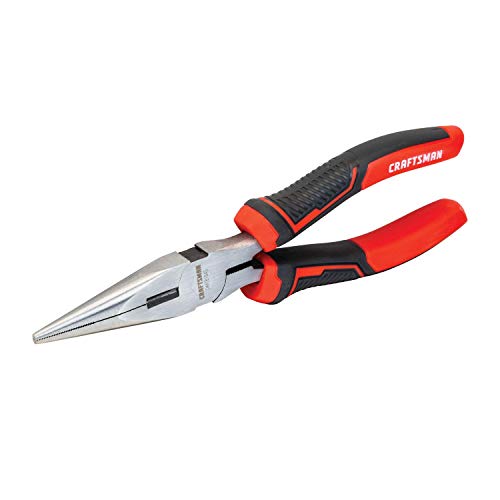
Needle-nose pliers have long, straight jaws that taper toward the tips. They are best when the retaining clip is directly in front of the access hole and you need maximum reach. Their narrow tips can enter gaps around 2 to 4 mm wide, although jaw thickness varies considerably between tools.
Bent-nose pliers use similar tapered jaws, but the jaws are angled—commonly 45 or 90 degrees—from the handles. That bend lets you work around a housing, shaft, wiring bundle, or panel without holding your hand directly in line with the recess. They usually offer better visibility because your hand is not blocking the work area.
Neither style is automatically a retaining-clip tool. If the part is a true internal or external circlip with holes in its lugs, use dedicated snap-ring pliers. General pliers can spread the lugs, slip off, or damage the clip and the groove.
Needle-nose vs bent-nose pliers
| Factor | Needle-nose pliers | Bent-nose pliers |
|---|---|---|
| Best access | Straight-in holes and narrow channels | Offset or side access around obstructions |
| Tip visibility | Often blocked by your hand | Usually easier to see around the bend |
| Reach | Typically longer and more direct | Effective reach is shorter because of the angle |
| Grip on flat clips | Good when aligned with the clip | Good at an angle, but easier to twist sideways |
| Risk of slipping | High if used sideways or on a smooth edge | High if the bend forces the jaws to twist |
| General usefulness | Usually more versatile for a basic toolbox | More specialized but faster in awkward recesses |
When needle-nose pliers are the better choice
Choose needle-nose pliers when you can approach the clip along its length. They work well for small E-clips, horseshoe clips, spring retainers, and flat stamped clips set in a straight bore. The long jaws can reach past a lip and grip the exposed edge without requiring a second angle change.
They are also the better option when the recess is deep. A 6-inch pair commonly gives roughly 2 to 3 inches of usable jaw reach, while compact 4-inch versions may leave too little metal engaged on the clip. Long-reach needle-nose pliers are useful in engine bays and appliances, but their slender jaws flex more under load. Do not use the tips as a pry bar.
For occasional work, a reasonably priced long-reach needle-nose plier is often enough. Look for jaws that meet evenly, serrations that continue close to the tip, and a pivot with little side play. Smooth, polished tips are poor at holding a greasy clip.
When bent-nose pliers are the better choice
Bent-nose pliers win when the retaining clip sits behind a shoulder or must be pulled sideways out of a groove. The angled jaws let you keep the handles outside the recess, which matters when a straight pair would hit the housing before the tips reach the clip.
A 45-degree bend is the more flexible choice for mixed work. It provides some offset without sacrificing too much jaw control. A 90-degree bend is better for a clip facing a side panel or for reaching around a shaft, but it can make the tool feel awkward in a deep, straight hole.
Use a bent nose when you need to rotate a clip slightly to release one edge, then pull it free. Do not force the entire clip sideways if it is locked into a machined groove. That can burr the groove or permanently distort the retainer.
If this is a recurring repair, compare a 45-degree bent-nose plier with a 90-degree version rather than buying the cheapest angled pair available. The bend angle and tip thickness matter more than a cushioned handle.
What to look for in the jaws
Measure the access opening and the clip before buying. A pair with 2.5 mm-wide tips will not enter a 2 mm slot, and forcing it can spread the housing. For clips under about 5 mm wide, fine tips are useful, but tips under 1 mm can bend if you squeeze hard.
Prefer moderately serrated jaws over needle-sharp, smooth tips. Serrations improve grip on a flat spring clip, especially when oil or dirt is present. However, aggressive serrations can mark a visible stainless or painted retainer. If the clip must be reused, grip the thicker end or an existing hole rather than the spring section.
Compound-leverage designs can generate more force, but they are often too bulky for recessed work. Standard slip-joint needle-nose or bent-nose pliers give better clearance. Locking pliers are usually a poor choice: their jaws are thick, their release action is abrupt, and they can crush a small retaining clip.
Technique and common failure modes
First, clean dirt from the recess and identify how the clip is retained. Use a pick or small screwdriver only to expose an edge, not to launch the clip across the shop. Wear eye protection; spring clips can eject several feet.
Grip as close to the clip’s center as possible. Squeeze only hard enough to prevent slipping, then pull in the direction the clip was designed to move. If the pliers twist in your hand, stop and change the angle. Twisting is what most often rounds edges, opens the clip, or snaps a fine plier tip.
For a stubborn clip, apply penetrating oil where appropriate and work the clip back and forth by a few degrees. Do not heat a plastic housing or pry against a wiring connector without checking what is behind it. If the clip is visibly distorted, replace it rather than reinstalling it.
Which pair should you buy?
Buy needle-nose pliers first if you want one general-purpose pair for electronics, appliances, small engines, and straight-in retaining clips. They are usually cheaper and useful in more situations. A basic pair is fine for light-duty clips, provided the jaws meet accurately and the tips fit the recess.
Buy bent-nose pliers instead when the job has a clear side approach or an obstruction that blocks straight access. For a toolbox that handles frequent repairs, owning both is sensible: a 6-inch straight pair for reach and a 45-degree bent pair for positioning. If the clip has lug holes, skip both and use internal and external circlip pliers matched to the clip size.