What's inside
As an Amazon Associate I earn from qualifying purchases. This post may contain affiliate links at no extra cost to you.
Bending small electrical connectors is a precision job, not a test of maximum jaw strength. The right long-nose pliers should hold a terminal securely, reach around insulation and adjacent wires, and make a controlled bend without crushing the metal. A cheap, blunt pair can work for occasional repairs, but poor jaw alignment and excessive play quickly show up on small spade terminals, relay sockets, pin connectors, and crimp tabs.
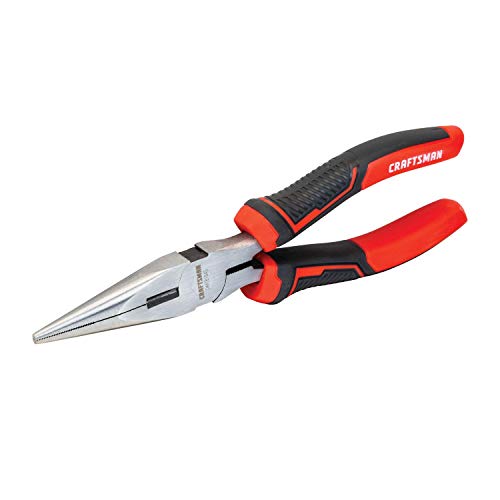
For most electrical work, look for 5- to 6-inch pliers with narrow, tapered jaws, smooth gripping faces, and a return spring. Serrated jaws are useful for gripping wire, but they can mark or deform a connector. If you regularly work on delicate pins, a smooth-jaw electronics or bent-nose design is usually the better choice.
As an Amazon Associate we earn from qualifying purchases at no extra cost to you.


Our Top Picks
 Amazon Basics Extra Long Reach Needle Nose Pliers3 Count (Pack Of 1)12.69 x 3.01 x 4.12 inchesCheck on Amazon
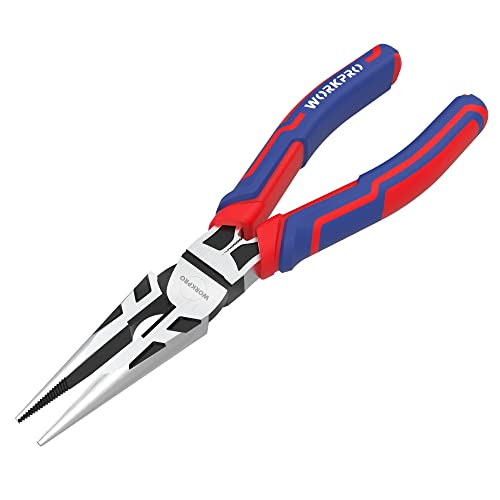

What makes a good pair for small connectors
Jaw alignment matters first. Close the pliers and hold them against a bright background. The two tips should meet evenly, without one jaw crossing the other or leaving a visible gap. A small gap is not automatically a problem on general-purpose pliers, but it makes thin connector tabs harder to control.
Tip width determines access. A tip around 1/8 inch wide can reach many automotive and appliance connectors while still supporting the metal. Needle-point tips reach tighter spaces, but they concentrate force into a tiny area and can leave dents. For terminals made from thin brass or copper, a slightly broader, smooth tip is safer.
Length affects leverage. Five-inch pliers give better control near a connector. Six- or 7-inch versions provide more bending force but are easier to overdo. If you are forming a small tab by 20 or 30 degrees, the shorter tool is generally easier to manage. Long handles are useful when the connector sits deep inside a panel, provided the jaws still fit.
Surface finish is important. Smooth jaws protect plated terminals and painted connector hardware. If you need serrated jaws, choose fine, shallow teeth rather than aggressive pipe-gripping teeth. Any burr on the jaw can score a connector, create a stress crack, or scrape plating that later corrodes.
The best long-nose plier types
| Type | Best use | Advantages | Limitations |
|---|---|---|---|
| Standard straight long-nose | General connector bending and wire positioning | Good reach, familiar control, inexpensive | Can be awkward around side-entry connectors |
| Smooth-jaw electronics pliers | Delicate terminals and plated contacts | Leaves fewer marks and offers precise control | Usually costs more and has less gripping bite |
| Bent-nose pliers | Connectors inside crowded panels | Improves visibility and access around obstructions | Less intuitive for straight, push-and-pull work |
| Extra-long needle-nose | Deep access and very small openings | Reaches where standard pliers cannot | Tips flex more and can bend thin tabs too quickly |
For a general toolbox, a 5-inch smooth-jaw long-nose plier is the safest starting point. It covers most small electrical connector work without being so sharp or powerful that it damages every part it touches.
Head-to-head buying choices
Standard versus electronics-grade: Standard long-nose pliers are the value choice. A decent pair is enough for bending robust crimp tabs, repositioning wires, and removing clips. They become less suitable when the connector is plated, thin, visible after assembly, or expensive to replace. Electronics pliers typically have cleaner pivots, more accurate tips, and smoother faces. Pay for them if you work on circuit boards, sensor connectors, or fine terminal pins every week. For two or three household repairs per year, the cheaper option is fine.
Straight versus bent nose: Straight jaws provide the most predictable bend because the jaws point directly at the work. Bent-nose pliers are better when a connector is recessed behind a dashboard, appliance frame, or wiring bundle. They also let you see the terminal more clearly from above. The trade-off is leverage: the angled head can make it harder to judge exactly where force is being applied.
Needle nose versus broad nose: Needle nose wins for access, but broad, tapered jaws win for controlled forming. If the terminal tab is only 0.5 to 1 mm thick, a needle tip can create a sharp crease instead of a smooth bend. That crease is a failure point, especially when the connector will be plugged and unplugged repeatedly. Use the narrowest tool that reaches the work, not the narrowest tool available.
A useful second tool is a smooth-jaw bent-nose electronics plier. It complements a straight pair rather than replacing it. The angled head can reach around a connector body while keeping your knuckles away from nearby wiring.
How to bend a connector without damaging it
Disconnect power first. For vehicles, remove the negative battery cable when appropriate and wait for airbag or control-module systems to discharge according to the service instructions. Do not use pliers on a live connector, even at low voltage; a slip can short adjacent contacts.
Inspect the terminal before bending. Identify the section intended to move, and support the connector body with your other hand or a nonconductive clamp. Grip as close as possible to the bend line, but leave enough jaw contact to avoid slipping. Make one small movement, usually 10 to 20 degrees, then check the fit. Several small adjustments are safer than one 60-degree twist.
Never bend the contact spring that provides the electrical wiping force unless the service procedure specifically calls for it. That spring needs its original shape and tension. Bend only a retention tab, mounting ear, or exposed crimp wing. If the metal starts whitening, cracking, or springing back immediately, replace the terminal instead of forcing it.
Features worth paying for
A smooth, low-play pivot is worth more than a flashy coating. Open and close the tool slowly: the jaws should track together without sideways movement, and the handles should not bind. A return spring reduces hand fatigue during repetitive work, but it should be removable or replaceable if it becomes weak.
Induction-hardened jaws can improve durability, while polished tips reduce marking. Insulated handles are useful around electrical assemblies, but they do not make a tool safe for energized work unless the entire tool is appropriately rated. A compact precision long-nose plier is often a better purchase than an oversized insulated pair when your actual job is shaping small contacts.
Keep a general-purpose pair for dirty work and reserve the smooth-jaw pair for clean terminals. Wipe the jaws after use, add a small drop of oil to the pivot, and store them closed or lightly protected. That simple separation prevents grit and damaged serrations from ruining the tool you use for precision connector work.