What's inside
As an Amazon Associate I earn from qualifying purchases. This post may contain affiliate links at no extra cost to you.
Our Top Picks
What you are comparing
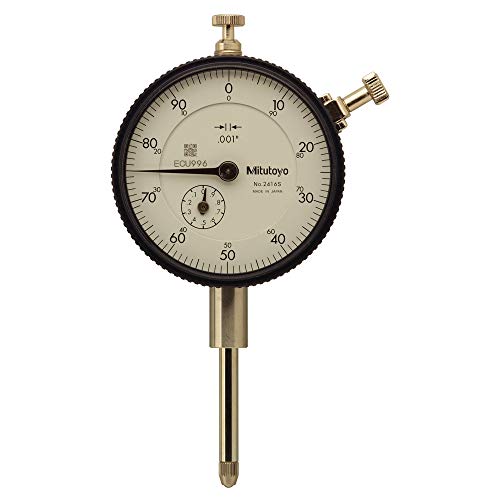
The Mitutoyo 2046S and Fowler 52-562-110 are both conventional plunger-style dial indicators for setup work. They are used to indicate runout, sweep a vise, check parallelism, locate a workpiece, and measure small changes while setting up a mill or lathe.
The important difference is not simply brand quality. The Mitutoyo 2046S is a metric indicator with 0.01 mm graduations and approximately 10 mm of measuring range. The Fowler 52-562-110 is an inch indicator with 0.001-inch graduations and a longer, approximately 1-inch range. That makes the Fowler more convenient in an inch-based shop and the Mitutoyo a better fit where metric drawings and tooling are standard.
As an Amazon Associate we earn from qualifying purchases at no extra cost to you.


| Feature | Mitutoyo 2046S | Fowler 52-562-110 |
|---|---|---|
| Display system | Metric dial | Inch dial |
| Graduation | 0.01 mm | 0.001 inch |
| Approximate measuring range | 10 mm | 1 inch |
| Measurement style | Plunger dial indicator | Plunger dial indicator |
| Typical use | Metric machine setup and inspection | General inch-based setup and inspection |
| Best advantage | Clear metric readings and Mitutoyo consistency | Longer range and usually lower purchase price |
Resolution and range
One Mitutoyo graduation equals 0.01 mm, or about 0.00039 inch. One Fowler graduation equals 0.001 inch, or 0.0254 mm. In pure resolution, the Mitutoyo dial divides movement more finely. That does not automatically make it more accurate for every job, but it makes small metric changes easier to read.
The Fowler’s roughly 1-inch range is more forgiving during rough setup. If a part is significantly out of position, you are less likely to run the plunger out of travel. The Mitutoyo’s 10 mm range is still ample for indicating a vise or checking a shaft, but it demands more careful positioning. A dial indicator should not be used as a crash stop; running the plunger into the end of its stroke can damage the mechanism or produce misleading readings.
For precision work, range is only part of the specification. Repeatability, hysteresis, contact force, and the condition of the mounting setup matter just as much. A cheap or poorly mounted indicator can show a changing reading even when the part is not moving.
Mitutoyo 2046S: where it fits
The 2046S makes sense in a metric workshop or anywhere the operator wants a finer-graduated dial. Mitutoyo indicators generally have a smooth plunger action and a well-finished dial that is easy to read at a normal working distance. The jeweled movement and controlled mechanism are useful when you repeatedly sweep parts and need the needle to return to the same position.
Its main limitation is the metric-only dial. If your machine tools, setup notes, and inspection targets are in inches, converting every reading adds an avoidable opportunity for error. A reading of 0.03 mm is about 0.00118 inch—not exactly one thousandth. That distinction matters when you are trying to hold a few tenths or compare a setup against an inch-based tolerance.
The 2046S is also not a substitute for a test indicator. Its plunger measures movement along the stem axis. It can sweep a surface, but the contact angle changes the effective reading. For indicating a bore or aligning a vise, a metric test indicator and magnetic base may be easier to use.
Fowler 52-562-110: where it fits
The Fowler 52-562-110 is the practical choice for a typical inch-based home shop, fabrication shop, or general machine setup. Its 0.001-inch dial is familiar, and the approximately 1-inch travel gives you more room when locating a part or checking a rough surface. It is often substantially less expensive than the Mitutoyo, making it attractive as a first indicator or as a second unit kept on another machine.
The trade-off is that the Fowler’s dial does not provide the Mitutoyo’s metric resolution. For ordinary tasks—tramming a vise, checking chuck or arbor runout, and aligning stock—the difference may not matter. If the needle moves several thousandths while you adjust a setup, a 0.001-inch graduation is entirely adequate.
Before ordering, check the current seller’s listing for travel, mounting style, and accuracy. Fowler has sold similarly named indicators in different configurations, and marketplace descriptions are not always consistent. Confirm that the included back, stem diameter, and lug or clamp arrangement match your indicator holder.
Setup details that matter more than the logo
Both indicators need a rigid mount. A dial indicator magnetic base with an articulating arm is the normal starting point, but a small base on a dirty or thin machine surface can flex enough to swamp the measurement. Clean the base and mounting surface, lock each arm joint firmly, and keep the arm as short as practical.
When checking shaft runout, rotate the work by hand in the normal direction and watch for the total indicator reading—the difference between the highest and lowest needle positions. Do not confuse that total with the actual radial error. A shaft showing 0.002 inch total indicated runout may have its center displaced by roughly 0.001 inch, assuming the error is simple eccentricity.
Common failures include pushing the contact tip sideways, mounting the indicator at a steep angle, allowing the magnetic base to shift, and reading parallax on a small dial. Preload the plunger enough to keep contact through the full movement, but leave usable travel in both directions. If you need to measure a springy part, take several passes and approach the final position from the same direction to reduce backlash effects.
Which one should you buy?
Choose the Mitutoyo 2046S if your shop is metric, you regularly read changes near 0.01 mm, or you value a smoother, more refined indicator for repeated setup work. Its shorter range is not a serious problem when the indicator is positioned carefully.
Choose the Fowler 52-562-110 if your machines and drawings are in inches, you want about an inch of travel, or you need a capable indicator without spending as much. For most woodworking-machine conversions, drill-press fixtures, hobby mills, and general lathe setup, the cheaper Fowler is fine when its specifications match the job.
Neither indicator solves a poor mounting problem. If budget is limited, buy the indicator that matches your unit system, then put some of the savings into a rigid holder, clean contact points, and a repeatable setup procedure. Those choices will usually affect the result more than the difference between two reputable dial movements.