What's inside
As an Amazon Associate I earn from qualifying purchases. This post may contain affiliate links at no extra cost to you.
Our Top Picks


What a small bucket demands from a drill
Joint compound is thick enough to stall a weak drill, but a small bucket makes an oversized mixer awkward and splash-prone. The best setup is a corded drill with a real low-speed range, a side handle, and a paddle short enough to stay submerged in the compound. Aim for a drill rated around 0–500 rpm under trigger control; the lower end matters more than a high maximum speed.
For a typical 1-gallon bucket, use a compact paddle roughly 2–3 inches wide and mix at about 200–300 rpm. Start slower, keep the paddle below the surface, and increase speed only if the material is not moving. Mixing at full speed can whip air into the compound, throw material onto the walls, and make a mess before the drill has a chance to stall.
As an Amazon Associate we earn from qualifying purchases at no extra cost to you.


Best drill type: a low-speed corded drill
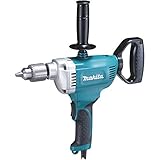
A dedicated low-speed mixing drill is the most controlled choice if you mix compound often. These tools are built for sustained torque at low rpm and usually include a long auxiliary handle, which helps resist the twisting force when a paddle catches. Their drawbacks are cost, weight, and bulk: a full-size mixer can feel clumsy over a small bucket.
For occasional patching or one small batch, a heavy-duty corded drill with a side handle is often enough. Look for a low first gear or variable-speed range that begins near zero, plus a stated low-speed maximum below about 600 rpm. A standard high-speed drill may work with a small paddle and a very light batch, but it is easier to over-speed and more likely to overheat under prolonged load. A cordless drill is convenient, but many compact models lack the sustained torque for thick compound and can drain a battery quickly.
Shop among low-speed mixing drills if this is a regular task. For occasional use, compare them with corded drills with a side handle rather than buying a larger mixer by default.
How the options compare
| Option | Best for | Main advantage | Trade-off |
|---|---|---|---|
| Dedicated low-speed mixer | Frequent or larger batches | Torque and control under mixing load | Costlier and often oversized for a small bucket |
| Heavy-duty corded drill | Occasional small batches | Good value if you already own one | Check low-speed rating and handle setup |
| Compact cordless drill | Small touch-ups and portability | No cord to manage | Battery, heat, and torque can limit mixing |
| High-speed drill | Only very light, brief mixing | May be already on hand | Easy to splash, aerate compound, or overload |
Match the paddle to the bucket
In a small bucket, paddle diameter and length matter as much as motor power. A wide paddle can hit the sides, drag the bucket around, or trap compound beneath the blade. Choose a narrow drywall or mud paddle that fits with clearance on all sides; check the actual blade dimensions against the bucket’s inside diameter rather than relying on a listing’s “small” label. A shaft that is too long can make it hard to keep the blade centered and submerged.
A small drywall compound paddle is usually a better fit than a broad mortar mixer for one-gallon batches. If you already own a suitable paddle, do not buy another just because it is marketed for drywall. Verify that its shank fits the drill chuck or mixer connection and that the blade clears the bucket.
Mix without splashing or overheating
Put the bucket on a level, non-slip surface and hold it steady. Insert the paddle before switching on. Start at the lowest speed with the blade near the bottom, then move it slowly through the material without lifting it above the surface. Scrape compound from the sides with a hand tool, stop the drill, and repeat. Do not use the paddle to scrape the bucket; that can bend the shaft or damage the blade.
Mix in short bursts of roughly 20–30 seconds, pausing if the drill housing becomes notably hot or the speed drops under load. If the motor strains, the bucket spins, or the paddle repeatedly stalls, stop. Reduce the batch size, use a narrower paddle, or choose a drill with more low-speed torque. A longer trigger squeeze is not a fix for an undersized drill and can overheat it.
Do not add water to a premixed product unless its instructions allow it, and add any permitted water in small amounts. Over-thinning can reduce workability or compromise the finish. Dry compound has its own water ratio and mixing directions; follow the bag, and avoid making a dusty cloud when adding powder.
What to buy for your situation
For frequent finishing work, choose a dedicated mixer with a side handle and a low-speed setting suitable for thick material. It costs more, but the torque and control are useful when mixing regularly. For a homeowner mixing one small bucket now and then, a heavy-duty corded drill with a side handle is the sensible lower-cost choice—provided its low gear stays below roughly 500–600 rpm and it can run under load without slowing sharply.
Use a compact cordless drill only for a small amount of already workable compound, and stop if the tool heats up or the battery sags. If all you own is a high-speed drill, hand mixing with a broad knife may be less frustrating for a small patch than risking a splashed bucket or overheated motor. The right choice is the lightest setup that can turn the compound steadily at low speed, not the drill with the biggest advertised wattage.