
What's inside
As an Amazon Associate I earn from qualifying purchases. This post may contain affiliate links at no extra cost to you.
For painted MDF trim, the blade matters—but it cannot compensate for a loose workpiece, a dirty blade, or a cut that lets the offcut tear away. The safest starting point is a sharp, high-tooth-count blade designed for fine crosscuts. For most 10-inch miter saws, that means a 80-tooth blade; for a 12-inch saw, look at 90 to 100 teeth.
Those counts are practical starting points, not guarantees. Tooth geometry, blade sharpness, saw alignment and support all affect the edge. The paint may chip even when the MDF underneath cuts cleanly, so test on a scrap painted with the same finish before cutting installed or costly trim.
As an Amazon Associate we earn from qualifying purchases at no extra cost to you.


Our Top Picks
 WEN BL1080 10-Inch 80-Tooth Carbide-Tipped Ultra-Fine Finish Professional10 inches10 x 10 x 0 Inches1.6 PoundsCheck on Amazon
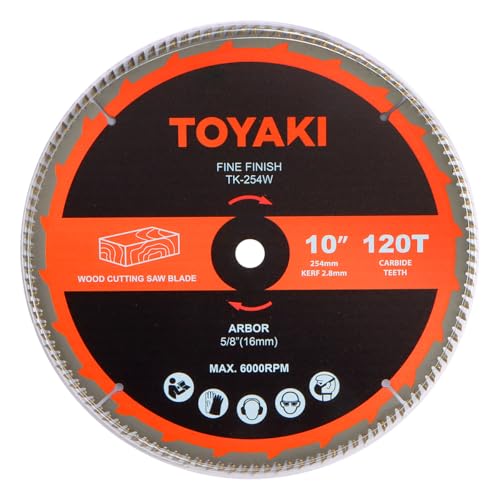


What to buy for painted MDF
Choose a carbide-tipped crosscut or fine-finish blade made for miter saw use, with a tooth count suited to the blade diameter. A high alternate-top-bevel (ATB) grind is a useful feature: the alternating bevels score the surface fibers before the tooth clears material. A thin-kerf blade can remove less material and put less load on a modest saw, but it must match the saw’s arbor, diameter, speed rating and guard clearance.
For a 10-inch saw, compare 10-inch 80-tooth fine-finish blades. For a 12-inch saw, a 12-inch 96-tooth fine-finish blade is a reasonable category to compare. Check the actual tooth grind and manufacturer’s intended use, not just the number printed on the package.
Blade choices compared
| Blade type | Typical use | Edge on painted MDF | Trade-off |
|---|---|---|---|
| General-purpose 40-tooth, 10-inch | Mixed framing and trim cuts | Often rougher; more likely to chip the coating | Fast and inexpensive; fine for hidden ends or rough work |
| 60-tooth crosscut, 10-inch | General finish carpentry | Usually cleaner than a low-tooth blade | Good middle ground, but not the safest pick for brittle paint |
| 80-tooth fine-finish, 10-inch | Trim and delicate crosscuts | Typically the best balance for painted MDF | Slower feed and more prone to loading if pushed or dirty |
| 90–100-tooth fine-finish, 12-inch | Fine crosscuts on a 12-inch saw | Often clean, provided the blade is sharp | More teeth are not automatically better; feed gently and avoid burning |
A 60-tooth blade can be the sensible cheaper option if the trim is inexpensive, cuts will be caulked or covered, and a test piece comes out clean. Buying a premium blade does not make sense for every repair. If the paint is brittle, glossy, or already lifting, start with the finer blade and plan on a test cut.
Why painted MDF chips
MDF has no wood grain to split, but its surface can still break away where the blade exits. The coating adds another weak layer: thick paint, hard enamel and old finishes may crack instead of being cleanly sliced. A blade with too few or damaged teeth can tear the edge; a dirty blade can drag; and a cut made too quickly can increase breakout.
Chipping on only one face often points to blade exit, not a defective blade. On a typical miter saw, the blade enters the visible upper face and exits the lower face, though bevels and saw design change the pattern. Inspect both sides of a test cut. If the visible edge is the one that chips, use a sacrificial backer or adjust the orientation so the cleaner face is the show face.
Set up the cut to protect the finish
First, clamp or firmly hold the trim against the fence and table. A long piece that moves during the cut can tear paint or leave an inaccurate angle. Support the stock level with the saw table; for long moulding, use a stand or blocks at the same height. Keep hands outside the marked danger zone and let the blade stop before lifting it.
Use a sharp pencil or knife to mark the cut. For a high-risk edge, score the paint line lightly with a sharp utility knife, taking care not to cut into the MDF. A zero-clearance insert or a sacrificial piece of thin, stable material tight against the fence can support the exit edge. The backer should be clamped and positioned so it cannot interfere with the blade or guard.
Bring the blade to full speed before cutting. Lower it steadily without forcing it through the material, then pause briefly at the bottom if your saw’s manual permits that technique. Do not drag a spinning blade through the trim on the way back up; wait for it to stop. If the edge burns or looks fuzzy, check for resin buildup, a dull blade, poor alignment or an overly slow, rubbing cut.
When the paint itself is the problem
Paint can chip after a clean MDF cut if it has poor adhesion or is brittle. Test a scrap from the same batch and finish. If paint flakes away beyond the cut line, no tooth count will reliably fix the underlying adhesion issue. A light score, a sharp blade and a backer may reduce damage, but plan to touch up the edge.
For a small number of cuts, a clean 60-tooth blade may be adequate. For repeated visible miters or expensive painted moulding, an 80-tooth blade on a 10-inch saw—or an equivalent fine-finish blade for your saw diameter—is the safer purchase. Keep it clean, verify that it is compatible with the saw, and let a test cut decide whether the setup is ready for the finished pieces.