Key takeaways
- A brand-by-brand power tool battery compatibility chart showing which platforms cross over, which never will, and which system suits your shop.
What's inside
As an Amazon Associate I earn from qualifying purchases. This post may contain affiliate links at no extra cost to you.
Buying a second cordless tool is where most people discover the real cost of cordless. The drill was cheap. The battery was not. And the 20V pack sitting on your bench will not fit the saw you just added to your cart, because “20V” is a marketing number, not a standard. A useful power tool battery compatibility chart is not a list of voltages. It is a map of which brands honor their own past, which ones quietly abandoned platforms, and which ones will still sell you a pack in eight years.
This is a comparison desk piece. We do not sell batteries and we have no favorite brand. Below is how the major US platforms actually behave on the things that cost you money later: how wide the tool range is, whether old packs keep working, what the warranty really covers, how easy replacements are to find at retail, and how the prices move through the year.
As an Amazon Associate we earn from qualifying purchases at no extra cost to you. Product prices and availability are accurate as of the date shown and are subject to change.



Power Tool Battery Compatibility Chart: The Major US Platforms
Read this as a compatibility and commitment chart rather than a spec sheet. “Backward compatible” means an older battery from the same platform generally runs newer tools on that platform, which is the single most important thing to know before you buy in.
| Platform | Voltage Family | Backward Compatible | Range Breadth | Best Suited To |
|---|
| Platform | Voltage badge | Same-platform backward compatibility | Tool range | Who it suits | |
|---|---|---|---|---|---|
| DeWalt 20V MAX / XR | 20V MAX (plus FLEXVOLT step-up) | Yes, across 20V MAX generations | Very broad, strong jobsite depth | Trades and mixed pro/DIY shops | |
| Milwaukee M18 / FUEL | M18 | Yes, long-running platform | Very broad, deepest specialty trade tools | Electricians, plumbers, heavy daily use | |
| Makita 18V LXT / XGT | 18V LXT and separate 40V XGT | Yes within LXT | XGT is a separate system | Extremely large LXT catalog | Woodworkers, finish work, big collections |
| Ryobi ONE+ | 18V ONE+ | Yes, unusually long continuity | Enormous, includes oddball lifestyle tools | Homeowners and hobby shops on a budget | |
| Bosch 18V | 18V | Yes within 18V | Moderate in the US, broad in Europe | Precision work, tool-first buyers | |
| Craftsman V20 | 20V | Yes within V20 | Moderate, homeowner oriented | Light DIY, garage basics | |
| Kobalt 24V / Hart 20V | 24V max / 20V | Yes within each | Store-limited but growing | Single-retailer shoppers |
Two things fall out of that table immediately. First, cross-brand compatibility is not a feature anyone offers on purpose. Second, the voltage number tells you almost nothing, because an 18V and a 20V MAX pack are usually the same five lithium cells counted two different ways. Nominal versus maximum. That is the whole difference.
Why Voltage Numbers Do Not Equal Compatibility
Physical fit is the gatekeeper. Every platform uses its own rail geometry, latch position, and terminal spacing, and most add a data pin so the tool and pack can talk about temperature and current draw. Even when two packs share a cell count, the plastic tells them apart, and that is deliberate. The battery is where the margin lives, so the interface is where the moat is dug.
What actually varies between platforms is the design philosophy behind the interface:
One platform, all sizes. Milwaukee M18 and DeWalt 20V MAX both stretch a single mount across everything from a screwdriver to a table saw, using bigger high-output packs to feed the hungry tools. The upside is that one battery family covers your whole shop. The downside is that a compact pack in a big saw will sag and shut off, and buyers blame the tool.
Two platforms, clear split. Makita runs 18V LXT for the mainstream catalog and 40V XGT for high-demand outdoor and construction gear. They do not interchange. That is honest, if inconvenient, and it means an LXT collection stays useful instead of being slowly deprecated.
Bridge platforms. DeWalt FLEXVOLT packs switch between 20V and 60V depending on the tool they are inserted into, so they run standard 20V MAX tools as well. That is real, useful cross-tier compatibility inside one brand, and it is the closest thing to a free lunch in this category.
DeWalt 20V MAX battery packs
If you want the lowest odds of being stranded, this is the safest platform bet in the US simply because every hardware store, home center and independent supply house stocks the packs. Buy capacity to match the tool: compact packs for drills and drivers, higher-capacity or high-output packs for circular saws, grinders and blowers. Check that the listing is sold by Amazon or the brand, not a third party with a generic name.
Adapters: What Works, What Voids Your Warranty
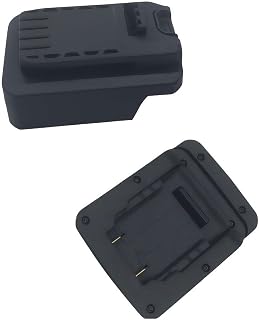
Search any marketplace and you will find adapters promising to run Milwaukee tools on DeWalt packs, or Ryobi tools on Makita packs. They exist, they sometimes work, and they carry real tradeoffs that the listings do not mention.
The problem is not usually the voltage. It is the conversation. Modern packs and tools exchange data about cell temperature, current draw, and low-voltage cutoff. A passive adapter passes power and drops the conversation, which means the tool’s protection circuit and the pack’s protection circuit are each guessing. On a light drill or a work light, that is mostly harmless. On a high-draw saw or grinder, it is how packs get cooked and tools get retired early.
- ✔ Lets you finish a job with the batteries you already own
- ✔ Genuinely useful for low-draw tools like lights, fans and inflators
- ✔ Cheap way to test a platform before committing to it
- ✔ Can extend the life of an orphaned tool whose original packs are gone
- ✘ Voids the tool warranty and usually the battery warranty on both sides
- ✘ Bypasses or blinds thermal and current protection on high-draw tools
- ✘ Adds length and weight, which ruins balance on compact tools
- ✘ No fast-charge or fuel gauge accuracy across brands
- ✘ Quality varies wildly between sellers with no way to verify
Our read: adapters are a bridge, not a plan. Use one to keep an older tool alive or to run something undemanding. Do not build a shop on them, and never use one on a tool you rely on for income.
Warranty, Availability and How Battery Prices Actually Move
This is the part most compatibility charts skip, and it is where the long-term cost sits.
Warranty length is not warranty value. Battery warranties across the major platforms typically run in the two to three year range, shorter than the tool warranty on the same platform. Read for what excludes coverage: normal capacity fade is almost never covered, and neither is damage from a third-party charger or adapter. A brand with a shorter warranty but service centers you can drive to is often worth more than a longer warranty administered by mail.
Availability is the sleeper factor. Ask where you will buy a replacement in year five, in your town, on a Saturday. Platforms sold through multiple national chains and independent suppliers give you options. Store-exclusive platforms are cheaper up front and fine while that retailer keeps the line healthy, but you are betting on one company’s shelf space.
Price behavior follows a calendar. Cordless batteries in the US are priced as a promotional item, not a commodity. Kit deals and free-battery-with-tool offers cluster around late spring and the November window, and the effective price of a pack swings widely. The practical move is to buy batteries as part of a kit or during a promo cycle, and to buy bare tools the rest of the year.
Milwaukee M18 batteries and starter kits
The strongest case for M18 is not the drills, it is the specialty tools nobody else makes at that quality. If your work involves conduit, pipe, or anything niche, this platform will hold you longest. Pay attention to pack tiers: standard, high-output, and high-demand ratings behave very differently under a grinder or a bandsaw. Buy from the brand store or a recognized tool retailer to avoid counterfeit cells.
Ryobi ONE+ 18V batteries
For homeowners, the compatibility argument is genuinely strong here: ONE+ has kept the same interface across a very long run, so a pack you buy today typically still fits the older tools in the garage. The tools are not built for eight-hour days, and that is fine if yours are not eight-hour days. Verify the listing is a current-generation lithium pack, not an old fitment.
How to Choose a Platform You Will Not Regret
Pick the platform by the tool you will use most, then let the batteries follow. Battery-first thinking is how people end up with three chargers and a drawer of dead packs.
Count your future tools honestly. If the answer is four or fewer and they are all household jobs, a homeowner platform is the rational choice and the savings are real. If the answer is a dozen and some of them are specialty, buy into a deep pro catalog even though the entry price stings, because the catalog is what you are actually paying for.
Then check three things before you commit: does the brand still support packs from five or six years ago on current tools, can you buy a replacement locally without ordering it, and does the platform have the one weird tool you will eventually need. If a brand fails any of those, the low kit price is a loan, not a discount.
One more practical note that has nothing to do with brands. Store packs indoors at moderate temperature and around a partial charge if they will sit for months, and keep them out of hot trucks and freezing sheds. Heat and deep discharge kill more batteries in the US than any tool ever does, and no compatibility chart will save you from a garage that hits 120 degrees in August.
Frequently Asked Questions
Are 18V and 20V batteries interchangeable? Electrically they are nearly identical, since both usually describe the same five-cell lithium arrangement measured either at nominal or maximum voltage. They are not interchangeable in practice because the housings, rails, latches and data terminals differ by brand. Without an adapter, an 18V Makita pack will not seat in a 20V MAX DeWalt tool, and vice versa.
Will my old batteries work on new tools from the same brand? Usually yes, within the same platform. DeWalt 20V MAX, Milwaukee M18, Makita 18V LXT and Ryobi ONE+ have all maintained the same interface across generations, so older packs generally run newer tools. The caveat is performance rather than fit: an older or lower-capacity pack may not deliver enough current for a high-demand tool, which can trigger the tool’s protection cutoff mid-cut. Makita’s 40V XGT is a separate system and does not accept LXT packs.
Are third-party replacement batteries worth the savings? They are the biggest gamble in this category. Some are competent, many use lower-grade cells with optimistic capacity claims and thin protection circuits, and using one typically voids your tool warranty. If you go that route, restrict it to low-draw tools, avoid anything with an unfamiliar seller name and a suspiciously high star count, and never leave one charging unattended. For a tool you depend on, the first-party pack bought during a promo cycle is usually the better math.
The honest summary is that there is no universal cordless standard and there is not going to be one, so the question is not which battery is best but which ecosystem you want to be locked into. Compare range, backward compatibility, local availability and promo timing, then buy once.
Check prices on Amazon →