What's inside
As an Amazon Associate I earn from qualifying purchases. This post may contain affiliate links at no extra cost to you.
Our Top Picks



The short answer
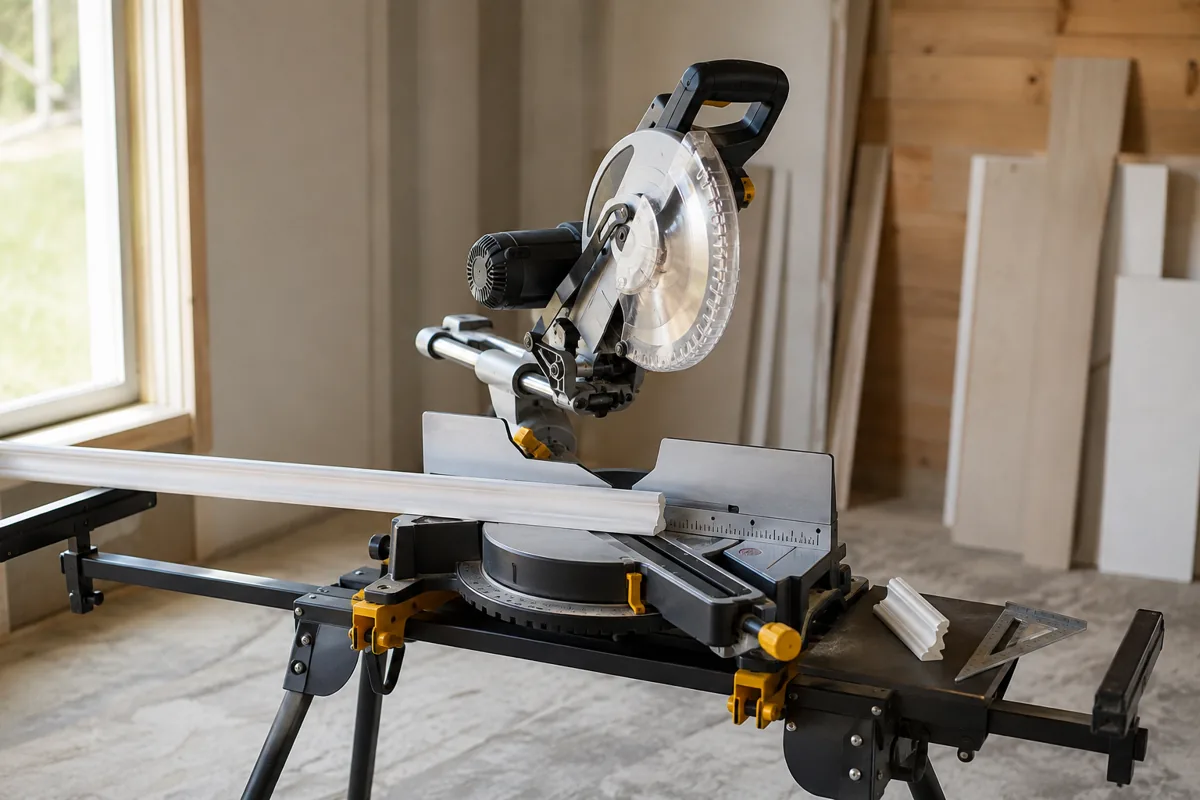
For accurate short crosscuts, a miter saw is usually the better buying choice. It is faster to set up, easier to use on narrow stock, and safer for repeated cuts when the saw is properly supported. A table saw with a well-built crosscut sled can be just as accurate—or more accurate—but it demands more shop space, careful construction, and disciplined technique.
Choose a compound miter saw if you mainly cut trim, framing lumber, shelving parts, or small furniture components. Choose a table saw sled if you already own a table saw and want a precise crosscut station for cabinet parts, boxes, and other repeatable shop work.
As an Amazon Associate we earn from qualifying purchases at no extra cost to you.


What counts as accurate?
For most construction work, being within 1/16 inch is adequate. Installing baseboard or cutting studs rarely requires more. Furniture work is less forgiving: a 1/32-inch error can show in a small box, and repeated parts may need to match within a few thousandths of an inch to assemble cleanly.
Accuracy has several parts. The cut must be square across the board, the miter angle must be correct, and repeated pieces must be the same length. A saw can produce a clean cut while still being inaccurate if its fence, blade, or work support is misaligned.
Miter saw vs. table saw sled
| Factor | Miter saw | Table saw with crosscut sled |
|---|---|---|
| Best use | Fast crosscuts, trim, framing, and long stock | Short parts, repeatable furniture cuts, and small panels |
| Typical setup time | Minutes | Hours to build and tune the sled |
| Crosscut accuracy | Very good when calibrated and supported | Excellent when the sled is square and the blade is aligned |
| Repeatability | Good with a stop block or fence system | Excellent with a stop block and fixed reference fence |
| Long boards | Much easier to support | Awkward unless the table and outfeed area are large |
| Small parts | Good, but keep hands clear of the blade path | Very good because the sled supports the work on both sides |
| Space and cost | Requires a saw and stable support stands | Requires a table saw, sled materials, and clear infeed/outfeed space |
Where the miter saw wins
A miter saw is the practical choice for short crosscuts because the workpiece stays on a stationary table while the blade comes down to the cut. A 12-inch saw commonly handles a 2×8 at 90 degrees, while a 10-inch saw is suitable for many 2x4s, 1x boards, and trim pieces. Capacity varies, so check the manufacturer’s specifications rather than assuming the blade diameter tells the whole story.
It is also better for long material. With an extension stand or properly level supports, you can cut 8-foot boards without balancing them across a narrow table. A stop block makes repeated cuts quick. For example, a stop set at 18 inches can produce a batch of shelf cleats with little measuring and marking.
The main weakness is that many miter saws are not perfectly square from the factory. The fence may be slightly out of alignment, the bevel stop may be off, or the turntable may not read exactly 45 degrees. A 1-degree error creates a visible gap across a wide casing joint. Check square with a reliable combination square and confirm a 45-degree setting with test cuts before blaming the blade.
Where a table saw sled wins
A crosscut sled rides in the table saw’s miter slots and carries the work through the blade. Its fence can be longer and more stable than a miter saw fence, and the sled supports narrow pieces that might otherwise tip or twist. This is particularly useful for box parts, drawer components, and cabinet dividers.
A properly tuned sled can also make repeat cuts extremely consistent. Add a stop block to the fence, but do not trap the offcut between the blade and stop. That can cause the offcut to bind, kick back, or be thrown across the shop. Put the stop on the waste side only when the cutoff cannot become trapped, or use a stop that ends before the blade kerf.
The sled’s accuracy depends on its construction. The runners must fit the slots without side play, the fence must be square to the blade path, and the table saw blade must be parallel to the miter slots. A 1/32-inch error across a sled fence can turn into visibly mismatched parts. Building and tuning one can take an afternoon, especially if you add a replaceable zero-clearance insert.
If you need a sled, start with a table saw crosscut sled kit or build one from stable plywood. Avoid warped material; a sled base that rocks will never cut consistently.
Safety and common failure modes
Both tools can produce kickback, but the risks differ. On a miter saw, the common mistakes are holding a short offcut too close to the blade, cutting unsupported long stock, and allowing the blade to contact the material from the side. Clamp small or awkward pieces, and keep your hands at least 6 inches from the blade path unless the saw’s instructions specify a greater distance.
On a table saw sled, never pull the sled backward while the blade is spinning. Keep the work tight against the sled fence, use the blade guard when compatible with the setup, and stand slightly to one side of the blade. A sled makes the cut feel controlled, but it does not eliminate kickback.
Blade choice matters too. A general-purpose blade may leave acceptable construction cuts, but a sharp 60- or 80-tooth crosscut blade usually produces cleaner results in plywood and hardwood. A dull blade increases burning, wandering, and force at the cut.
Which one should you buy?
Buy a miter saw when speed, portability, and long-board support matter. It is the cheaper option if you already have a workbench or can make simple support wings, and it handles the majority of household crosscutting jobs. Add a miter saw stand with a stop block if you regularly cut batches of identical parts.
Use a table saw sled when you already own a table saw and your work centers on small, square furniture parts. The sled is not a substitute for a miter saw’s capacity or convenience, but it can be the more accurate system for repeatable short cuts in a dedicated shop. If you only need occasional 12-inch crosscuts, building a sled is usually unnecessary; a calibrated miter saw and a sharp blade will do the job with less setup and fewer opportunities for error.