What's inside
As an Amazon Associate I earn from qualifying purchases. This post may contain affiliate links at no extra cost to you.
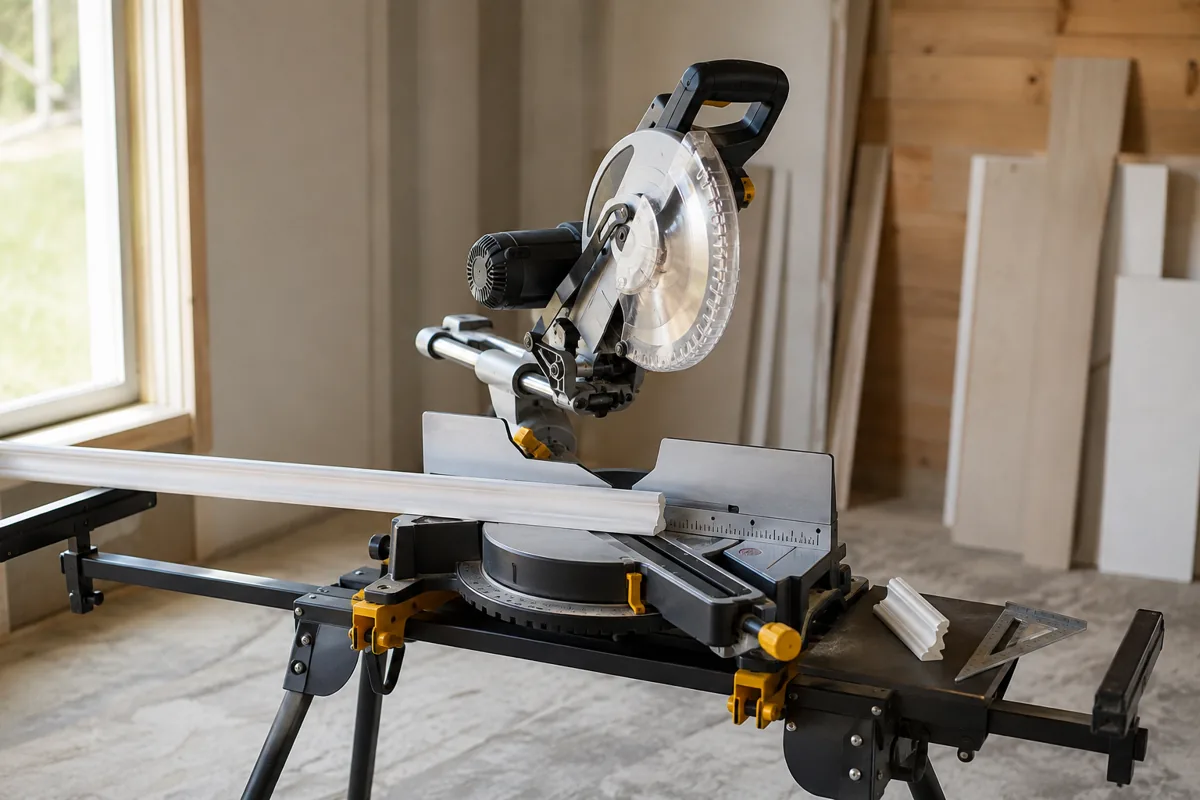
Long trim stock exposes the weaknesses of an ordinary miter saw stand. A 12-foot piece of baseboard can tip off a short extension, drag across the stand as you cut, or pull the saw out of alignment. The right stand does more than hold the saw: it supports the workpiece at the correct height, keeps long material level, and lets you make repeatable cuts without fighting the stock.
Our Top Picks
 POWERTEC Portable Miter Saw Stand w/ Quick-release Mounting1PK49 x 16.25 x 8.25 inchesCheck on Amazon

Start With the Stock You Actually Cut
Measure the longest and heaviest material you expect to handle. A stand that works for 8-foot casing may be frustrating with 16-foot crown molding. Trim is usually light, but its length creates leverage. A 12-foot board hanging several feet beyond the stand can lift the opposite end or twist the stand when you slide it into position.
For occasional 8- to 10-foot boards, a stand with extensions reaching about 8 feet overall may be enough. For 12- to 16-foot material, look for extensions that provide at least 10 to 12 feet of usable support, or plan on using a separate roller stand or sawhorse. The support does not need to span the entire board, but the unsupported overhang should be manageable and stable.
Also check the stand’s weight rating. A trim board may weigh only a few pounds, yet a bundle of boards or a long, dense hardwood casing can load the extensions heavily. A realistic stand should support at least 300 pounds overall, with clearly stated limits for each extension.
Choose the Right Extension Style
There are three common support arrangements. Flat extensions are simple steel or aluminum arms with a top surface. They are inexpensive and work well for wide casing, baseboard, and other stock that stays flat. Their weakness is friction: a long board may catch on the surface instead of sliding smoothly.
Roller extensions use one or more rollers. They are useful when you feed long boards into the saw repeatedly, especially in a shop. However, rollers can allow narrow trim to drift sideways. A roller that is not exactly level can also change the board’s position as it approaches the blade.
Material stops are valuable for repeated cuts. A stop gives you a fixed reference point instead of requiring a tape measure for every piece. Look for a stop that folds out of the way and locks positively. A loose stop can shift under pressure and turn a batch of identical pieces into a stack of nearly identical pieces.
| Support type | Best for | Main advantage | Common drawback |
|---|---|---|---|
| Flat extension | Wide trim and occasional use | Stable, simple, and inexpensive | Long stock may drag instead of sliding |
| Roller extension | Frequent crosscutting and long boards | Feeds stock smoothly | Narrow trim can wander sideways |
| Extension with stop | Repeated parts and production work | Fast, consistent length cuts | Stop can interfere with long or awkward profiles |
| Separate roller stand | Very long stock or occasional extra support | Flexible placement | More setup and another item to level |
Check Saw and Mounting Compatibility
Do not assume every stand fits every miter saw. Check the mounting-slot range, included hardware, and maximum saw base size. A stand should let you bolt the saw down without forcing the mounting brackets against an edge or blocking the saw’s bevel and slide functions.
Quick-release brackets are convenient if you move the saw between a bench and the stand. They are worthwhile for remodelers and installers who load tools into a vehicle every day. For a permanently mounted shop saw, fixed brackets are usually cheaper and can be just as secure.
Pay attention to the saw’s height above the supports. The saw table and both extensions need to be coplanar. Even a 1/16-inch step can make thin trim rock as you push it toward the blade. If the extensions are too low, the board dips and the cut can close against the blade. If they are too high, the board may lift off the saw table, producing an inaccurate or unsafe cut.
Before buying, compare the stand’s published working height with your saw table height. If the stand has adjustable feet or extension supports, that is a useful safeguard. Otherwise, you may need shims, which are acceptable for setup but inconvenient when the stand is folded and moved.
Prioritize Stability Over Portability
A portable stand should remain planted when you push a long board across it. Wide feet, locking legs, and a rigid center beam matter more than a very small folded size. A narrow stand may be easy to carry but can rock when the stock is off-center.
Look for legs that lock with a clear mechanism rather than relying on friction alone. Test whether the stand twists when you press down on one extension. Some lightweight stands support the advertised weight only when it is centered; long trim applies leverage far from the center.
Wheels are helpful on a large stand, but they add cost and can reduce stability if the wheel locks are poor. For a shop where the stand moves across a smooth floor, wheels make sense. On uneven flooring or a jobsite, solid feet are often less troublesome.
For a basic, mostly stationary setup, a folding miter saw stand with extensions is usually sufficient. You do not need a premium rolling system just to cut a few pieces of baseboard each month.
Features Worth Paying For
Spend extra on long, rigid extensions, accurate adjustment, and a dependable material stop. These features directly affect cut quality. A tool tray, carrying handle, and quick-release mounts are useful, but they do not compensate for a sagging support arm.
If you regularly cut crown molding or tall baseboard, favor broad, flat supports over narrow rollers. Profiled trim can sit unevenly on a roller and rotate as you cut. A flat surface gives you more control, provided it is aligned with the saw table.
For frequent cutting of long boards, consider a miter saw stand with roller extensions and a material stop. For occasional long stock, a cheaper stand plus a separate adjustable roller stand can provide nearly the same support for less money and more flexible placement.
Set It Up Correctly
Place the stand on a level surface and extend both sides before loading the board. Adjust each support until a straightedge laid across the saw table and extensions shows no gap or step. Lock the extension knobs firmly, but do not overtighten them to the point that adjustment becomes difficult.
Support the stock before starting the saw. Keep the board tight against the fence, and do not use a loose roller as a substitute for controlling the workpiece. If the trim is warped, support it in the same orientation it will have during the cut; forcing it flat can release tension when the cut is made.
Finally, check the stand whenever you relocate it. Folding joints loosen over time, stops can move, and a previously level extension may settle on an uneven floor. A two-minute setup check is cheaper than replacing a length of expensive trim—or correcting a cut that was wrong by just enough to show after installation.