What's inside
As an Amazon Associate I earn from qualifying purchases. This post may contain affiliate links at no extra cost to you.
Our Top Picks
 SKIL 10" Dual Bevel Sliding Compound Miter Saw-MS6305-0010''35.43 x 22.44 x 14.17 inches39.4 poundsCheck on Amazon
 DOVAMAN 12-Inch Dual-Bevel Sliding Compound Miter Saw12 Inch35 x 22 x 21 inches53.9 poundsCheck on Amazon



The short answer
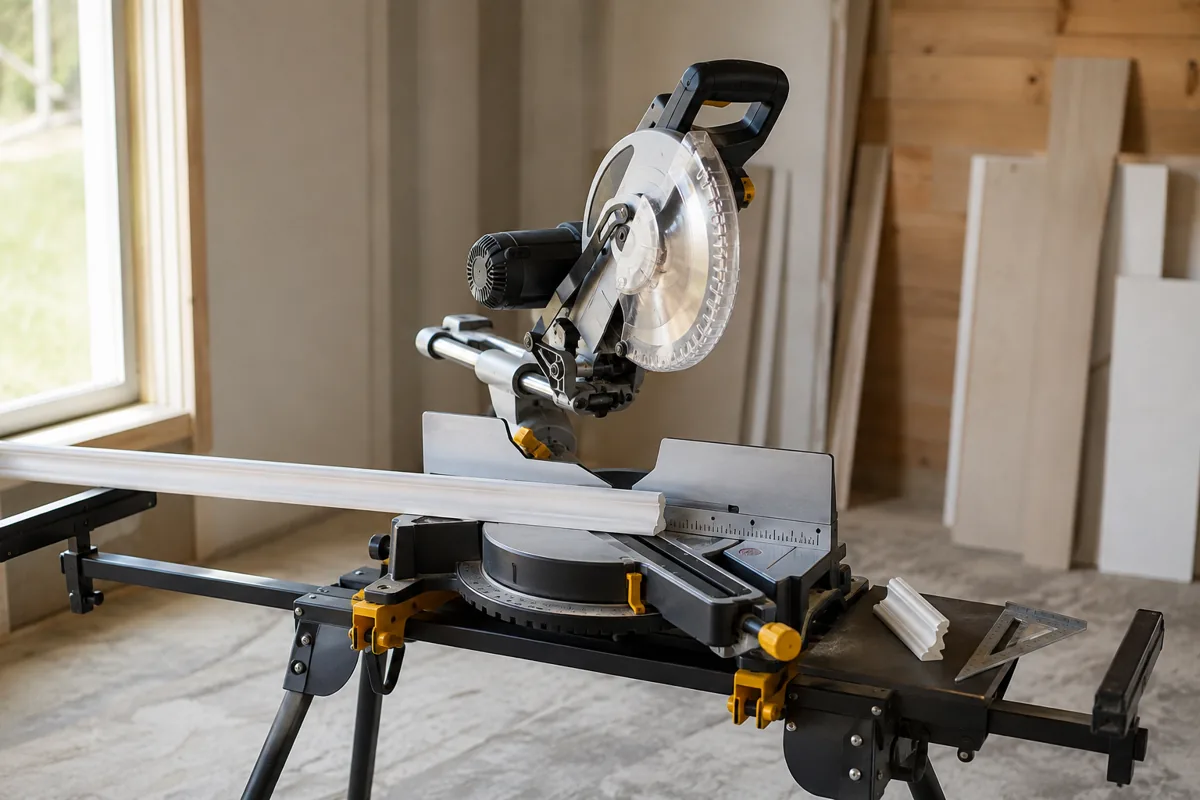
For cutting crown molding, a dual-bevel compound miter saw is the faster, more convenient choice. It lets you tilt the blade left or right without turning the molding over, which matters when you are making repeated inside and outside corner cuts.
A single-bevel saw can still produce equally accurate crown molding cuts. It costs less and is often the better buy for one room or occasional trim work. The trade-off is that you must flip or reposition the molding for some cuts. That adds setup time and creates more opportunities to place the molding incorrectly.
As an Amazon Associate we earn from qualifying purchases at no extra cost to you.


What the bevel adjustment does
The miter setting rotates the blade across the face of the material. The bevel setting tilts the blade through its thickness. Crown molding uses both adjustments because it sits diagonally between the wall and ceiling.
With a typical 52/38 crown profile, the molding rests against the saw fence at about a 52-degree spring angle. Common cuts are around 31.6 degrees on the miter scale and 33.9 degrees on the bevel scale, although those numbers only work when the molding and corner are close to the expected angles.
A dual-bevel saw tilts in both directions. A single-bevel saw tilts in only one direction, usually left. The motor and blade cut the same way, so dual bevel does not automatically mean better cuts. It mainly reduces repositioning.
Dual-bevel vs. single-bevel
| Feature | Dual-bevel | Single-bevel |
|---|---|---|
| Blade tilt | Left and right | One direction only |
| Crown molding workflow | Keep the molding in the same position for many cuts | Flip or reposition molding for opposing bevels |
| Speed on a large room | Faster, with fewer setup changes | Slower, especially around multiple corners |
| Risk of orientation mistakes | Lower | Higher if the molding is flipped incorrectly |
| Price | Usually higher | Usually lower |
| Best fit | Frequent trim work, long runs, and production work | DIY projects, one-room jobs, and budget buyers |
Why dual bevel is easier for crown molding
The main benefit is consistency. You can leave the molding oriented with its ceiling edge against the fence and make left- and right-hand compound cuts by changing only the saw settings. You do not have to turn a long, flexible piece around on the saw table.
That becomes useful on outside corners. A long piece of crown can be awkward to flip without bumping the fence, changing its spring angle, or losing track of which end is waste. On a dual-bevel saw, the cut direction is easier to follow from the face of the molding.
Dual bevel also helps when making nested cuts, where the molding sits against the fence and table in the same position it will have on the wall. This method avoids calculating compound angles, but it requires a saw with enough height and throat capacity for the molding profile. A taller 5 1/4-inch crown may not fit nested on a compact saw.
When a single-bevel saw is enough
For a short crown molding project, a single-bevel saw is not a serious limitation. You can make the same compound cuts by turning the molding over or cutting from the opposite end. Mark the waste side clearly, and keep a scrap piece nearby as an orientation reference.
Single-bevel is especially reasonable when the saw also has a reliable positive stop or a clear bevel scale. A 10-inch saw with a sharp 60- or 80-tooth finish blade can cut most residential crown molding cleanly, regardless of whether it bevels one way or two.
The cheaper option is fine if you are trimming one bedroom, using coping cuts on inside corners, or willing to test each setup on scrap. Coping reduces the number of precise inside-corner compound cuts, since one piece is cut square and the other is shaped to follow its profile.
Accuracy problems that matter more than bevel count
Most crown molding gaps are caused by incorrect corner measurements or poor support, not by choosing a single-bevel saw. A corner that measures 88 degrees does not use the same miter setting as a perfect 90-degree corner. For a standard 52/38 profile, a digital angle finder or a two-piece test cut is more useful than trusting the printed scale.
Use a sharp blade with at least 60 teeth for painted wood or MDF. A dull or coarse blade can tear the face, especially near the thin ceiling edge. Support long stock on both sides of the saw; unsupported molding can lift as the blade exits and create a gap even when the angle is correct.
Another common failure is cutting the wrong end. Label each piece “left,” “right,” “inside,” or “outside” before cutting. Make a small pencil arrow showing which edge touches the ceiling. This simple mark prevents the most expensive single-bevel mistake: flipping a finished-length piece and discovering that the cut faces the wrong direction.
What to look for when buying
If you install trim regularly, choose a 12-inch dual-bevel miter saw with a tall fence, positive bevel stops, and a workable crown-molding guide. The larger blade is not automatically more accurate, but it provides more capacity for tall nested molding and wide baseboard.
For occasional DIY use, a 10-inch single-bevel compound miter saw is often the value choice. Spend the savings on a good finish blade, extension supports, and a digital angle gauge. Those accessories can improve real-world results more than moving from single bevel to dual bevel.
Choose dual bevel when speed, repeated cuts, and fewer orientation mistakes justify the added cost. Choose single bevel when the project is small and you are comfortable making test cuts and repositioning the molding. Either saw can produce tight crown molding joints; the better setup and careful marking usually matter more than the direction of the blade tilt.