What's inside
As an Amazon Associate I earn from qualifying purchases. This post may contain affiliate links at no extra cost to you.
Our Top Picks


What these staplers do
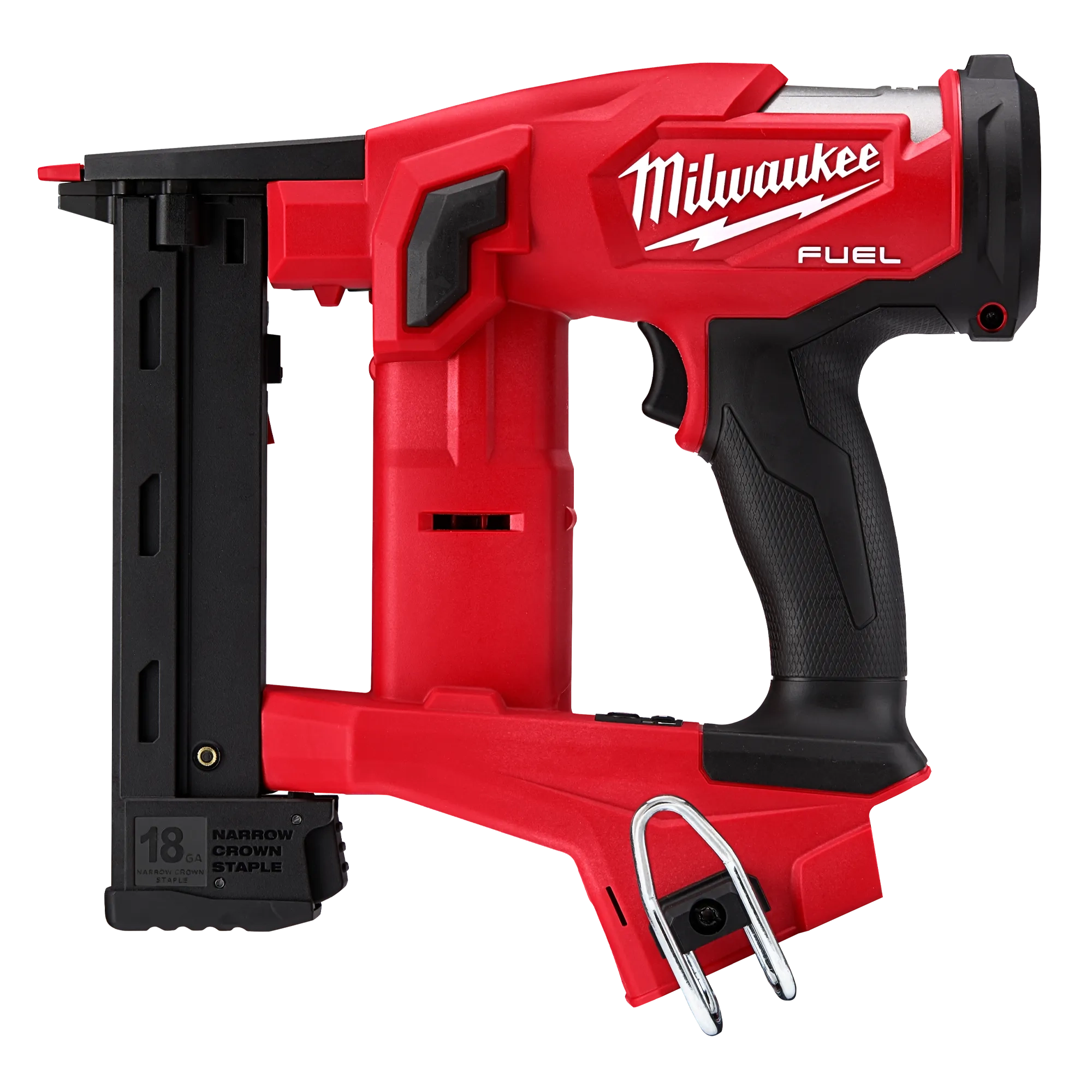
The Milwaukee M18 FUEL narrow crown stapler and DeWalt DCN701 are cordless tools for installing staples into wood, not general-purpose nailers. Their 18-gauge narrow crown staples are commonly used for cabinet backs, drawer bottoms, and other sheet goods where a small crown is less visible than a wider staple. Neither replaces a brad nailer for trim or a finish nailer for heavier fastening.
The key buying question is whether you want a stapler that fits an existing battery platform or one designed around DeWalt’s 20V MAX system. Before ordering, check the exact tool listing and manual for staple dimensions, magazine capacity, and included accessories. Similar-looking narrow crown staplers can take different staple lengths or crown widths; staples that do not match the tool’s specifications can jam or fail to feed.
As an Amazon Associate we earn from qualifying purchases at no extra cost to you.


Milwaukee M18 FUEL vs DeWalt DCN701
| Consideration | Milwaukee M18 FUEL narrow crown stapler | DeWalt DCN701 |
|---|---|---|
| Battery platform | Milwaukee M18 | DeWalt 20V MAX |
| Fastener type | Narrow crown staples; confirm approved sizes in the manual | Narrow crown staples; confirm approved sizes in the manual |
| Best fit | Owners already invested in M18 batteries | Owners already invested in DeWalt 20V MAX batteries |
| Main trade-off | Higher cost and weight than a basic pneumatic setup, especially as a bare tool | Same cordless convenience trade-off; sensible value when bought into an existing DeWalt system |
| Before purchase | Check staple compatibility, kit contents, and whether your battery size balances well | Check staple compatibility, kit contents, and whether your battery size balances well |
Both tools avoid dragging an air hose around a kitchen or shop. That convenience matters when you are fastening cabinet backs across a room, working on a repair, or moving between a workbench and an install. It matters less at a fixed assembly station with a compressor already set up.
Driving staples in cabinet work
For cabinet backs, the goal is a staple seated flush without crushing the thin panel or splitting the cabinet material. Test on offcuts of the actual panel and cabinet stock before loading a finished piece. Adjust the tool’s depth setting, if equipped, in small increments: a crown left proud can snag or show, while a staple driven too deeply may break through a thin back or weaken its hold.
Staple length should suit both the panel and the material beneath it. A staple that is too short may not grip the cabinet; one that is too long can emerge through the far side. As a starting point, measure the panel thickness and the available depth behind it, then follow the tool and cabinet maker’s fastening guidance. Do not assume that the longest staple the tool accepts is right for the job.
Sequential contact firing gives more deliberate placement than bump firing, which is useful around cabinet edges and narrow rails. Even with a suitable mode, keep the nose square to the work and avoid firing too close to an edge. A staple driven at an angle can split a rail or leave one leg exposed.
Jams, misses, and upkeep
Cordless staplers can misfire or jam if staples are bent, loaded backward, or outside the specified dimensions. Dust and glue residue around the nose and magazine can also interfere with feeding. If a staple sits proud, check your depth setting and material before blaming the tool. If the motor fires but no staple comes out, stop, disconnect the battery, and clear the tool as directed in its manual rather than repeatedly pulling the trigger.
For a cabinet run, bring spare staples and a charged battery. Battery runtime depends on the battery capacity, material hardness, staple length, and how often the tool has to drive against knots or dense edges; there is no reliable single shot count for every job. A compact battery is easier to handle in a cabinet but may need replacing sooner. A larger pack can extend runtime while making the tool more tiring overhead or inside a tight box.
Which one should you buy?
Choose the Milwaukee if your shop already runs on M18 and you want one battery system for drilling, fastening, and cabinet installation. Choose the DeWalt if your batteries and chargers are already in the 20V MAX lineup. For a buyer with no batteries, compare the full kit price rather than the bare-tool price: charger, battery, and case can make a meaningful difference.
For occasional cabinet-back work, the cheaper option is fine if it accepts the staple size you need, drives consistently in a test piece, and has a return policy you trust. You may not gain enough from paying extra for another cordless platform if you only fasten a few backs each year. If the tool will see daily production use, handling, jam clearing, service access, and battery availability deserve as much weight as the purchase price.
A pneumatic stapler is also worth considering for a fixed shop where a compressor and hose are already available. It can be a lower-cost route for repeated bench work, but the hose limits mobility and adds setup. For cordless cabinet installation, compare the Milwaukee M18 narrow crown stapler and DeWalt DCN701 against the batteries you already own. For a fixed workshop, a pneumatic narrow crown stapler may be the more economical choice.
Whichever you choose, verify staple width and length in the manual, test depth on scrap, and keep staples clear of cabinet edges. Those checks prevent more ruined panels and call-backs than buying a higher-priced tool.