What's inside
As an Amazon Associate I earn from qualifying purchases. This post may contain affiliate links at no extra cost to you.
Our Top Picks


The short answer
For a home mechanic buying one socket set, 3/8-inch drive is usually the better first choice. It handles more of the fasteners you’re likely to meet on cars and light trucks, from roughly 10 mm through 19 mm, without making the ratchet or sockets unwieldy. A 1/4-inch set is the better tool for small fasteners, tight spaces and delicate work—but its ratchet and sockets are easier to overload.
If you work on bicycles, small engines, appliances or interior trim, 1/4-inch may be enough. If you service brakes, suspension, wheels or general under-hood parts, start with 3/8-inch and add 1/4-inch for smaller jobs. Neither drive size replaces a breaker bar or torque wrench when the job calls for one.
As an Amazon Associate we earn from qualifying purchases at no extra cost to you.


What drive size means
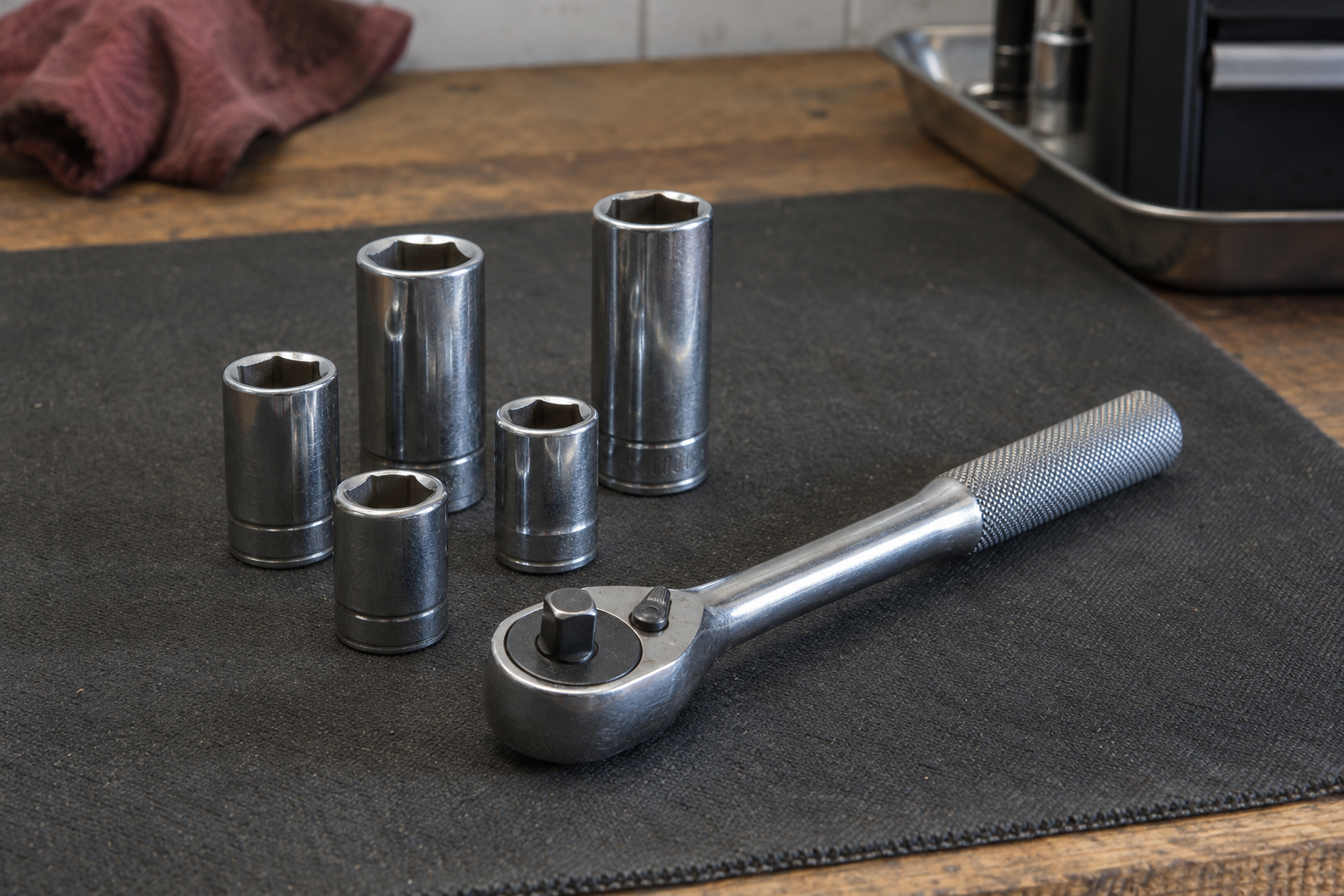
Drive size is the square connection between the ratchet and the socket, not the socket’s width across the fastener. A 10 mm socket can come in both 1/4-inch and 3/8-inch drive. The larger drive generally allows a stronger ratchet and socket, but also takes up more room.
That trade-off matters in a cramped engine bay. A compact 1/4-inch ratchet can reach a small bolt that a 3/8-inch ratchet can’t swing, while the 3/8-inch setup gives you more leverage for stubborn fasteners. Leverage is useful, but too much force on a small bolt can strip its head or break it before the tool gives way.
1/4-inch vs 3/8-inch at a glance
| Factor | 1/4-inch drive | 3/8-inch drive |
|---|---|---|
| Best fit | Small fasteners and restricted access | General automotive and household repair |
| Typical socket range | About 4–14 mm | About 8–22 mm |
| Ratchet size | Shorter, slimmer and easier to fit | Larger, with more leverage |
| Common risk | Overloading the ratchet or socket | Rounding or breaking a small fastener with excess force |
| Good first-set choice when | Your work is mostly small, light-duty jobs | You want one set for varied car repairs |
Socket ranges vary by set, and the numbers above are typical rather than guaranteed. Check the included sizes before buying: a set that skips the size you need is a poor bargain, whatever the drive.
Where 1/4-inch wins
Choose 1/4-inch for work involving small bolts, screws with socket heads and fasteners in confined spots. It’s handy for dashboard panels, hose clamps, small brackets and bicycle components. The smaller ratchet head can fit between hoses or behind trim where a 3/8-inch head won’t.
It also discourages brute force. That can be an advantage on small fasteners, where hand feel matters more than leverage. But don’t mistake “small drive” for a torque limiter: a long-handled 1/4-inch ratchet can still apply enough force to damage a small bolt.
A 1/4-inch socket set is a sensible first purchase if most of your jobs are light-duty and access is tight. It’s also a useful second set alongside 3/8-inch, especially if it includes both shallow and deep sockets.
Where 3/8-inch wins
For routine car maintenance, 3/8-inch covers more ground. It’s a practical choice for spark plugs when the socket and extension fit, many engine-bay fasteners, brake service and general chassis work. It gives you more leverage than 1/4-inch without the bulk of a 1/2-inch setup.
That doesn’t make it suitable for every stubborn bolt. Rusted suspension hardware, axle nuts and wheel fasteners may need a 1/2-inch breaker bar, a correctly rated impact tool or a long-handled torque wrench, depending on the task. For example, wheel-lug torque on many passenger cars is around 80–100 ft-lb, but the vehicle’s manual is the authority. Don’t use a small ratchet as a substitute for a torque wrench when tightening to specification.
For a single general-purpose set, look for a 3/8-inch metric socket set with common sizes, a ratchet, extensions and a spark-plug socket if you’ll use one. A metric set is a strong starting point for most modern cars; add SAE sockets if your equipment actually uses inch-size fasteners.
How to choose your first set
Start with the fasteners you expect to turn, not the largest number of pieces on the package. For a car-owning beginner, a 3/8-inch metric set is the safer all-round purchase. For bikes, furniture, appliances and small engines, a 1/4-inch set can cost less and take up less space—and it may be all you need.
Pay attention to the included sizes and the ratchet’s clearance. A compact-head ratchet can be more useful than a large assortment of sockets if you’re working in tight quarters. Deep sockets help when a nut sits on a long exposed stud; shallow sockets are shorter and fit where clearance is limited. Extensions improve reach but can make it harder to feel when a fastener is tightening.
If your budget allows, having both drives is more useful than forcing one to do everything. A modest 1/4- and 3/8-inch socket set combination covers small, awkward fasteners and most general repairs. Just inspect the contents: combination kits sometimes pad the piece count with bits or duplicate sizes rather than filling useful gaps.
Avoid common mistakes
Use a socket that fits snugly; a loose or nearly fitting socket can round a fastener. Keep the socket straight on the head, particularly when using an extension. If a fastener won’t move with reasonable hand pressure, stop and check for corrosion, thread direction or a hidden retaining clip before adding leverage.
Don’t use adapters to turn a small-drive ratchet into a heavy-duty tool. An adapter doesn’t increase the strength of the ratchet or the smaller connection, and the weak link may twist or break. For seized or high-torque fasteners, move up to the correct tool rather than risking a damaged fastener or an injury.
Make the choice by job
Buy 3/8-inch first if your home mechanic work includes a range of automotive repairs. Buy 1/4-inch first if you mainly handle small fasteners or need a compact kit for light jobs. If you do both, keep both drives on hand: the smaller one improves access, and the larger one handles more demanding everyday work. The right set is the one that fits the fastener without forcing the tool—or the job—beyond its limits.