What's inside
As an Amazon Associate I earn from qualifying purchases. This post may contain affiliate links at no extra cost to you.
When a trim router is used for edge profiles, hinge mortises, sign work, or template routing, seeing the bit is not a minor convenience. It affects whether you can follow a layout line, spot tear-out early, and keep your hands clear of the cutter. The Makita RT0701C and DeWalt DWP611 are closely matched compact routers, but they present the work differently.
The short answer: the DeWalt DWP611 offers better out-of-the-box bit visibility because its clear base includes built-in LED lights. The Makita RT0701C is often the better value if you already have good shop lighting, prefer its slimmer feel, or plan to buy a plunge base. Neither router gives perfect visibility with every bit and workpiece.
As an Amazon Associate we earn from qualifying purchases at no extra cost to you.


Our Top Picks
 BOSCH PR20EVS Colt 1.0 HP Variable-Speed Palm Router35 in9.41 x 7.43 x 4.7 inches3.3 PoundsCheck on Amazon

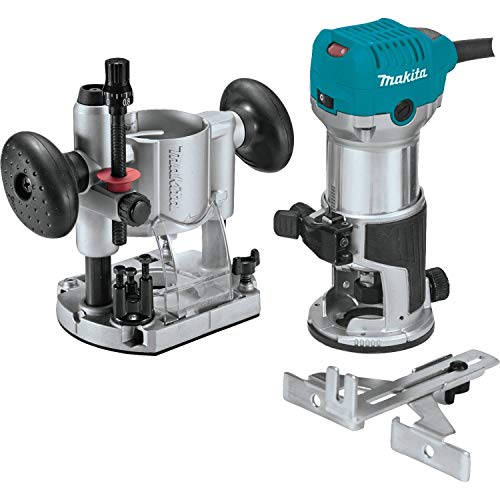

Makita RT0701C vs DeWalt DWP611 at a glance
| Feature | Makita RT0701C | DeWalt DWP611 |
|---|---|---|
| Motor rating | 1.25 peak horsepower, 6.5 amps | 1.25 peak horsepower, 7 amps |
| Speed range | 10,000–30,000 RPM | 16,000–27,000 RPM |
| Collet | 1/4 inch | 1/4 inch |
| Bit visibility | Clear base, no built-in LEDs | Clear base with dual LEDs |
| Depth adjustment | Rack-and-pinion style adjustment | Ring adjustment with clamp lock |
| Variable speed | Yes | Yes |
| Typical bare-tool weight | About 3.9 pounds | About 4.6 pounds |
Which router lets you see the bit better?
The DWP611 has the clear advantage in dim or awkward conditions. Two LEDs mounted near the collet shine into the cutting area and illuminate the bit, the base opening, and some of the surrounding material. This helps when routing inside a cabinet, working along a dark edge, or making a shallow pass where the bit is partly hidden by the base.
The LEDs are not magic. Dust can coat the clear base and scatter the light, and a wide baseplate or large-diameter bit can still block your view. The lights also do not show the exact cutting edge on every profile. A round-over bit, for example, may hide its lower edge behind the base while you are looking from above.
The RT0701C uses a clear plastic base and an open design that provides a good view under normal shop lighting. Its smaller, lighter motor housing is easy to angle and reposition, which can make practical visibility better than the specifications suggest. You can also add a work light, but that introduces shadows depending on where the lamp sits. If reliable illumination is important, the DeWalt’s integrated LEDs are more useful than an improvised lamp.
Handling, control, and depth adjustment
The Makita feels more compact in the hand. Its lower weight is noticeable when trimming several dozen feet of edge banding or routing small parts without a bench support. It also has a broad speed range down to 10,000 RPM. That is useful with large bits, plastic, and some hardwood operations where running a small router at maximum speed can scorch the edge.
The DeWalt is heavier but has a substantial, stable feel. Its soft-start motor reduces the initial twist when you switch it on, and electronic feedback helps maintain speed under load. The Makita also uses soft start and electronic speed control. In ordinary 1/4-inch trim-router work, neither motor is clearly more capable; feed rate, bit sharpness, and cutting depth matter more.
Depth adjustment is a real difference. The Makita’s rack-and-pinion mechanism makes coarse changes quick and repeatable. You can loosen the clamp, turn the adjustment mechanism, and lock the motor at the desired height. The DeWalt uses a rotating depth ring and clamp. It is straightforward, but small adjustments can require more attention because the scale and locking action are less mechanically positive than the Makita’s rack system.
For a hinge mortise or template cut, make several shallow passes rather than trying to reach full depth at once. A practical limit is roughly 1/8 inch per pass in hardwood, less if the bit is large or the router is being pushed sideways. A deep single pass increases chatter, obscures the cut with chips, and can pull the router away from the guide.
Base options and accessory costs
Both routers are sold with fixed bases and can be used with optional plunge bases. The fixed bases are the best choice for edge work, rabbets, chamfers, and trimming laminate. A plunge base is more useful for stopped grooves, mortises, and starting a cut in the middle of a panel.
Accessory compatibility can change the value calculation. Makita offers a broad ecosystem of bases and guides, and its compact motor is commonly sold in kits with multiple bases. DeWalt also has a useful plunge-base option and a strong selection of edge guides. Check the exact package before buying: a listing may show several bases in product photos while the SKU includes only the fixed base.
If you need a replacement or extra guide, compare the price of Makita RT0701C router accessories or DeWalt DWP611 router accessories before choosing based only on the bare-router price.
Visibility problems that cause bad cuts
A clear base does not prevent mistakes if the router is tilted. Keep the base flat on the reference surface; tipping it causes the bit to cut deeper on one side and can leave a gouge at the end of an edge. This is especially common when the workpiece is narrow and the base has little support.
Dust is another frequent cause of poor visibility. Connect a vacuum when possible, and stop to brush the base clean rather than continuing when the cut line disappears. Do not rely on the LEDs to illuminate a cloud of chips. Use a sharp bit, take a lighter pass, and keep the router moving to reduce burning.
Large bits deserve extra caution. A 1/2-inch round-over or panel-raising bit can hide much of the cutting area and place more load on a compact motor. Use the router manufacturer’s recommended speed range, keep the bit projection as short as practical, and make sure at least most of the shank is securely held in the collet.
Which one should you buy?
Choose the DeWalt DWP611 if bit visibility is your top priority, especially for basement work, cabinet interiors, or jobs where you cannot position a bright lamp easily. Its LEDs are the clearest functional advantage in this comparison. It is also a good choice if you prefer a heavier router that feels planted on a broad edge.
Choose the Makita RT0701C if you value lower weight, a wider speed range, and quick mechanical depth adjustment. It is a particularly sensible buy when the price is meaningfully lower or when you plan to purchase a multi-base kit. For normal edge trimming in a well-lit shop, the missing LEDs are rarely a deal-breaker.
For occasional laminate trimming or rounding over a few furniture edges, buy whichever is cheaper and spend the savings on a sharp 1/4-inch router bit set and hearing protection. For frequent template routing or stopped cuts, prioritize the DeWalt’s lighting or budget for a dependable router dust-collection attachment. The right setup and cutting technique will improve visibility more than a small difference in motor power.