
What's inside
As an Amazon Associate I earn from qualifying purchases. This post may contain affiliate links at no extra cost to you.
For heavy edge work, the Makita RP1800 has more cutting capacity and a stronger power reserve. The DeWalt DW618PK is easier to control, more versatile as a kit, and usually the better buy for general shop work. The deciding factor is whether “heavy” means occasional large-profile cuts or repeated production routing in hardwood and thick stock.
As an Amazon Associate we earn from qualifying purchases at no extra cost to you.


Our Top Picks


Quick verdict
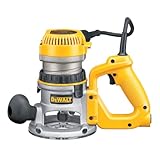
Choose the DeWalt DW618PK router if you want one router that can work as both a plunge and fixed-base machine. Its 12-amp motor, variable speed, 1/4- and 1/2-inch collets, and manageable size suit cabinet parts, signs, dados, hinge mortises, and moderate edge profiles.
Choose the Makita RP1800 router for deep plunges, large bits, thick hardwood, and long runs where motor reserve matters more than compact handling. It is a bigger, heavier plunge router with roughly 3-1/4 horsepower and a 15-amp motor. That extra capacity is useful, but it does not make the tool automatically better for every edge.
DeWalt DW618PK vs Makita RP1800 specifications
| Feature | DeWalt DW618PK | Makita RP1800 |
|---|---|---|
| Tool type | Fixed and plunge bases included | Large plunge router |
| Motor | 12 amps, about 2-1/4 hp | 15 amps, about 3-1/4 hp |
| Collet capacity | 1/4 and 1/2 inch | 1/2 inch |
| Speed | Variable, approximately 8,000–24,000 rpm | Up to approximately 22,000 rpm |
| Plunge depth | About 2-1/8 inches | About 2-3/4 inches |
| Best use | General routing and controlled edge work | Large profiles and deep cuts in thick stock |
Published specifications can vary slightly by market and production version, so check the supplied collets and base configuration before ordering. The broad difference is clear: the DeWalt is a flexible two-base system, while the Makita is a high-capacity plunge router.
Performance on heavy edge profiles
A large edge bit removes a surprising amount of material. A 1-1/2-inch round-over or ogee bit can require several passes even in softwood. In hard maple, oak, or beech, trying to take the full profile in one pass can overload the motor, burn the edge, and leave ridges where the cutter stalls briefly.
The Makita’s 15-amp motor handles this work with more authority. It is the better choice for repeated cuts on thick slabs, wide stair parts, solid-wood countertops, and large architectural profiles. Its approximately 2-3/4-inch plunge range also gives more room for deep work, although the cutter should still be lowered in stages rather than forced to full depth immediately.
The DW618PK is capable of heavy edge routing, but it rewards a more conservative method. Take two or three passes, keep the feed rate steady, and use the 1/2-inch collet for large bits. The fixed base is particularly useful when the job is simply running a bearing-guided profile around an edge. The DeWalt’s lower weight makes it less tiring to start and stop accurately.
Control, handling, and accuracy
The DeWalt has the easier learning curve. The motor and bases are compact enough to see the work, and the fixed base is convenient for table-style or edge-guide routing. Switching between bases also makes it practical for a small workshop where one tool needs to cover many tasks.
The Makita is more substantial. That mass helps resist twisting when a large cutter enters the work, but it also makes the router harder to hold against a narrow edge. A plunge router of this size can drift if the base is not kept flat, especially when starting at a corner or crossing end grain. Use both hands, support the work firmly, and make sure the base does not rock on clamps or uneven stock.
For a handheld edge, the Makita’s weight is a real trade-off rather than a minor inconvenience. For a router table, lift setup, or repeated plunge operation, its power becomes more valuable. Neither model should be treated as a substitute for a dedicated router table when using very large bits.
Bits, speed, and safe cutting
The DW618PK’s variable speed is an advantage with larger cutters. Large-diameter bits should run slower than small straight bits; the exact setting depends on the cutter manufacturer, material, and bit diameter. Never assume maximum speed is best. Excessive rpm can overheat carbide, scorch wood, and make a bearing-guided bit noisy and difficult to control.
The Makita’s single 1/2-inch collet is well suited to large shank bits. A 1/2-inch shank is stiffer than a 1/4-inch shank and is less likely to chatter under a heavy cut. The limitation is cost and availability: small trim-router bits and inexpensive 1/4-inch sets cannot be used without the correct manufacturer-approved collet arrangement. Do not use a loose sleeve or improvised adapter.
For serious edge work, buy a quality 1/2-inch large-profile router bit and take shallow passes. Inspect the bearing before each job. A seized or loose bearing can gouge a finished edge within seconds.
Common failure modes
Both routers can produce poor results when the bit is dull, the collet is dirty, or the workpiece is not secured. Clean the collet and shaft, insert the bit fully, then pull it back slightly before tightening so it does not bottom out. Tighten with the supplied wrenches; an under-tightened bit can creep downward during a long cut.
Burn marks usually mean the bit is dull, the feed is too slow, or the cut is too deep. Chatter usually points to excessive depth, a loose bit, a flexible 1/4-inch shank, or insufficient support. Tear-out at the end of a board is normal enough that planning the feed direction matters: climb-cutting can clean a short trouble area, but it is easy to lose control and should be limited to a very shallow pass.
Which router should you buy?
For most home shops, cabinet builders, and repair work, the DeWalt DW618PK is the smarter purchase. The included fixed and plunge bases cover more jobs, and its 1/2-inch collet supports the large bits needed for occasional heavy edge work. It is also the better choice when the router must be carried around a jobsite or used on smaller parts.
The Makita RP1800 is worth choosing when large, deep, repeated cuts are central to the work. Its power and plunge range reduce strain on the motor, but you still need multiple passes, solid stock support, dust extraction, and a firm two-handed grip. If you only rout a few countertop edges or hardwood shelves each year, the Makita’s extra capacity will mostly add weight and cost.
For a dedicated heavy-routing setup, consider a router table and lift system instead of relying entirely on handheld work. It provides better support for long edges and makes height adjustments more repeatable, while the router itself should still be matched to the bit size and material.