What's inside
As an Amazon Associate I earn from qualifying purchases. This post may contain affiliate links at no extra cost to you.
A drill chuck is the part that grips the bit, and choosing the wrong one can mean a bit that slips, a shank that will not fit, or a chuck that cannot handle the drill’s torque. For most DIY work, the choice comes down to three things: chuck capacity, how it attaches to the drill, and whether a keyed or keyless design suits the job.
Start with chuck capacity
Chuck capacity is the largest shank diameter it can grip—not the diameter of the hole the drill can make. Common sizes are 3/8 inch and 1/2 inch. A 3/8-inch chuck accepts bits with shanks up to 3/8 inch; a 1/2-inch chuck accepts larger shanks as well as smaller ones.
For light household work, small pilot holes, and bits with shanks no larger than 3/8 inch, a 3/8-inch chuck is often enough. A 1/2-inch chuck is the more flexible choice for general woodworking and metalworking, especially if you use larger twist drills, hole saw arbors, or accessories with 1/2-inch shanks. It does not make the drill more powerful by itself, and it does not mean you should run a large bit at high speed.
Check the bit’s shank, not just its cutting diameter. Some larger bits have reduced shanks that fit a smaller chuck; others do not. Also check the drill’s manual for its maximum bit size in wood or metal. A chuck that can physically close on a bit does not mean the drill has enough power or speed control to use it safely.
Keyed or keyless?
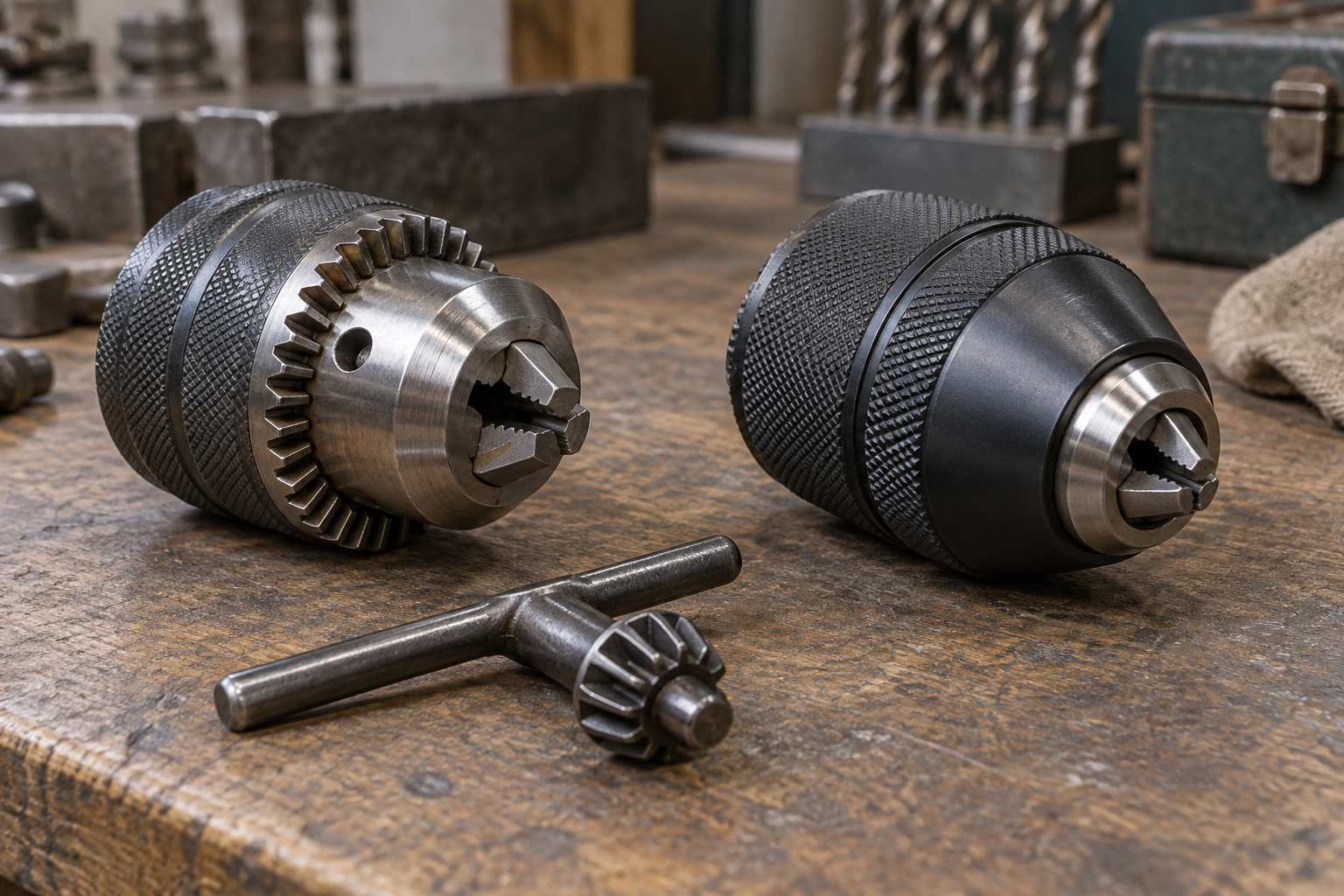
A keyed chuck tightens with a separate toothed key. The key gives you mechanical leverage, which helps clamp a bit firmly and reduces slipping during demanding work. The trade-off is convenience: you must keep the key nearby, and tightening from only one position can leave the bit off-center. Tighten at each key position around the chuck for a more even grip.
A keyless chuck tightens by hand. It is faster for frequent bit changes and works well for ordinary drilling in wood, plastic, and light-gauge metal. Its main limitation is clamping force: oily hands, worn jaws, or high-torque work can make a bit more likely to slip. If you notice the shank spinning in the jaws, stop and inspect the bit and chuck rather than simply increasing pressure on the drill.
| Chuck type | Best fit | Main advantage | Trade-off |
|---|---|---|---|
| Keyed | Repetitive or demanding drilling | Strong, controlled clamping | Slower changes; key can be misplaced |
| Keyless | General-purpose DIY and frequent bit changes | Fast, tool-free tightening | Hand-tightening may be inadequate for high torque |
| SDS-Plus or SDS-Max | Rotary hammer drilling with matching masonry bits | Bit locks into the hammer mechanism | Not a standard chuck; incompatible with ordinary round-shank bits without an adapter |
For a replacement, choose a 1/2-inch keyless drill chuck if your drill accepts that mount and your work is mostly general-purpose. If you often drill large holes, use hole saws, or work in metal, a 1/2-inch keyed chuck is worth considering. A keyed chuck is not automatically better for every job; for occasional small holes, keyless is usually less hassle.
Check the mounting style before buying
Chucks attach to drills in different ways. The common options are a threaded mount and a taper mount, often called Jacobs taper. Many cordless drills use a threaded chuck. Bench drills and some older drills commonly use a taper. They are not interchangeable, even if the chuck capacity is the same.
Before ordering a replacement, check the drill manual or identify the existing mount. Threaded chucks may also have a retaining screw inside the jaws; on many drills it has a left-hand thread, so it loosens clockwise. Do not assume every chuck uses the same thread size. If you cannot verify the specification, a chuck made for the exact drill model is safer than guessing.
Some drills have a 1/4-inch hex quick-change holder rather than a conventional chuck. These accept hex-shank accessories, not ordinary round-shank bits. An adapter can add flexibility, but it adds length and another connection that can wobble or loosen. For accurate holes, avoid unnecessary adapters.
Match the chuck to the material and bit
Woodworking bits include brad-point drills, auger bits, Forstner bits, and hole saws. Their shanks and torque demands vary. A small brad-point bit is easy work for a keyless chuck; a large auger or hole saw puts more load on the jaws and drill. Use low speed, secure the workpiece, and back out periodically to clear chips. If the bit catches, the drill can twist suddenly—even with a strong chuck.
For metal, standard twist drills with clean, straight shanks are easiest to grip. Larger holes often call for a pilot hole and lower speed. A dull bit or excessive feed pressure can make the bit bind, which may spin the shank in the chuck or wrench the drill out of your hand. Cutting fluid can help with many metals, but follow the bit and material guidance, and keep fluid away from electrical parts.
Do not clamp on flutes, a damaged shank, or the cutting end of a bit. Grip the smooth shank with the jaws centered and tightened evenly. If the bit repeatedly runs off-center, the cause may be debris in the jaws, bent tooling, worn jaws, or a damaged chuck—not a need to tighten harder.
When a replacement is worthwhile
Replace a chuck if its jaws no longer close evenly, it cannot hold a clean shank, or runout makes holes visibly wander. First clean the jaws and check with a straight, undamaged bit; a bent bit can mimic chuck runout. On an older drill, compare the chuck’s replacement cost with the price of a complete drill. A cheap chuck is a sensible fix for a sound drill, but a replacement will not cure worn bearings, a failing gearbox, or a bent spindle.
For occasional household drilling, a correctly fitted budget chuck is usually fine. Pay more attention to the mount, capacity, and jaw condition than to claims about maximum torque. For regular metalworking or large wood bits, favor a well-made chuck that grips consistently, and choose keyed if hand-tightening has been a recurring problem. A replacement chuck matching your drill’s mount is a practical option only after you have confirmed that mount.