What's inside
As an Amazon Associate I earn from qualifying purchases. This post may contain affiliate links at no extra cost to you.
What Drill Chuck Size Actually Means
Drill chuck size refers to the largest bit shank the chuck can grip, not the largest hole the drill can make. A 1/2-inch chuck accepts bits with shanks up to 1/2 inch, but it may safely drive a 2-inch Forstner bit, a large auger, or a hole saw with a smaller arbor. Conversely, a 3/8-inch chuck cannot hold a 1/2-inch-shank bit, even if the drill has enough power.
For large woodworking bits, chuck capacity is only one part of the decision. You also need enough torque, a suitable speed range, a rigid spindle, and a side handle. A large bit can grab the work suddenly, stall a motor, or twist a drill out of your hands.
3/8-Inch vs. 1/2-Inch vs. 5/8-Inch Chucks
| Chuck size | Typical use | Advantages | Limitations |
|---|---|---|---|
| 3/8 inch | General drilling, small Forstner bits, bits with reduced shanks | Light, compact, usually less expensive | Cannot grip many large-shank bits; often paired with lower torque |
| 1/2 inch | Large woodworking bits, hole saws, augers, construction drilling | Accepts common 1/2-inch shanks and supports stronger drills | Heavier and more expensive; can still lack torque for very large bits |
| 5/8 inch | Heavy-duty drilling and large-diameter accessories | Handles oversized shanks and demanding work | Bulky, costly, and usually unnecessary for normal furniture work |
For most serious woodworking, a 1/2-inch chuck is the sensible target. It gives you access to a broad range of bits without forcing you into an especially large drill. A 3/8-inch drill is fine if your largest accessories have 3/8-inch or smaller shanks. A 5/8-inch chuck is mainly justified for heavy construction, shipbuilding, timber work, or unusually large hole saw arbors.
Match the Chuck to the Bit Shank
Check the shank specification before buying the drill. A 2-inch Forstner bit may have a 3/8-inch shank, while another bit of the same cutting diameter may use a 1/2-inch shank. Some large augers use a reduced shank so they fit a standard 1/2-inch chuck. The cutting diameter alone tells you very little about chuck compatibility.
Also check the chuck’s minimum capacity. Some larger chucks start at 1/16 or 1/8 inch, while others may not close securely on very small bits. If you expect to use both tiny brad-point bits and large Forstners, a chuck with a broad clamping range is more convenient.
For bits with a hex shank, a standard drill chuck can work, but a quick-change hex driver is often faster. Hex shanks can also slip if the chuck jaws are worn or only lightly tightened. Do not use a smooth, oversized shank in a chuck that cannot close fully around it.
Keyed or Keyless: Which Is Better?
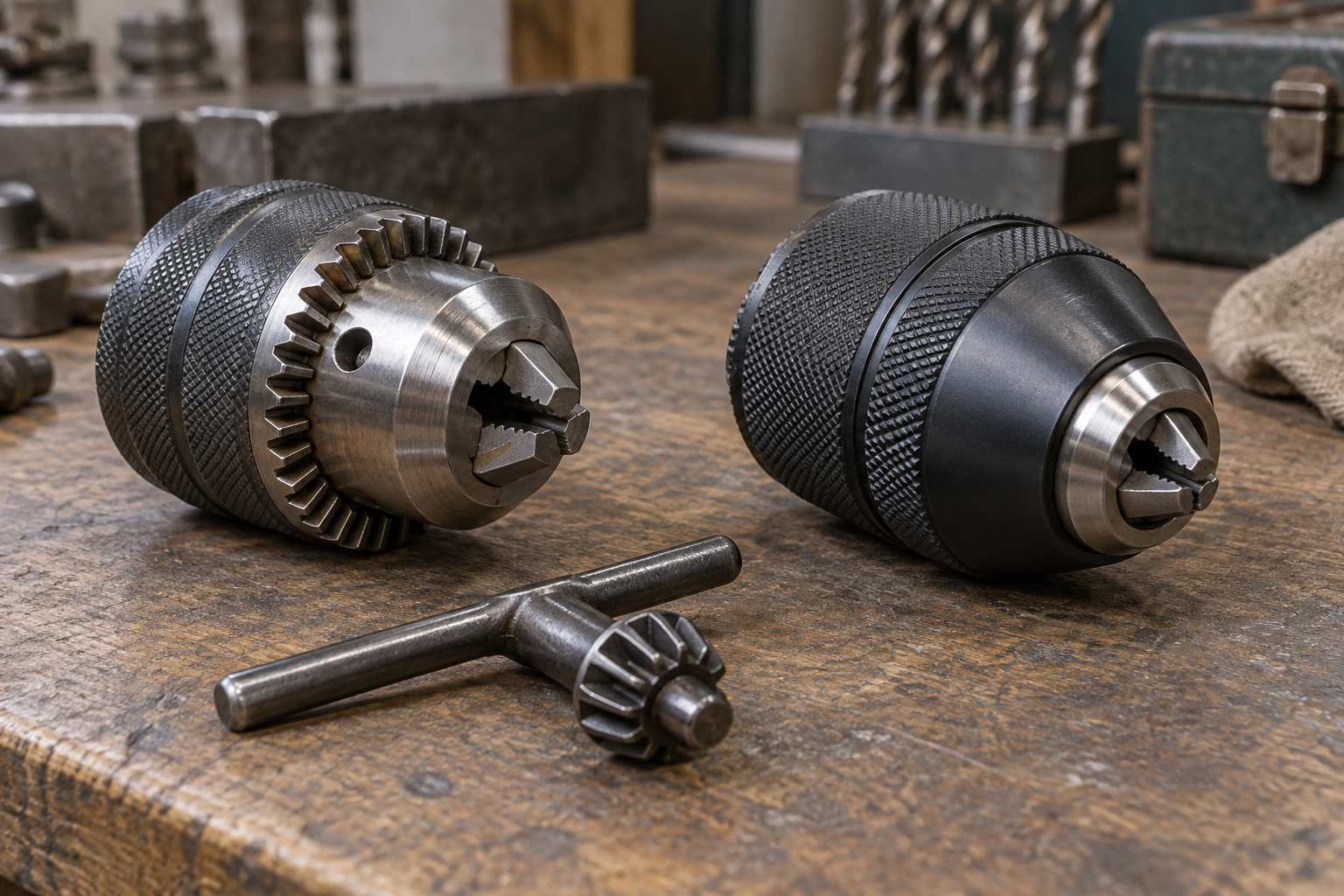
A keyed chuck is usually the better choice for large bits. The key lets you apply more clamping force, and the jaws are less likely to loosen when a large bit catches. This matters with Forstner bits, hole saws, and augers, where interrupted cutting or knots can create sudden torque.
A keyless chuck is faster and more convenient for routine bit changes. A good industrial keyless chuck can hold large bits securely, but cheap keyless chucks are more prone to slipping. If the chuck body gets oily or the jaws are worn, hand-tightening may not be enough.
If you already own a drill with a 3/8-inch keyless chuck, replacing the chuck with a larger one is rarely a practical upgrade. The spindle thread, mounting system, motor, and internal gearing may not support it. Buy a drill designed with the capacity you need instead.
Power and Speed Matter More Than Capacity
A 1/2-inch chuck does not automatically make a drill suitable for a 3-inch hole. Large bits need low speed and high torque. For a 2-inch Forstner bit in hardwood, a speed around 250 to 500 rpm is a reasonable starting range, then adjust for the bit design, wood species, and manufacturer’s instructions. Running it at the drill’s maximum speed can burn the edge, scorch the wood, and overload the motor.
For large woodworking bits, look for variable speed, a low first gear, and a side handle. A corded drill with a 1/2-inch chuck often delivers more sustained power than a compact cordless drill. A powerful cordless model is more convenient, but expect battery drain and possible electronic shutdown when a bit binds.
For regular holes larger than about 2 inches, a drill press is usually safer and more accurate. It controls feed pressure and keeps the bit square. For portable work, consider a 1/2-inch corded drill with a side handle rather than choosing solely by chuck size.
Choose the Tool for the Bit
Forstner bits cut clean, flat-bottomed holes but create substantial resistance, especially in hardwood. Brad-point bits are easier on a smaller drill but are not commonly available in very large diameters. Auger bits clear waste efficiently and work well in framing lumber, but their lead screw can pull the drill forward aggressively. Hole saws remove a plug and can bind when the waste cannot escape.
For occasional large holes, a cheaper 3/8-inch drill is fine if your accessories use compatible shanks and you work slowly. For repeated large holes, the extra cost of a 1/2-inch low-speed drill with a keyed chuck buys better control and broader accessory compatibility.
Prevent Slipping, Binding, and Damage
Clean the shank before inserting it, and seat it fully between the jaws. Tighten a keyed chuck at all available positions rather than using only one hole. With a keyless chuck, tighten firmly by hand and recheck after the first few seconds of cutting. Never leave the chuck key installed.
Clamp the workpiece, keep both hands on the drill, and use the side handle. Withdraw the bit periodically to clear chips, particularly in deep holes. If the drill begins to twist, stalls repeatedly, or smells hot, stop and reduce the speed or bit size. For hole saws, pilot bits and arbors should be rated for the saw diameter; a larger chuck cannot compensate for a weak arbor.
Finally, check runout if clean joinery matters. A badly worn or inexpensive chuck can make a bit wobble, enlarging holes and leaving uneven bottoms. For occasional construction holes that may not matter. For doweling, hinge boring, and visible furniture work, choose a better chuck or use a drill press.