What's inside
As an Amazon Associate I earn from qualifying purchases. This post may contain affiliate links at no extra cost to you.
A long screw magnifies small alignment errors. If the driver bit sits loosely in the holder, the bit can orbit, the screw can start crooked, and the head can cam out before the fastener is seated. The holder matters, but it cannot correct a screw that is already angled or a driver held off-axis.
For most impact-driver work, a short, rigid holder with a strong magnet is the best starting point. If you regularly drive 3-inch or longer screws into framing, a guide-style holder can do more to steady the screw. Flexible extensions are useful for access, not for reducing wobble.
As an Amazon Associate we earn from qualifying purchases at no extra cost to you.


Our Top Picks
 BOSCH ITBH201 1-Piece 2 In. Impact Tough Magnetic2 In.0.47 x 1.75 x 1.01 inches0.06 PoundsCheck on Amazon


What causes wobble
Wobble usually comes from movement at one or more points: the driver’s 1/4-inch hex collet, the holder’s shank, the bit-to-holder fit, or the screw’s contact with the bit. A long bit or extension makes any looseness more visible because the distance from the loose joint to the screw head gives it more leverage.
Magnet strength helps keep a screw on the bit, but it does not make a loose bit run true. Nor does a long holder automatically improve alignment. A longer tool can make it easier to see the screw and keep your hands clear, but it also gives small angular errors more room to show up. For long screws, keeping the driver square to the work is at least as important as the holder itself.
Holder types compared
| Holder type | Best use | Wobble control | Main trade-off |
|---|---|---|---|
| Short rigid magnetic holder | General driving and compact setups | Good if the bit fits tightly | Provides little guidance to a long screw |
| Guide-style holder with sleeve | Long screws and one-handed starts | Best for keeping the screw aligned near the head | Bulkier; sleeve may limit access |
| Locking bit holder | Preventing bits from pulling out | Good bit retention; not necessarily less runout | Extra mechanism and length |
| Flexible extension | Reaching around obstructions | Poor for straight, wobble-free driving | Flex under impact can make alignment harder |
Best choice for long screws
For straight driving into lumber, choose a rigid guide-style holder with a sleeve that supports the screw close to its head. That support helps during the first few turns, when the screw is most likely to walk. Look for a sleeve that slides freely and stays in place rather than one that binds against the screw. A screw-guide bit holder for an impact driver is worth considering if you often start long screws without a pilot hole.
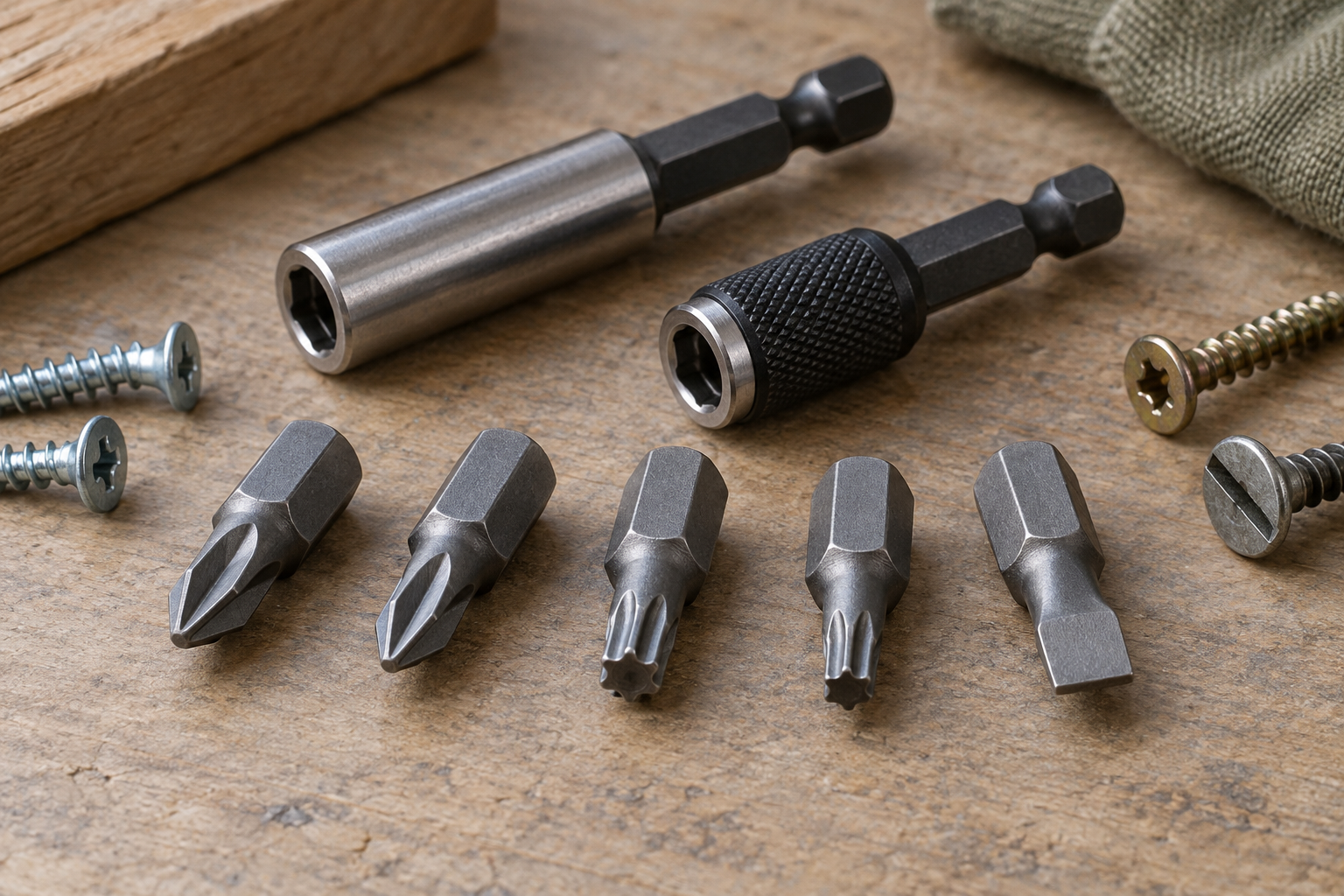
For occasional deck repairs or a handful of 3-inch screws, a basic rigid magnetic holder is often enough. Spend more only if the screw repeatedly slips, the bit falls out, or you need to start fasteners one-handed. A short magnetic impact bit holder keeps the setup compact and leaves fewer joints that can add play.
A locking collar is useful when bits tend to stay behind in the screw head or pull out of the holder as you withdraw the driver. It solves retention, not necessarily wobble: the bit can still have clearance inside the holder. If you choose one, check that it accepts standard 1-inch insert bits and that the collar does not obstruct the screw head.
Fit matters more than extra features
Hex bits and holders are made to standard dimensions, but manufacturing tolerances, wear, and dirt can leave one combination noticeably looser than another. Before buying a specialty holder, test the bits you use most. Insert a fresh bit, hold the driver still, and gently move the bit side to side. A little movement is normal; obvious rocking is a reason to try a better-fitting holder or a different bit.
Keep the holder’s shank clean and fully seated in the impact driver’s collet. A shank that is not pushed in all the way can wobble or slip under load. Replace bits with rounded or twisted hex ends, and discard bits whose tips are worn enough to rock in the screw recess. No holder can make a damaged Phillips or square-drive tip fit tightly.
Technique that prevents crooked starts
Mark the screw location and, for a thick board or a screw near an edge, drill a pilot hole sized for the screw’s shank. A pilot hole reduces splitting and the force needed to start the screw. For a screw going into hardwood, a pilot hole is usually more helpful than upgrading from a basic holder to a premium one.
Set the screw in the holder, place its tip on the mark, and keep the driver aligned with the screw’s axis. Start at low speed or use the trigger gently for the first few turns. Once the threads have engaged and the screw tracks straight, increase speed. If the screw leans, stop and back it out; forcing it in can strip the recess or leave the fastener crooked.
Use the correct drive type and size. A bit that is slightly undersized can slip and cam out, especially when the impact mechanism starts hammering. For long structural screws, follow the fastener maker’s guidance on bit type, pilot holes, and installation. Avoid leaning hard on the driver to compensate for poor fit; excess pressure can hide a slipping bit until the recess is damaged.
A practical buying checklist
Choose a rigid holder for straight work, and a guide sleeve if you need help supporting the screw at startup. Prefer a snug bit fit, a magnet strong enough to hold the fastener during positioning, and a sleeve that moves without sticking. Avoid flexible extensions for long screws unless reaching the fastener is the main problem. If access is the issue, a rigid impact-driver bit extension is generally easier to control than a flexible shaft.
Don’t buy based on maximum length alone. A longer holder can reach past an obstruction, but it adds leverage and may amplify runout. For routine work, a compact holder and a sharp, correctly sized bit are the economical choice. Move to a screw-guide design when long screws are hard to start straight, not simply because the screws are long.