What's inside
As an Amazon Associate I earn from qualifying purchases. This post may contain affiliate links at no extra cost to you.
A chuck can feel tight and still let a large bit slip. That matters most when a bit binds in hardwood, a hole saw catches, or a large auger starts pulling hard. In those situations, a keyed chuck usually provides the more dependable grip because a wrench lets you apply extra clamping force. A good keyless chuck can handle plenty of ordinary drilling, but it relies on hand torque—and its grip depends heavily on chuck quality, bit condition, and technique.
As an Amazon Associate we earn from qualifying purchases at no extra cost to you.
Our Top Picks


The short answer
For large bits and high-torque work, choose a keyed chuck if secure clamping is your priority. It is especially useful with drill presses, corded drills, and jobs where a bit may bind. For routine drilling with smaller bits, frequent bit changes, or work where convenience matters more than maximum clamping force, a quality keyless chuck is usually fine.
“Large” depends on the bit and material. A 1/2-inch twist bit in softwood is not the same load as a 2-inch hole saw in hardwood. The bigger and more grab-prone the cutter, the more valuable a wrench-tightened chuck becomes. Chuck capacity is also separate from holding power: a chuck that accepts a 1/2-inch shank does not guarantee that it will hold every bit securely under heavy torque.
How the two chucks grip
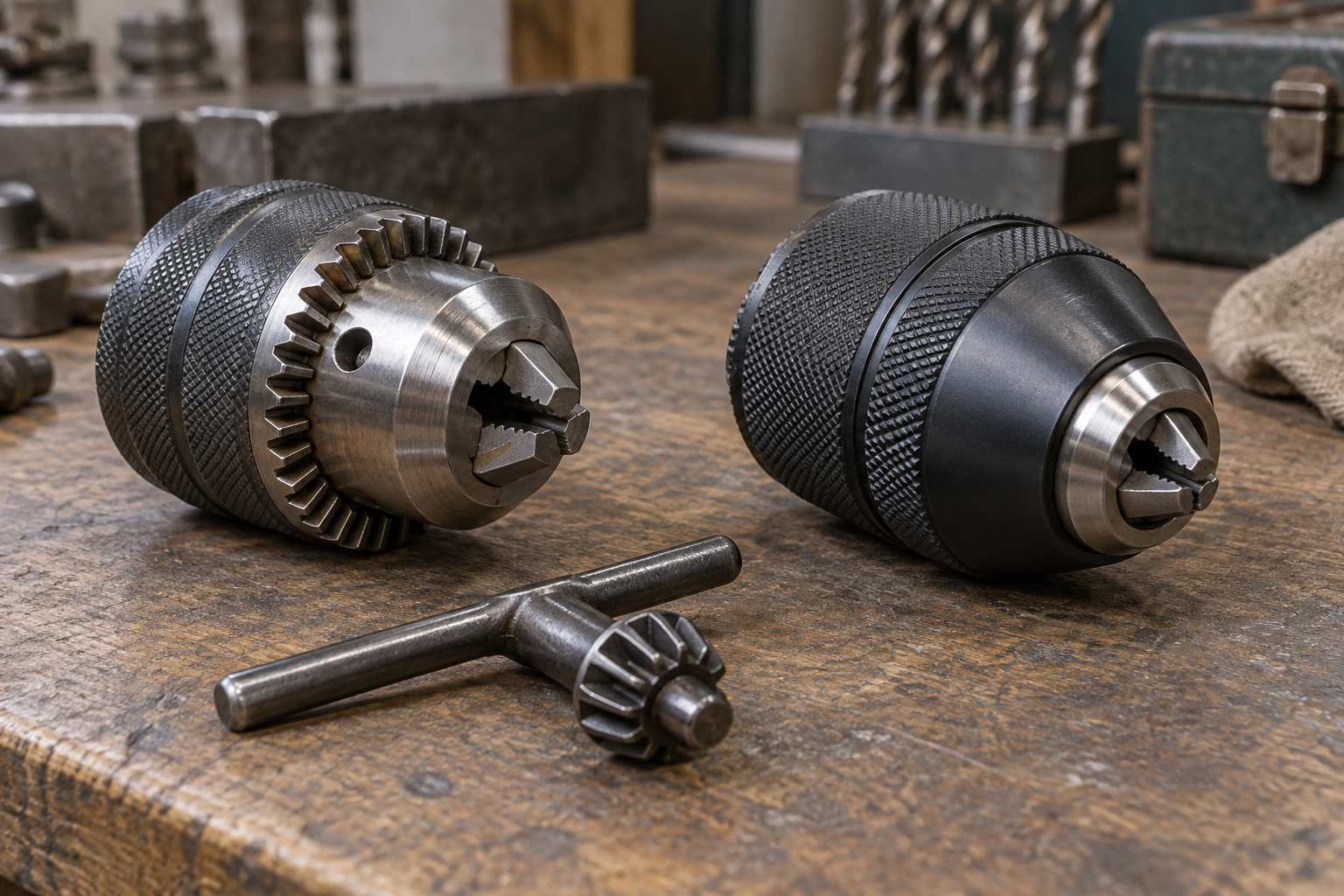
A keyed chuck uses a toothed wrench to turn the chuck’s outer ring and drive its jaws inward around the bit shank. The leverage makes it easier to clamp firmly than fingers alone. Many keyed chucks have several key sockets around the body; tightening at more than one position can help seat the bit evenly.
A keyless chuck tightens by hand, usually by turning a sleeve while holding the drill or chuck body. Some designs are single-sleeve; others use two sleeves. Ratcheting sleeves can make a keyless chuck easier to tighten securely, but they still depend on the user’s grip and the chuck’s internal mechanism.
Keyed vs. keyless at a glance
| Factor | Keyed chuck | Keyless chuck |
|---|---|---|
| Clamping force | Higher potential; wrench leverage helps | Usually adequate for general drilling; hand torque limits tightening |
| Large, grab-prone bits | Better choice when slipping would be costly | Can work, but quality and tightening technique matter more |
| Bit changes | Slower; requires the correct key | Faster and more convenient |
| Common failure | Lost key, worn teeth, or uneven tightening | Bit slips, sleeve loosens, or jaws wear |
| Best fit | Drill presses and demanding drilling | Everyday drilling and frequent bit changes |
When a keyed chuck is the safer bet
Choose keyed for large hole saws, large twist bits, and other cutters that can catch suddenly, especially in dense wood or metal. If a cutter locks, the drill may twist in your hands, the workpiece may move, or the bit may spin in the jaws. A keyed chuck cannot prevent a bind, but a properly tightened one lowers the chance that the shank will slip inside the chuck.
Keyed chucks are also a practical choice for a drill press that stays set up for demanding work. You trade a few seconds per bit change for more control over clamping force. Keep the key nearby and remove it before turning the drill on. A key left in the chuck can become a projectile.
For a drill that regularly runs large bits, compare keyed drill chucks by capacity, spindle mounting, and whether the correct key is included. The chuck must match the drill’s mounting system; capacity alone is not enough.
When keyless is enough
A keyless chuck is a sensible choice for most household drilling: pilot holes, cabinet hardware, small twist bits, and moderate work in wood or plastic. It saves time when changing bits repeatedly, and you do not have to keep track of a separate wrench. For many users, that convenience is worth more than the extra clamping force they rarely need.
It can also hold larger bits securely when the chuck is well made, the jaws are clean, and the shank is suitable. Tighten the chuck firmly by hand, following the tool maker’s instructions; do not assume that a quick twist is enough. If the bit slips during a cut, stop, inspect the jaws and shank, and retighten before continuing. Do not compensate for a slipping chuck by holding the bit or chuck while the drill runs.
If you want quick changes and mostly drill ordinary holes, look at keyless drill chucks intended for your drill’s mounting type. A cheap or worn keyless chuck can be frustrating: jaws may close unevenly, the sleeve may be hard to turn, or bits may loosen under load.
What causes slipping—and what does not
A chuck can only grip the shank it contacts. Oil, dust, burrs, or a damaged shank can reduce friction. Smooth round-shank bits are normal for many chucks, but a worn chuck may struggle to hold them under high torque. Clean the jaws and bit, seat the shank straight, and avoid clamping on a fluted or tapered section unless the bit design calls for it.
Slipping is not always a chuck problem. A bit that is too large for the drill, a dull cutter, excessive feed pressure, or a binding hole saw can overload the tool. Use a pilot bit where appropriate, clear chips from deep holes, and reduce pressure if the drill slows. For a large hole saw, a drill with a side handle gives better control; neither chuck style makes a high-torque bind harmless.
Also check the drill’s rated chuck capacity and the bit maker’s limits. A 1/2-inch chuck accepts shanks up to 1/2 inch, but that does not mean every 1/2-inch bit is suitable for every drill. Large bits often need lower speed and more torque than small ones.
Which should you buy?
Pick keyed if you regularly use large, aggressive cutters, work at a drill press, or want the strongest practical hand-tightening advantage. Pick keyless if most of your work is general-purpose drilling and fast bit changes matter more. If you already own a sound keyless drill, there is no need to replace it just because you occasionally use a larger bit; work within the drill’s capacity and stop if the bit slips.
For demanding work, a keyed chuck is the more secure choice in a head-to-head comparison. For everyday jobs, a decent keyless chuck is often the better tool to live with. The right answer is not “keyed is always safer” or “keyless is always convenient”—it is matching the chuck to the bit, the drill, and the load.