What's inside
As an Amazon Associate I earn from qualifying purchases. This post may contain affiliate links at no extra cost to you.
For drilling holes around 1/2 to 1-1/2 inches through framing lumber, both auger bits and spade bits can do the job. The right choice depends on how many holes you need, whether you care about a clean exit, and what drill you’re using. Auger bits cut more steadily and clear chips well; spade bits cost less and are often the practical choice for a handful of rough holes.
As an Amazon Associate we earn from qualifying purchases at no extra cost to you.


Our Top Picks


Quick comparison
| Factor | Auger bit | Spade bit |
|---|---|---|
| Typical cost | Higher | Lower |
| Cutting action | Screw point pulls the bit into the wood | Flat blade scrapes and cuts at the edges |
| Chip removal | Good, thanks to the flutes | Limited; back the bit out to clear chips |
| Hole quality | Usually cleaner and more controlled | Rougher, especially at the exit |
| Best fit | Repeated holes, deeper boring, controlled feed | Occasional holes where speed and price matter |
How they cut—and why that matters
An auger bit has a threaded screw point that draws the cutting edges into the wood. Its spiral flutes carry chips back out of the hole. That self-feeding action makes boring deep holes less of a stop-and-clear routine, but it also means the drill can pull hard. If the bit catches on a knot or buried fastener, the drill may twist suddenly.
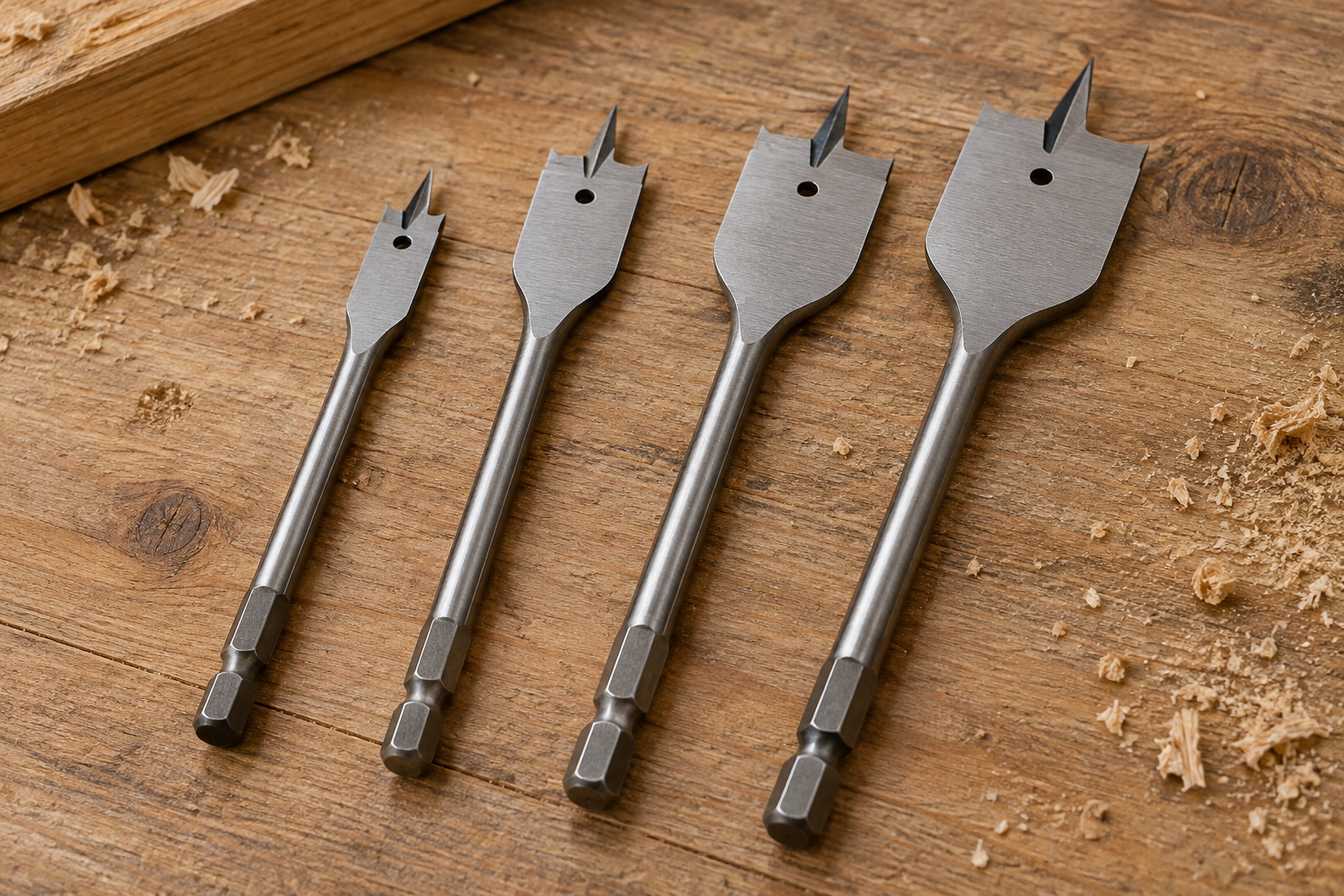
A spade bit has a broad, flat blade with a point at the center. It cuts quickly, but the shallow blade does not move chips out as effectively as an auger’s flutes. In a deep hole, withdraw it every few seconds to clear sawdust and keep the cutting edges from binding. Expect more tear-out on the back face unless you drill into a sacrificial backing board or stop partway through and finish from the other side.
Choose an auger for repeated or deeper holes
For a run of holes through studs, plates, or joists, an auger is usually easier to control and less frustrating. It is a strong pick when you need holes roughly 3/4 inch or larger, when the hole is deep, or when chip clearing would otherwise slow the job. A clean, centered hole is also easier to achieve, though an auger is not a finish-wood bit and can still splinter at the exit.
The trade-off is cost and torque. Larger augers put significant load on a drill, especially in dense wood or when the flutes are packed with chips. Use a drill with a side handle when the bit size and tool allow it, keep a firm two-handed grip, and avoid forcing the bit. If the drill stalls, release the trigger rather than twisting against a locked bit. A wood auger bit set makes sense if you expect to use several sizes or bore regularly.
Choose a spade bit for occasional rough holes
For a few clearance holes for cable or pipe, a spade bit is often enough. It is inexpensive, widely available, and easy to replace if it gets dull or damaged. A basic wood spade bit set is a reasonable buy for a homeowner who only drills large holes now and then.
Its weak points show up on deeper cuts and harder wood. The blade can wander if you start at an angle, and a dull edge can burn or tear instead of cutting cleanly. For a hole through a 2×4, withdraw the bit periodically; for thicker stock, clear chips more often and take care not to overheat the bit. If the hole must look neat on both sides, use a backing board or drill halfway through from each face.
Match the bit to the drill and the framing
Check the bit’s shank and the drill chuck before buying. Many large bits use a 1/2-inch shank, which will not fit every compact drill. A powerful drill is useful, but raw power does not make a catch safe: large bits can bind abruptly in framing lumber. A side handle and a secure grip matter more as diameter increases. If your drill has a clutch or low-speed setting, use a controlled speed rather than running a large bit at full trigger.
Before drilling a stud or joist, confirm that the hole is allowed by the applicable building rules and does not compromise the member. The permissible hole size and location depend on whether the framing is a stud, floor joist, or another structural member. Check the relevant code or plans instead of assuming a large bit is acceptable. Also scan for wiring, plumbing, and fasteners; hitting a nail can damage the bit and kick the drill.
The practical buying decision
For one or two rough holes, buy a spade bit in the needed size and spend the savings elsewhere. For repeated holes, deeper boring, or work where steady chip removal matters, choose an auger. Neither bit is ideal for a polished finish hole; if appearance is critical, consider a hole saw or Forstner bit suited to the material and drill setup. In framing, where the hole is hidden and the job is simply to pass a service through, the cheaper spade bit is often perfectly adequate.