
What's inside
As an Amazon Associate I earn from qualifying purchases. This post may contain affiliate links at no extra cost to you.
Cutting a deep mortise is one of the jobs where router-base design matters more than motor size. A fixed-base router can remove a lot of wood accurately, but it is awkward to start inside a workpiece. A plunge router starts cleanly and controls depth better, especially for stopped mortises. The right choice depends on how deep the mortise is, whether it is open or stopped, and how accurately you need to repeat the cut.
As an Amazon Associate we earn from qualifying purchases at no extra cost to you.


Our Top Picks


The basic difference
A fixed-base router holds the motor at one preset height. You set the bit depth, lock it, and move the tool across the work. This is stable and predictable for cuts that begin at an edge or run through the workpiece.
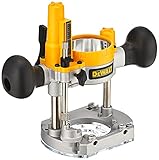
A plunge router lets the motor and bit travel vertically while the base stays on the work. You can start with the bit above the surface, lower it into the cut, and stop at a controlled depth. That makes it the natural choice for a stopped mortise, where the cut must begin and end inside the stock.
For deep mortises, “deep” should be treated as a process rather than a single pass. A 1/2-inch-deep mortise in softwood is routine. A 1-inch or deeper mortise in hardwood may require several passes, a rigid template, and a router with enough power to maintain speed under load.
Fixed-base vs. plunge router
| Factor | Fixed-base router | Plunge router |
|---|---|---|
| Starting a stopped mortise | Awkward; requires a drilled starter hole or ramp-in | Simple and controlled |
| Depth adjustment | Fast once set, but less convenient between passes | Excellent for incremental depth changes |
| Stability in a template | Very good, with less vertical movement | Good, but the plunge action must be locked or controlled |
| Edge and open-ended mortises | Excellent | Also excellent, but usually heavier |
| Size and handling | Usually lighter and easier to maneuver | Heavier, but safer for internal starts |
| Best use | Through mortises, edge cuts, repeatable shallow passes | Stopped mortises and cuts requiring controlled entry and exit |
When a fixed base is the better tool
Choose a fixed-base router when the mortise is open at one end, the cut starts at an edge, or you can safely use a starter hole. It is also a good choice when the router will remain at one depth for many identical parts. The lower center of gravity and simpler movement make it easier to keep the bit tracking a straight template.
A fixed-base router can cut a stopped mortise if you first drill away most of the waste. Drill inside the layout with a bit slightly smaller than the mortise width, leaving about 1/16 inch for the router to clean up. The router then removes the remaining material rather than plunging a full-width bit into solid hardwood.
Another method is a ramp-in: start with one edge of the base supported on the template, then gradually lower the router while moving forward. This is workable, but it is less forgiving. If the base rocks, the bit can grab, burn the wall, or widen the entrance. For occasional work, a 1/2-inch fixed-base router is often the cheaper and perfectly adequate option.
When a plunge router earns its cost
A plunge router is the better purchase for a deep, stopped mortise. You can position the base on a template, start the motor above the work, and lower the bit into the opening without dragging a spinning cutter across the surface. The depth stop lets you increase the cut in measured steps, such as 1/4 inch at a time.
That control matters with long bits. A 1/2-inch-diameter mortising bit extending 1-1/2 inches below the collet has considerable leverage. If you enter at full depth, the bit can deflect, pull the router sideways, or break at the shank. A plunge mechanism does not eliminate those forces, but it makes the entry more gradual and repeatable.
Look for a plunge router with a 1/2-inch collet, a rigid depth turret, and enough power for the cutter diameter. A compact 1-1/4-horsepower router may handle shallow work, but a 2-1/4- to 3-1/4-horsepower plunge router is more comfortable for deep hardwood mortises. The extra weight is a disadvantage for small parts, so do not buy the largest tool if most of your work is light-duty.
A reliable method for a deep mortise
Use a template whenever possible. Make it from 1/2-inch plywood or MDF, clamp it securely, and size the opening for the guide bushing and bit combination. A template that shifts by even 1/32 inch will produce a loose joint.
Mark the mortise ends clearly and use a bit with a cutting length longer than the final depth. Do not confuse cutting length with overall bit length; the cutter must remain engaged in the work while enough shank stays inside the collet. Insert the shank fully, then pull it back approximately 1/16 inch before tightening so it does not bottom out in the collet.
Set the first pass to roughly 1/4 inch in hardwood or 3/8 inch in softwood. Make several passes rather than forcing the tool to full depth. On a deep cut, clear chips frequently. Packed chips increase heat, dull the bit, and can force the router upward or sideways.
For a rectangular mortise, remove the middle first and make the final pass around the perimeter. Feed against the bit’s rotation: with a conventional router cut, keep the work moving so the bit pulls into the uncut material rather than climbing along the edge. A climb cut can suddenly accelerate the router and damage both the template and the joint.
Bit choice and failure modes
Use a sharp, solid-carbide upcut bit when chip evacuation is important. Upcut bits clear waste well but can lift the workpiece or pull fibers from the top surface, so clamp the stock firmly. Downcut bits leave a cleaner top edge but pack chips into a deep mortise and are a poor choice for long, enclosed cuts unless you stop often to clear them.
Do not rely on the router’s depth scale alone. Measure from the base to the bit tip with the tool unplugged, then test on scrap. Check the mortise depth in at least two places. A bottom that varies by 1/8 inch usually indicates flex, a loose template, excessive feed pressure, or a bit that was plunged too aggressively.
Which one should you buy?
Buy a fixed-base router if you mainly cut open-ended mortises, trim edges, or make repeated cuts at one setting. It costs less, handles more easily, and is not a compromise for those jobs.
Buy a plunge router if your mortises are stopped, deeper than about 3/4 inch, or made in batches where consistent entry and depth matter. If you want one router to cover both situations, a variable-speed plunge router with a 1/2-inch collet is the more versatile choice. It costs more and weighs more, but for deep mortising its controlled plunge is a practical safety and accuracy advantage, not merely a convenience.