
What's inside
As an Amazon Associate I earn from qualifying purchases. This post may contain affiliate links at no extra cost to you.
Cutting door hinge mortises is one of the jobs where either router style can work well, but the better choice depends on how you set the cut up. A fixed-base router is usually the cheaper, simpler tool for repeated hinge work. A plunge router is more versatile and safer when starting in the middle of a door edge or cutting without a full-length template.
As an Amazon Associate we earn from qualifying purchases at no extra cost to you.
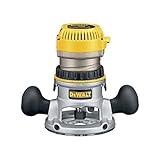


Our Top Picks


The short answer
For a few standard butt hinges, choose a small fixed-base router with a hinge template and a bearing-guided bit. It is compact, easy to control, and typically costs less. For installing hinges on several doors, working with different hinge sizes, or cutting mortises on an already assembled door, a plunge router gives you more control over entry and exit.
The router itself is only part of the system. A solid template, the correct guide bearing, a sharp bit, and careful depth adjustment matter more than whether the router plunges. A badly clamped template can ruin a door with either type.
Fixed-base vs. plunge router
| Feature | Fixed-base router | Plunge router |
|---|---|---|
| Best use | Template-guided hinge mortises and repeated work | Starting cuts in open areas and general routing |
| Depth control | Fast and precise once set | Adjustable while cutting, with turret stops on many models |
| Control at the cut | Very predictable on a supported template | More flexible, but can feel top-heavy |
| Typical size | Compact and light | Larger and heavier |
| Price | Usually lower | Usually higher |
| Versatility | Good for edge work and repeated settings | Better for dados, mortises, and general woodworking |
Why a fixed-base router works well
A fixed-base router is easy to set to a precise depth and then leave there. For a typical interior-door hinge, the mortise is often around 3 to 3.5 mm deep, though the exact depth should match the hinge leaf and the door jamb. Set the router too deep and the hinge will sit below the surface, pulling the door out of alignment. Set it too shallow and the hinge leaf will stand proud, leaving a gap at the hinge side.
Fixed-base routers also tend to be shorter and lighter. That helps when holding the tool against a narrow hinge template near the edge of a door. A compact compact fixed-base router with a 1/4-inch collet is adequate for hinge mortises. You do not need a large 2-1/4-horsepower router for this job; the bit is small and the cut is shallow.
The main limitation is starting the cut. A fixed-base router must be placed on the template before the bit is lowered into the work, unless you use a separate plunge base. That is not a problem with a hinge template that fully surrounds the mortise, but it is less convenient for a partial template or a freehand repair.
When a plunge router is the better choice
A plunge router lets you start with the base flat on the work, then lower the bit into the mortise. This reduces the chance of dropping a running bit onto the door surface. It is useful when the template has an open side, when you are extending an existing mortise, or when the door is already hung and access is awkward.
Plunge action also makes multiple depth passes straightforward. For example, you can set the first pass to about 1.5 mm, remove the waste, and then lower the bit to the final 3 mm. That is gentler on the bit and gives you a chance to catch a template that has shifted before the full-depth cut is made.
The trade-off is bulk. A plunge router can be awkward on a narrow door edge, especially if the base is wide and the template offers little support. If you tilt the router even slightly, the mortise can become deeper on one side. A plunge router with a lockable depth stop and a relatively small base is the most practical type for hinge work. Browse small plunge routers rather than automatically buying a full-size production model.
The setup matters more than the router
Use a hinge template sized for the actual hinge, or make one from stable plywood or acrylic. Clamp it firmly, and check that the template is square to the door edge. A hinge mortise that is only 1 mm out of position can make the hinge barrel bind against the jamb or change the reveal along the door.
A bearing-guided hinge bit is convenient because the bearing follows the template opening. Match the bearing and cutter diameter to the template; otherwise the mortise will be undersize or oversize. A straight bit with a guide bushing can also work, but the template opening must account for the offset between the bushing and the bit.
Use a sharp bit and make shallow passes. A dull bit burns the wood, pushes the router sideways, and can chip the corner where the bit exits. On a solid-core or hardwood door, take two or three passes instead of trying to remove the full depth at once. Keep the router moving steadily and feed against the bit’s rotation where the template allows it.
Common mistakes and how to avoid them
Cutting too deep: Measure the hinge leaf with calipers or a ruler, then test on scrap. Do not assume every hinge is the same thickness.
Template movement: Clamps can interfere with the router base, so place them outside the travel path. Double-sided tape can supplement clamps, but should not be the only restraint on a heavy router.
Rounded inside corners: Router bits leave rounded corners. Either round the hinge corner to match or square the corners with a sharp chisel. A 1/2-inch chisel is useful for many residential hinge leaves.
Wrong cutting direction: If the router grabs and runs, stop immediately. Reposition the cut so the router moves against the bit rotation, and make sure you are not taking an unnecessarily deep pass.
Which one should you buy?
Buy a fixed-base router if hinge mortises are your main task, you are using a full template, and you want the lowest-cost tool that will do clean work. A basic 1/4-inch hinge-mortise router bit and a dependable template are more important than extra motor power.
Buy a plunge router if you also expect to cut dados, stopped grooves, hinge recesses in place, or other internal openings. It costs more and weighs more, but the plunge mechanism earns its keep on varied woodworking jobs. If you already own a fixed-base router, adding a compatible plunge base can be cheaper than replacing the whole tool; check that the base accepts your router’s motor and collet system.
For one or two doors, the cheaper fixed-base setup is entirely adequate. For regular installation work, a small plunge router is the more capable long-term choice, provided you use a rigid template and take the time to set the depth accurately.