
What's inside
As an Amazon Associate I earn from qualifying purchases. This post may contain affiliate links at no extra cost to you.
A plunge base is the part that makes an inlay recess repeatable. It controls how far the bit enters the work, keeps the router moving vertically instead of tipping into the edge, and gives you a stable platform for a template guide bushing. For most inlay work, the best choice is not the cheapest base that fits your router. It is the base with the most predictable depth stop, the least side-to-side play, and a plate that accepts the guide system you intend to use.
As an Amazon Associate we earn from qualifying purchases at no extra cost to you.
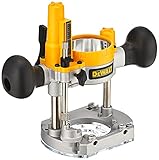


Our Top Picks


What makes a good inlay plunge base
Look first at plunge smoothness and depth control. A base that drops in jerks can widen a recess at the starting point, especially with a small bit. The plunge mechanism should move freely through its full travel without noticeable wobble. A lock or turret stop is useful, but repeatable inlays benefit from a fine-height adjustment rather than relying only on a coarse stop.
The base plate also matters. It should be flat, rigid, and large enough to bridge the template without rocking. A plate around 5 to 6 inches across is easier to control than a small compact plate, but it can be awkward near corners or on narrow stock. Check that the plate accepts standard guide bushings or has a dedicated template-guide system. A router can be perfectly capable yet poorly suited to inlay work if its guide-bushing adapter is unavailable or difficult to center.
For plunge-cutting, use a base with handles rather than gripping the motor body. Two handles let you lower the bit straight down and resist twisting when the cutter contacts the work. Clear plastic around the bit improves visibility, although dust can quickly obscure it unless the base has useful extraction.
Plunge base types compared
| Base type | Best use | Advantages | Limitations |
|---|---|---|---|
| Dedicated full-size plunge router | Frequent inlays and deep recesses | Best stability, long plunge travel, strong depth adjustment | Heavier and less convenient for small parts |
| Interchangeable plunge base for a compact router | Occasional inlays and general trim work | Lower cost, lighter handling, one motor for several jobs | Shorter travel and smaller footprint; base compatibility varies |
| Offset or specialty plunge base | Edges, tight corners, and restricted access | Improves visibility and reaches places a standard base cannot | Usually less stable and not the best first base |
| Fixed base with an improvised depth stop | Very occasional shallow work | Uses tools already owned | Higher risk of tipping, inconsistent depth, and damaged templates |
The best choice for most users
For a homeowner or furniture maker doing inlays a few times a year, an interchangeable plunge base for a compact router is usually the sensible purchase. Search for a compact router plunge base with guide-bushing support that is made for your exact motor. Bases are not universal: clamp diameter, mounting screws, shaft height, and the opening in the plate can all differ.
This setup handles typical decorative inlays 1/16 to 1/8 inch deep without the fatigue of a larger router. It is also easier to control when routing a small box lid or guitar headstock. The trade-off is reduced stability. A compact base can rock if only half of its plate is supported, and some have limited plunge travel. Keep the recess shallow, support the base fully, and do not force the router through hard material.
If you rout inlays regularly, particularly in hardwood slabs or thick workpieces, step up to a dedicated full-size plunge router with template guide bushings. The extra mass damps movement, the handles provide better leverage, and the depth mechanism is generally easier to set in small increments. You pay in weight and cost, and a full-size router can be clumsy on a 6-inch box lid, but it is the safer tool when the template is large or the cut is deeper than about 1/4 inch.
Guide bushings and templates
A guide bushing is the key to repeatability. The bushing rides against the template while the bit cuts below it. The recess size is determined by the bit diameter plus the difference between the bushing diameter and the bit diameter. This means a template made for one bushing may not work with another.
Before buying a base, confirm the bushing system. Some bases accept threaded guide bushings directly; others need an adapter plate. The bushing must be centered around the collet. If it is off-center by even 1/32 inch, a narrow border can become uneven or disappear on one side.
For a typical 1/8-inch decorative inlay, use a rigid template at least 1/4 inch thick. Thin plywood can flex under the base and produce a recess that varies in depth. Secure the template with double-sided tape, clamps outside the routing path, or both. Do not depend on hand pressure for a small template.
Setting depth and avoiding failures
Set the router on the actual workpiece and lower the bit until it just touches the surface. Lock that position as zero, then add the desired depth. For veneer or contrasting wood inlays, start around 1/16 inch and test on scrap. Going deeper does not automatically make the inlay stronger; it increases glue cleanup and makes gaps at the edge more noticeable.
Make several shallow passes if the recess is deeper than 1/8 inch. Plunging the full depth in one pass can burn the bit, overload a compact motor, or pull the router sideways. Enter with the base flat, plunge slowly, and move the router clockwise around the inside of a template when cutting an enclosed recess. That keeps the bit’s cutting forces pushing the guide bushing against the template rather than away from it.
Common failures include a loose collet, a template that shifts, and a base plate that is not fully supported. A loose bit can move vertically during the cut, while a shifted template ruins an otherwise clean job. Tighten the collet properly, check the plunge lock before starting, and make a dry run with the router unplugged. For the bit itself, a sharp solid-carbide spiral or straight bit in the correct diameter is more important than buying the most expensive base.
What to buy
Choose a compact plunge base if your work is shallow, small, and occasional, and spend the saved money on a rigid template, accurate guide bushings, and a sharp bit. Choose a full-size plunge router if you need a wider base, smoother depth adjustment, longer travel, or repeated work in dense hardwood. If you already own a compatible compact router motor, a replacement plunge base and base plate can be a better value than buying another complete router.
Before ordering, verify motor compatibility, guide-bushing availability, plunge travel, plate diameter, and dust-extraction clearance. Those details determine whether the base produces clean, repeatable recesses or merely gives you another way to hold a router.