What's inside
As an Amazon Associate I earn from qualifying purchases. This post may contain affiliate links at no extra cost to you.
Our Top Picks


Short answer: it depends on the cabinet run
For a typical kitchen installation, a cross-line laser is usually faster overall. Its horizontal line gives you a continuous reference for cabinet tops or bottoms, while its vertical line helps with end panels and alignment. A self-leveling dot laser is better when you need a few precise points, such as transferring a height around a corner, and don’t need to see a line across the wall.
That distinction matters more than the tool’s advertised accuracy. Both can speed up layout, but neither makes an uneven floor, bowed wall, or badly placed cabinet disappear. If you install cabinets occasionally and already own a dot laser, you can do the job with it. If you’re buying one mainly for a full run of wall and base cabinets, the cross-line laser is generally the more useful choice.
As an Amazon Associate we earn from qualifying purchases at no extra cost to you.


What the lasers actually project
A self-leveling dot laser projects one or more bright points. Depending on its layout, it may provide dots up, down, or across, so check the configuration rather than assuming every dot laser has the same functions. You transfer a mark from one spot to another by moving the tool or measuring from the dot.
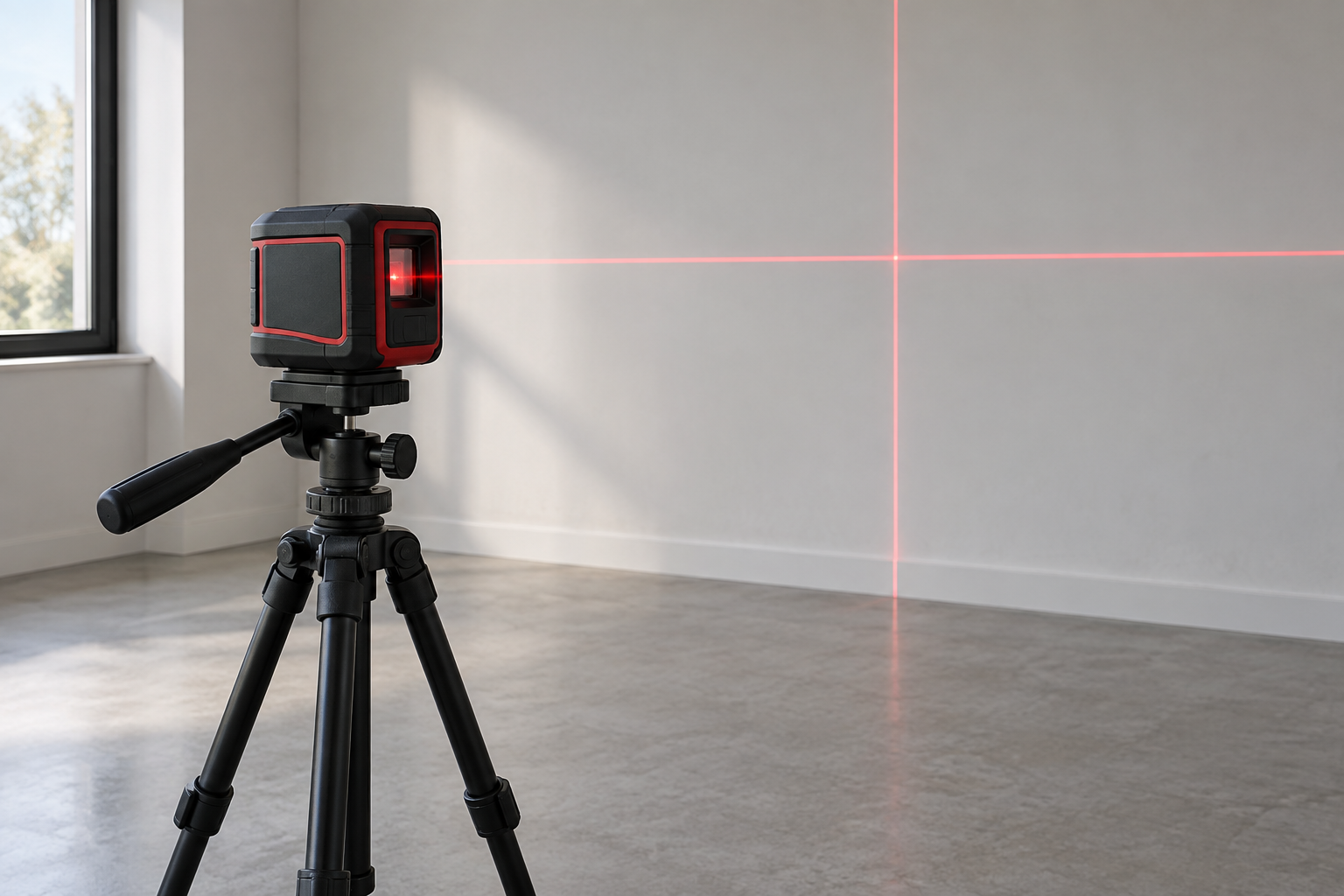
A cross-line laser projects a horizontal line, a vertical line, or both at once. The horizontal line acts as a visible reference across the wall; the vertical line can help align cabinet edges, fillers, or an appliance opening. Some cross-line models project multiple planes, but a basic level-and-plumb cross line is enough for many cabinet jobs.
“Self-leveling” means the tool corrects its projection within a limited tilt range. It does not find the right cabinet height for you. Set the laser close to level, let it settle, and verify that it is not flashing or otherwise warning that it is outside its leveling range.
Which is quicker for common cabinet tasks?
| Task | Cross-line laser | Dot laser | Practical edge |
|---|---|---|---|
| Marking a continuous cabinet reference | Shows a line across the wall | Requires transferring points and connecting them | Cross-line |
| Checking a cabinet edge for plumb | Vertical line gives a direct reference | Needs a suitable vertical dot setup or separate measurements | Cross-line |
| Transferring one height around a corner | Useful if its line reaches the next wall | Works well by moving the point and checking the transfer | Either |
| Working in a crowded, reflective room | Long lines can be harder to read on busy surfaces | A point may be easier to pick out at one location | Dot, sometimes |
| Keeping the tool simple and inexpensive | More visible output, often more functions | Can be a lower-cost fit for point transfers | Dot |
A line can save several setup-and-measure steps over a long run. For example, on a 10-foot wall, you can mark the planned cabinet reference at one end and see whether it remains consistent across the run. With dots, you must establish and transfer enough points to trust the same reference, then mark a line between them. The time difference is modest for one short cabinet, but grows when you repeat the process across several walls.
Using a cross-line laser for cabinets
First, decide what the laser line represents. For upper cabinets, installers commonly establish a level reference for the cabinet tops or bottoms, then measure to the actual cabinet rail or hanging hardware. For base cabinets, the floor is often not level, so a line can identify a level starting reference—but it does not tell you how much to shim each cabinet. Measure the floor at the cabinet locations and plan for the high point.
Set the tool on a stable surface or mount it securely, then project the line at a convenient height. A line that lands behind the cabinets may be useful for layout but awkward to see during installation. Mark the wall at several points, especially near ends and corners. If a wall bows, don’t assume the line means the cabinet backs will sit flat; check the wall and decide where scribing or shimming is needed.
Use the vertical line to check an end panel or a cabinet side, but don’t use it as a substitute for checking the cabinet itself. A cabinet can be plumb while the face frame is out of alignment with the next unit. Clamp neighboring cabinets together, align their faces, and verify level and plumb before fastening.
When a dot laser is enough
A dot laser is a reasonable buy if your work is mostly point-to-point transfers: carrying a height through a doorway, matching marks on opposite sides of a room, or setting one isolated cabinet. It can also be handy where a projected line is obscured by cabinet boxes or difficult to distinguish against a cluttered wall. You’ll need a ruler or tape and a pencil to turn the reference point into useful layout marks.
The main failure mode is transferring a point inaccurately. If the tool shifts between readings, or you measure from different edges of the dot, the error can carry through the run. A dot also doesn’t show a sag or obstruction between two marks. Take repeated measurements, keep the tool fixed when possible, and check the final layout with a level or straightedge.
What to buy and what to check
For a kitchen or bathroom cabinet run, start with a self-leveling cross-line laser. Check whether it projects both horizontal and vertical lines, how it mounts, and whether its manual specifies the accuracy and leveling range. A common stated accuracy is around 1/8 inch at 30 feet, but compare the actual specification; “laser” alone is not a guarantee of precision.
If you only need occasional transfers and want to spend less, a self-leveling dot laser can be perfectly adequate. For either type, visibility in your room matters. Bright ambient light and long distances make lines and dots harder to see; a detector can help only if the tool is compatible with one. Indoors, a basic tool may be easy to read at a few feet but frustrating across a bright, sunlit room.
Before trusting any laser, check it against a known level reference or follow the manufacturer’s accuracy-check procedure. A dropped or poorly calibrated tool can project a clean-looking but wrong line. Keep the laser steady, wait for it to self-level, and verify important marks with a reliable level. A cross-line laser usually saves more layout time for cabinet installation, but careful checks—not the projection pattern—are what keep the finished run straight.