What's inside
As an Amazon Associate I earn from qualifying purchases. This post may contain affiliate links at no extra cost to you.
Tile layout depends on straight reference lines, not on the laser doing the setting-out for you. A self-leveling laser is usually quicker to position and easier to repeat; a manual laser can cost less and work well if you are willing to level it carefully. For most DIY tile jobs, the better choice depends on how often you will use it, how large the room is, and how much time you want to spend checking the tool.
As an Amazon Associate we earn from qualifying purchases at no extra cost to you.


Our Top Picks


What the two types do
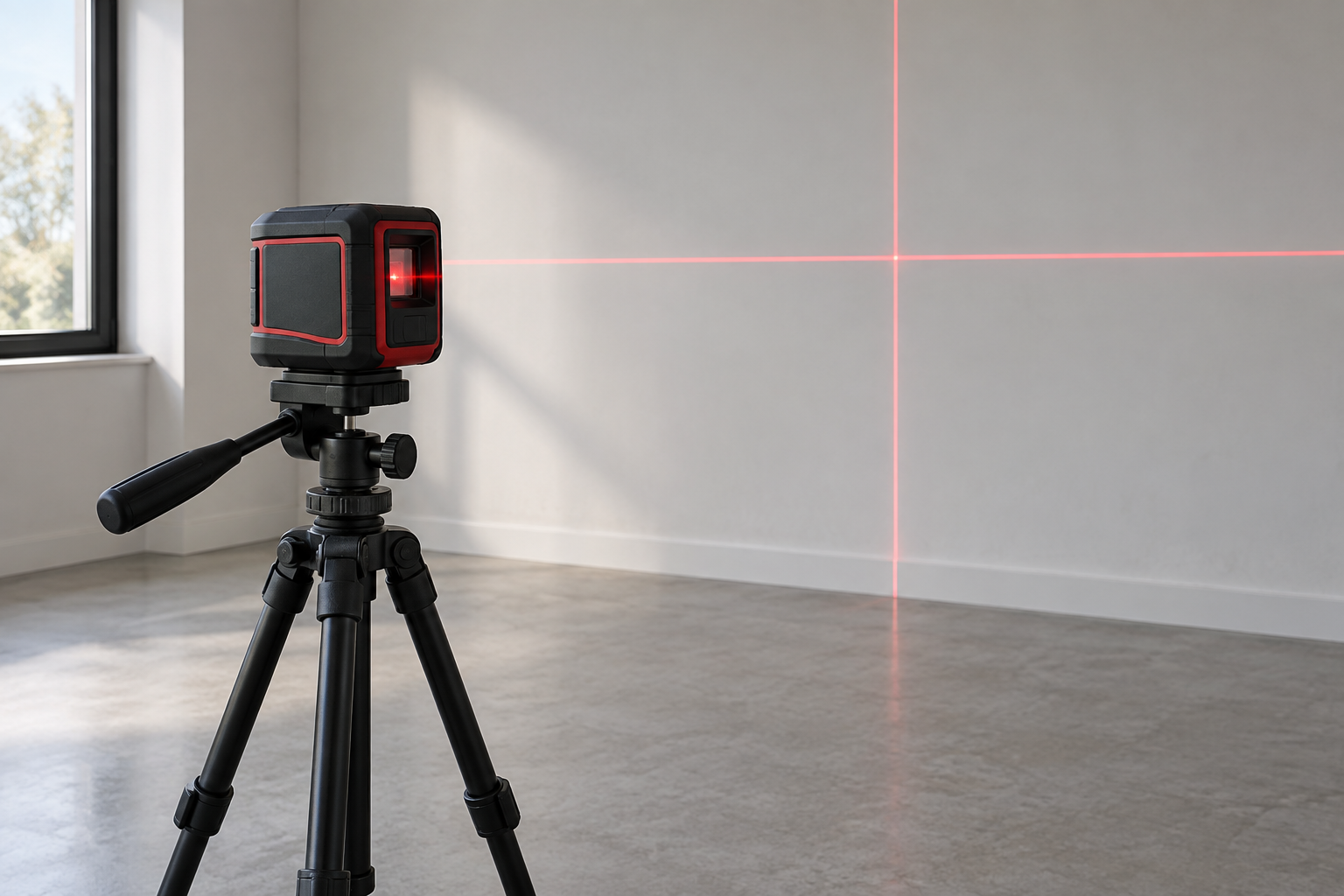
A self-leveling laser uses a pendulum or electronic mechanism to bring its beam level or plumb within a stated range. Set it on a stable surface, wait for it to settle, and it projects a reference line. If it is tilted beyond its leveling range, many models blink or otherwise warn you rather than silently showing a false line.
A manual laser has no automatic leveling mechanism. You adjust its position with a bubble vial, leveling screws, or a tripod head until the beam is level. It can be accurate, but the user must do the leveling and verify it. Some rotary lasers and specialty tools have different controls, so check the specific tool’s instructions rather than assuming all manual models work alike.
Neither tool measures tile spacing or guarantees a square room. A laser gives you a line; you still need to check layout, account for grout joints, and avoid ending up with narrow slivers at walls.
Quick comparison
| Factor | Self-leveling laser | Manual laser |
|---|---|---|
| Setup | Fast once placed within its leveling range | Requires careful adjustment and checking |
| Repeatability | Good when used on a stable mount and not disturbed | Depends on how accurately it is leveled each time |
| Cost | Typically higher, especially for brighter or multi-line units | Often the cheaper option |
| Best fit | Frequent layout work, larger rooms, or solo installation | Small jobs, occasional use, or a tight budget |
| Main risk | Assuming it is level when it is out of range or bumped | Leaving the beam slightly out of level during setup |
Which is better for tile layout?
For a typical floor, a self-leveling cross-line laser is the more convenient choice. Its two perpendicular lines can help establish a starting grid, and the automatic leveling saves repeated adjustments when you move the tool. This matters when setting out a large room or when you need to re-establish a reference after shifting furniture or materials.
For a small bathroom or backsplash, a manual laser can be entirely adequate. If the reference is a short distance and you can take a minute to level and test the beam, paying extra for automation may not improve the finished tile. A straightedge, tape measure, and a reliable square are still essential, particularly when checking whether a planned grid is square to the room.
Tile layout often starts from a chosen centerline or a prominent edge, not automatically from a wall. Walls may be out of square. Dry-lay a few rows or mark the layout before spreading mortar, then adjust the starting point to avoid awkward cuts. A laser helps keep those lines visible; it cannot decide where the cuts should fall.
Accuracy, range, and common mistakes
Look at the accuracy specification, commonly expressed as a tolerance over a distance—for example, a few millimeters over 10 meters. That figure is not a promise that every setup will produce a perfect installation, but it lets you compare tools. For close tile work, check the beam against a long straightedge or a measured reference rather than judging it only by eye.
Before relying on a laser, check it on a known surface. One practical check is to mark the beam at two points, rotate the laser 180 degrees without changing its height, and see whether the reference shifts. Follow the manufacturer’s calibration-check procedure where available. A tool that has been dropped or stored loose may need service or adjustment.
Common failures are mundane: setting the laser on a springy tripod, bumping it while carrying tile, placing it beyond its self-leveling range, or losing the beam in bright light. A receiver can help with compatible outdoor or bright-site work, but many indoor tile layouts do not need one. Keep the tool clear of wet mortar and dust, and do not assume a blinking beam is usable without checking what the warning means.
What to buy for your job
If you install tile regularly, choose a self-leveling line laser with a clear lock or transport mode, a stable mounting option, and a beam you can see in the room where you work. A green beam may be easier to see in some conditions, but it does not make a laser more accurate, and visibility varies with ambient light and surface color. Compare the stated accuracy, working range, battery type, and warranty before choosing a self-leveling cross-line laser.
For one small project, a basic manual model is a reasonable budget choice if it has a usable vial and a secure way to mount or position it. Allow extra setup time and verify the beam whenever the tool is moved. A manual laser level with a tripod may be enough for a backsplash, short floor run, or occasional home repair.
Whichever type you buy, use it as a reference tool, not as a substitute for layout checks. Mark your grid, measure diagonals where squareness matters, and confirm that the first rows land well against the most visible boundaries. The self-leveling model saves setup effort; the manual model saves money. For a single modest job, careful setup often matters more than automation.