What's inside
As an Amazon Associate I earn from qualifying purchases. This post may contain affiliate links at no extra cost to you.
Our Top Picks
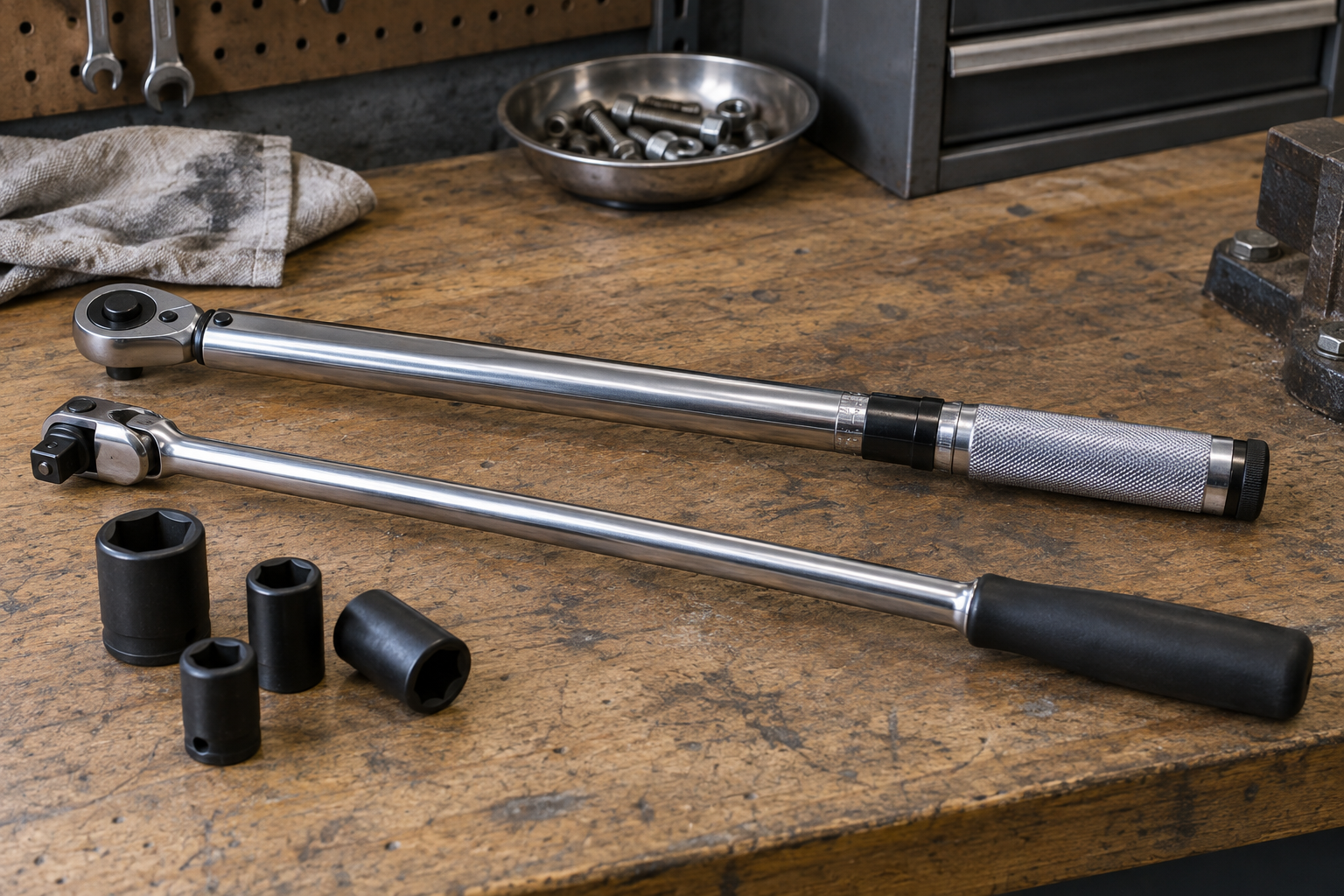
Flex-Head Breaker Bar vs Fixed-Head Breaker Bar: Which Offers Better Leverage?
A breaker bar gives you more torque than a ratchet by using a longer handle and a solid drive connection. The basic leverage equation is simple: torque equals force multiplied by distance. Push with 50 pounds on a 24-inch bar and you produce about 100 foot-pounds of torque, assuming the handle stays at the correct angle and nothing flexes or slips.
The choice between a flex-head and fixed-head breaker bar is less about maximum theoretical leverage than control, access, and durability. A fixed head is usually stronger and more predictable. A flex head is more useful around suspension parts, recessed fasteners, and awkward approach angles. For most home garages, either can work well, but they suit different jobs.
As an Amazon Associate we earn from qualifying purchases at no extra cost to you.


How the head designs differ
A fixed-head breaker bar has a rigid head permanently aligned with the handle. The drive square normally points straight out from the bar, so the tool behaves like one solid lever. There is no hinge to move, wear, or fold under load.
A flex-head breaker bar uses a pivoting head. You can fold the drive end through a range of angles, commonly around 180 degrees, before applying force. This lets you position the handle where there is more room. It can also help you keep your body and hands out of the path of a sudden release.
The pivot does not create extra torque by itself. A 24-inch flex-head bar and a 24-inch fixed-head bar have the same leverage when the handle length, applied force, and angle are the same. The flex design only makes it easier to put that leverage to work in confined spaces.
Which one offers better leverage?
For pure leverage, the fixed-head bar has the advantage in practice. Its rigid connection wastes almost no motion, and the head is less likely to shift as you pull. That matters when breaking loose a rusted lug nut or a seized suspension fastener. A 24-inch fixed-head breaker bar is often the better choice when access is open.
A flex head can deliver the same torque, but only when the head is supported correctly. If the pivot is loose, the head may fold instead of transferring your effort. Some designs also have a detent or locking mechanism that can wear. A head that moves unexpectedly can cause scraped knuckles, a dropped socket, or a sudden loss of balance.
Bar length makes a larger difference than head style. A 36-inch bar gives roughly 50 percent more leverage than a 24-inch bar with the same force. However, more length also increases the risk of damaging a fastener, socket, stud, or tool. If a fastener is rated for a specific torque, use a torque wrench for final tightening rather than estimating with a breaker bar.
Flex-head vs fixed-head breaker bar
| Feature | Flex-head | Fixed-head |
|---|---|---|
| Leverage at equal length | Essentially the same | Essentially the same |
| Access around obstacles | Excellent | Limited by handle alignment |
| Rigidity under heavy load | Good, but depends on pivot design | Excellent |
| Risk of head movement | Higher if unlocked, worn, or poorly supported | Very low |
| Maintenance | Pivot may need cleaning or lubrication | Minimal |
| Best use | Confined engine bays and suspension work | Open access and maximum confidence under load |
| Typical value | Convenience justifies the extra cost for some jobs | Usually the cheaper, simpler option |
Where a flex-head earns its place
Flex heads are especially useful when the handle cannot swing in line with the fastener. A control arm bolt may sit behind a frame rail. An engine mount fastener may be reachable only from below. A recessed crank pulley bolt can leave just a narrow path for the socket and extension. In these situations, changing the handle angle can turn an impossible pull into a controlled one.
They are also useful for the initial breakaway pull, after which you can remove the bar and use a ratchet or impact wrench if appropriate. A 18- or 24-inch 1/2-inch-drive flex-head breaker bar covers many automotive jobs without becoming excessively bulky.
Do not assume every flex head locks positively. Some heads are held by friction and can swing freely when you lift the tool. For high-load work, keep the pivot positioned so the force pushes the head into its stop rather than trying to fold it. If the manufacturer specifies a particular loading direction, follow it.
Where a fixed head is the safer buy
Choose a fixed head when you have a clear approach to the fastener and expect high resistance. Removing axle nuts, trailer hardware, large suspension bolts, and heavily corroded fasteners rewards rigidity. There is less to inspect, and the tool is less likely to surprise you.
A 1/2-inch-drive fixed-head breaker bar is also a sensible low-cost addition to a basic tool kit. The cheaper option is fine if you mainly work on wheel lugs, brackets, and household repairs with reasonable access. You are not giving up leverage simply because the head does not pivot.
For very stubborn fasteners, consider a longer bar only after checking clearance. A 30-inch or 36-inch tool can exceed the strength of a 3/8-inch drive socket or an old fastener. Match the breaker bar, socket, extension, and adapter to the load. Avoid stacking several adapters, using chrome hand sockets with an impact gun, or sliding a pipe over a bar unless the tool maker explicitly allows it.
Safe use and buying advice
Use six-point sockets whenever possible. They grip the flats rather than the corners and are less likely to round a seized fastener. Seat the socket fully, keep the bar close to 90 degrees to the fastener when possible, and pull smoothly instead of bouncing. If you must push, keep your face and hands clear of the release path.
Before buying, check drive size, overall length, pivot construction, and whether the head locks or has a firm stop. A 3/8-inch bar is convenient for smaller fasteners, but a 1/2-inch model is the better general automotive size. A flex head is worth paying for when access is your recurring problem. Otherwise, buy the fixed head, put the savings toward quality six-point sockets, and use penetrating oil and heat where appropriate.