What's inside
As an Amazon Associate I earn from qualifying purchases. This post may contain affiliate links at no extra cost to you.
Lippage is the one flaw that instantly makes an otherwise perfect tile job look amateur. You can mix thinset perfectly and still end up with one tile edge sitting just high enough to catch light, catch a toe, and catch every critical eye. After setting, lifting, and resetting more square footage than we care to admit, we learned that a good leveling system does not make you a better tile setter — it just stops the floor or wall from fighting you while the mortar cures.
What separates a usable system from a frustrating one is not marketing, it is breakaway consistency, wedge grip, and whether the clip actually holds tension without creeping. Cheap clips snap at the wrong point and leave plastic buried in the joint, soft wedges slip under the plier, and oversized systems waste time on small-format work. The eight kits below were judged on how cleanly they hold a plane, how little cleanup they demand, and how well the included tool matches the clip design.
As an Amazon Associate we earn from qualifying purchases at no extra cost to you. Product prices and availability are accurate as of the date shown and are subject to change.




Quick Picks
| Product | Best for | Price |
|---|---|---|
| DGSL 600 Clips + 200 Wedges with Plier (1/8″) | Large rooms and open floors | $37.04 |
| DGSL 300 Clips + 100 Wedges with Plier (1/8″) | Mid-size bathroom and kitchen jobs | $25.99 |
| 200 Levellers + 4 Wrenches + 1000 Spacers Kit (2mm) | Precise joints with reusable levellers | $29.75 |
| ALBO 400-Piece Reusable Cap System (1/8″) | Pro finish on large-format tile | $62.99 |
| Budget 300 Clips + 100 Wedges Kit with Plier (1/8″) | Best value for first-time users | $17.49 |
| DGSL 1000 Clips + 200 Wedges with Plier & Mallet (1/8″) | Whole-home and pro volume | $34.19 |
| DGSL 300 Clips + 100 Wedges with Plier (1/16″) | Tight grout lines and polished tile | $25.99 |
| 1000 Clips + 300 Wedges Set (1/16″) | High-volume thin-joint installs | $39.99 |
How We Picked
We weighted holding power and release cleanliness first, because a system that cannot keep adjacent tiles coplanar under load or that leaves debris in the joint creates more work than it saves. Next we looked at system type and joint control, comparing traditional wedge-and-clip kits against reusable cap systems and different spacer widths to see how each affects alignment and grout consistency. Finally we judged completeness and durability, including whether the included plier, wrenches, or mallet actually fit the clips, whether wedges and caps are truly reusable, and how economically the piece count covers real projects without constant reordering.
The 8 Best Tile Leveling Systems in 2026
1. DGSL 600 Clips + 200 Wedges with Plier (1/8″)
This is the workhorse for anyone tiling more than a single accent wall. With a generous count of clips and reusable wedges plus a dedicated plier, it is built for continuous runs where you do not want to ration clips. Rated 4.4/5, it balances clip rigidity with a predictable snap that leaves joints clean after curing. It is ideal for contractors and ambitious DIYers tackling living areas or multiple bathrooms in one go.
- Pro: High clip count covers expansive areas without mid-project resupply
- Pro: Included plier seats wedges with even pressure, reducing hand fatigue
- Con: Standard wedge-clip design means clips are single-use and add ongoing cost
Skip it if you only need a tight joint look or prefer a reusable cap system for large-format tile.
2. DGSL 300 Clips + 100 Wedges with Plier (1/8″)
Essentially the same proven 1/8 inch wedge system as its larger sibling, but sized for a single room. At $25.99 and rated 4.4/5, it hits the sweet spot for a standard bathroom, laundry, or kitchen backsplash where 600 clips would be overkill. You get the same anti-lippage control and plier-assisted tightening without overbuying. It is perfect for homeowners doing one project at a time.
- Pro: Right-sized quantity minimizes leftover plastic waste
- Pro: Reliable breakaway base reduces time spent cleaning joints
- Con: Not economical if you have several rooms planned back-to-back
Skip it if you are tiling a whole house or need a narrower joint width.
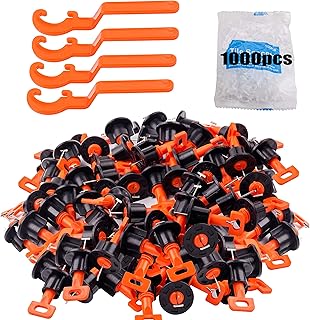
3. 200 Levellers + 4 Wrenches + 1000 Spacers Kit (2mm)
This kit takes a different approach, swapping wedges for twist levellers and adding an abundance of spacers. The 2mm spacers give a clean, modern joint, while the reusable levellers are tightened with the four included wrenches for very controlled pressure. Rated 4.5/5, it shines on walls and floors where uniform tightening matters more than speed. Best for detail-oriented installers who value repeatable tension over rapid wedge insertion.
- Pro: Reusable levellers lower long-term consumable cost
- Pro: Massive spacer count ensures consistent joints across large layouts
- Con: Twist tightening is slower than wedge-and-plier workflow
Skip it if you prioritize fast installation over fine tension control.
4. ALBO 400-Piece Reusable Cap System (1/8″)
The ALBO system is the most deliberate, pro-leaning option here. Instead of disposable clips, it uses reusable caps and protection plates that thread down to pull tiles into plane while shielding the tile surface. This makes it especially kind to polished porcelain and natural stone where surface marring is a concern. At $62.99 and rated 4.3/5, you pay more upfront, but caps are designed for reuse across jobs.
- Pro: Protection plates help prevent surface scratches and pressure marks
- Pro: Reusable caps are economical over multiple projects
- Con: Higher initial price and more parts to manage during install
Skip it if you want the simplest disposable system or are on a tight budget for a one-off job.
5. Budget 300 Clips + 100 Wedges Kit with Plier (1/8″)
This is the entry point that does not feel like a compromise. Offering 300 clips and 100 wedges with a plier at just $17.49, it delivers the core lippage control of pricier wedge systems at the lowest price in this roundup. Rated 4.3/5, it holds plane well for ceramic and standard porcelain in typical residential thicknesses. It is ideal for first-timers, rental flips, or anyone testing a leveling system for the first time.
- Pro: Outstanding value with plier included at a budget price
- Pro: Straightforward wedge system with minimal learning curve
- Con: Wedges and clips feel less robust under heavy repeated use
Skip it if you need high volume or plan to reuse components across many jobs.
6. DGSL 1000 Clips + 200 Wedges with Plier & Mallet (1/8″)
For whole-home tiling, this high-volume DGSL kit is hard to beat. You get a full 1000 1/8 inch clips and 200 reusable wedges, plus both a plier and a rubber mallet to seat tiles without cracking. Rated 4.5/5 and priced at $34.19, it offers the lowest cost per clip in the DGSL lineup while adding the mallet that the smaller kits lack. It is the choice for pros and homeowners doing floors throughout.
- Pro: Exceptional coverage for large areas with tools included
- Pro: Rubber mallet helps set tiles firmly without damaging edges
- Con: Bulk quantity requires storage if you only tile occasionally
Skip it if your project is small or you prefer a narrow joint.
7. DGSL 300 Clips + 100 Wedges with Plier (1/16″)
When you want a near-minimal grout line, this 1/16 inch version of the DGSL system delivers the same wedge-and-plier ease with tighter spacing. At $25.99 and rated 4.4/5, it keeps rectified tiles aligned with a fine, contemporary joint that highlights the tile rather than the grout. The clip base is slim enough for tight joints yet still snaps cleanly. Perfect for modern bathrooms with polished or rectified porcelain.
- Pro: Narrow joint creates a seamless, high-end appearance
- Pro: Same ergonomic plier and reliable wedge grip as the 1/8 inch kits
- Con: Thin joint leaves less room for error on uneven substrates
Skip it if your tiles are not rectified or your subfloor has notable variation.
8. 1000 Clips + 300 Wedges Set (1/16″)
This set is built for installers who live in the thin-joint world and need volume to match. With 1000 clips and a full 300 reusable wedges in 1/16 inch, it supports expansive layouts without running short on wedges — a common bottleneck. Rated 4.4/5, the wedges provide strong bite and reuse well, while clips break consistently at the base. Best for large modern floors where a tight, uniform grout line is the design goal.
- Pro: Extra wedges extend reuse and keep workflow uninterrupted
- Pro: Very high clip count ideal for continuous large-format runs
- Con: No plier included, so you must supply your own tensioning tool
Skip it if you need a complete kit with plier or prefer wider joints.
Buying Guide
Wedge-and-Clip vs. Reusable Cap Systems
Most kits here use the classic wedge-and-clip method: a disposable clip sits under two tiles, a wedge slides through and is tightened with a plier to pull the surfaces level. It is fast, intuitive, and clips snap off after cure, leaving only the base in the joint. Cap systems like the ALBO replace wedges with threaded caps and protection plates. They take slightly longer to set but shine on large-format, polished, or stone tiles because pressure is distributed evenly and caps are reusable. Choose wedge speed for standard ceramic and porcelain, choose caps when surface protection and long-term reuse outweigh speed.
Joint Width: 1/8 Inch vs. 1/16 Inch vs. 2mm
Joint width is both aesthetic and practical. A 1/8 inch joint is forgiving on slightly irregular tiles or substrates and makes grouting easier, which is why most all-purpose kits default to it. A 1/16 inch joint gives a tighter, more contemporary look and works best with rectified tiles and flat substrates; any subfloor variance will telegraph quickly. The 2mm spacer in the leveller kit sits between the two, offering a European standard that balances clean lines with workable tolerance. Match the width to your tile calibration and how perfect your substrate is, not just the look you want.
Tools and Reusability
Do not underestimate the tool. A plier that matches the wedge angle reduces hand strain and prevents over-tightening that can bow tiles or stress clips, while a rubber mallet helps seat tiles into thinset before leveling. Wrenches serve the same role for twist levellers. Reusability also affects cost: clips are always single-use, but wedges, levellers, and caps can be reused if not damaged during removal. If you tile often, a system with durable reusable components pays for itself; for a single project, prioritize included tools and sufficient consumables over long-term reuse.
Our Verdict
Our top pick is the DGSL 1000 Clips + 200 Wedges with Plier & Mallet (1/8″) at $34.19. With the highest rating in the DGSL family, the best clip quantity for the price, and both plier and mallet included, it covers everything from one large room to a full-house install without needing immediate resupply. For the budget pick, the Budget 300 Clips + 100 Wedges Kit with Plier (1/8″) at $17.49 delivers genuine lippage control with a plier included for less than any other complete system, making it perfect for first-time or small-project buyers. If you are setting large-format, polished, or stone tile where surface protection matters, the ALBO 400-Piece Reusable Cap System wins despite its higher upfront cost because its caps and protection plates are designed for repeated use and gentler clamping.
FAQ
Do tile leveling systems replace the need for a flat substrate?
No. Leveling systems hold tile edges coplanar while mortar cures, but they cannot fix a wavy subfloor or wall. You still need proper substrate prep and appropriate thinset coverage. Think of them as lippage insurance, not a leveling compound replacement.
Are wedges and caps really reusable?
Wedges, twist levellers, and threaded caps are designed for multiple uses if removed without damage, while clips and bases that sit in the joint are always single-use and snap off. Clean mortar from reusable parts promptly and inspect for cracks before the next job. Discard any wedge that no longer grips firmly.
What joint width should a beginner choose?
A 1/8 inch joint is the most forgiving for beginners because it accommodates slight tile size variation and makes grout application easier. Narrower joints demand flatter substrates and more precise tile calibration. Start wider unless your tiles are rectified and your substrate is verified flat.
When should I remove the leveling components?
Remove clips or bases only after the thinset has cured per the mortar manufacturer instructions, typically once the tile is firmly set and will no longer shift. Removing too early can allow tiles to settle unevenly, while waiting too long can make breakaway harder. Always kick or snap clips parallel to the joint to ensure a clean break at the intended point.