What's inside
As an Amazon Associate I earn from qualifying purchases. This post may contain affiliate links at no extra cost to you.
Our Top Picks
 Klein Tools 93MCLPG Compact Self-Leveling Laser Level4.45 x 2.98 x 0.1 inches0.62 poundsCheck on Amazon

The short answer
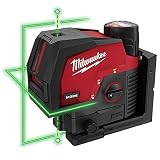
The Milwaukee M12 Green Cross-Line Laser is usually easier to use in a bright room, but the difference is not as dramatic as the green-beam marketing suggests. Both lasers use green lines that are easier to see than red lines under typical indoor lighting. In direct sunlight, bright work lights, or across a large room, both eventually need a detector.
Milwaukee gets the edge for most users because its M12 battery system provides longer practical runtime, the laser is quick to set up, and its included controls are straightforward. The Klein 93LCLS is a better value when you only need occasional layout work, especially if you find it at a substantially lower price. For precise work beyond roughly 30 to 50 feet in a bright room, plan on using a detector with either one.
As an Amazon Associate we earn from qualifying purchases at no extra cost to you.


What each laser is designed to do
Both tools project horizontal and vertical green lines for tasks such as setting cabinets, aligning electrical boxes, leveling shelving, installing tile, and laying out wall framing. Both are self-leveling tools with a magnetic mounting solution and tripod compatibility.
The Milwaukee is part of the M12 battery platform. Its battery-powered design is useful on longer jobs because you can carry a spare battery instead of stopping to recharge an internal pack. The Klein 93LCLS uses an integrated rechargeable battery. That makes the tool compact and convenient, but runtime depends on remembering to charge it before the job.
These are cross-line lasers, not full 360-degree room-layout lasers. A line projected in one direction may require repositioning the tool when you move around the room. If you regularly install cabinets or partitions across several walls, a 360-degree green line laser can save setup time, even though it costs more.
Bright-room performance
Green light generally appears brighter to the human eye than red light at the same output level. That helps both the Milwaukee and Klein in rooms with white walls, overhead LED lighting, or moderate daylight through windows. At close and medium distances, the green line is normally easy to follow.
There are three important limits:
-
Green does not make the beam visible through an obstruction. Cabinets, framing, dust, and uneven surfaces still interrupt the line.
-
A laser line becomes harder to see as it spreads over distance. The line may be visible near the tool but fade by the far wall.
-
Direct sunlight is much brighter than either tool’s projected line. Outdoors or beside an uncovered window, a detector is usually the correct solution.
Without a detector, expect the usable visible range to vary widely with wall color and ambient light. In a normal interior, both can work well around 30 to 50 feet. In a brightly lit commercial room, that distance can be considerably shorter. With a compatible detector, the working range extends to roughly 165 feet, making the brightness of the line itself much less important.
Milwaukee M12 vs. Klein 93LCLS
| Feature | Milwaukee M12 Green Cross-Line | Klein 93LCLS |
|---|---|---|
| Beam color | Green | Green |
| Laser type | Horizontal and vertical cross-line | Horizontal and vertical cross-line |
| Accuracy | About 1/8 inch at 33 feet | About 1/8 inch at 33 feet |
| Self-leveling range | Approximately 4 degrees | Approximately 4 degrees |
| Range with detector | Up to about 165 feet, depending on detector and conditions | Up to about 165 feet, depending on detector and conditions |
| Power | Removable M12 battery | Integrated rechargeable battery |
| Best advantage | Replaceable battery and jobsite ecosystem | Simple, compact rechargeable design |
| Main limitation | Higher system cost if you do not own M12 batteries | Recharge time matters if the battery runs down |
Which one is easier to set up?
The Milwaukee is the easier choice for repeated professional use. Insert a charged M12 battery, unlock the pendulum, select the needed line, and mount the laser. If the battery goes flat, replacing it takes seconds. That matters when the laser is mounted high on a tripod or bracket and you are moving between several rooms.
The Klein is not difficult to operate. Its integrated battery keeps the body tidy and avoids the need to buy a separate battery platform. The trade-off is less flexibility: if it is empty, you must connect a charger or wait. For a homeowner doing one backsplash or a few shelves, that is rarely a serious problem.
Both tools need a stable mounting point. A magnetic bracket works well on steel studs, door frames, and electrical boxes, but it is not a substitute for a solid surface. On drywall, a tripod or clamp is safer. If the tool moves even 1/16 inch while you mark several points, the error can become visible across a long wall.
Accuracy and common failure modes
The published accuracy of about 1/8 inch at 33 feet is adequate for cabinets, outlets, shelving, and most finish carpentry. It is not survey equipment. At 10 feet, that specification represents a much smaller possible error; at longer distances, the error becomes more noticeable.
Do not trust a line when the out-of-level indicator is flashing or the pendulum is locked. Self-leveling only works within the tool’s leveling range. A tripod on an uneven floor can put the laser outside that range, causing a warning or preventing the line from appearing level.
Vibration is another frequent problem. A running saw, someone bumping the bracket, or a loose tripod head can shift the reference line. Check the tool after moving it and before making final cuts. For critical cabinet runs, mark two points several feet apart and verify them with a spirit level or a second measurement.
Which should you buy?
Choose the Milwaukee M12 green cross-line laser if you already own M12 batteries, work in bright rooms regularly, or need to run the laser for several hours over multiple jobs. The removable battery is the most practical advantage, not a dramatically brighter green line.
Choose the Klein 93LCLS if you want a capable green cross-line laser for occasional remodeling, electrical, or installation work and it costs noticeably less than the Milwaukee setup. It is fine for normal indoor rooms, and its rechargeable design keeps the purchase simple.
If the job involves strong daylight, long distances, or a large open commercial space, spend the money on a detector before paying extra for a supposedly brighter laser. That accessory changes bright-room usability more than the difference between these two tools.