What's inside
As an Amazon Associate I earn from qualifying purchases. This post may contain affiliate links at no extra cost to you.
For repeated fasteners, a ratcheting wrench is usually faster once there is room to swing its handle. It turns the nut without lifting the wrench off the fastener after every short stroke. A standard box-end wrench needs to be lifted and reseated each time, which adds motion and can be frustrating in tight spaces.
That does not make the ratcheting wrench the better tool for every job. Its mechanism adds cost and can be damaged by abuse, while a conventional box end is simple, strong and often the better choice for breaking loose a stubborn fastener. The right pick depends on access, fastener condition and how many turns the job requires.
As an Amazon Associate we earn from qualifying purchases at no extra cost to you.



Our Top Picks
 GEARWRENCH 14 Piece 6 Point Combination Metric WrenchMetric14.8 x 3.9 x 1.9 inches0 poundsCheck on Amazon

How the two wrenches work
A box-end wrench surrounds the fastener with a closed head, commonly with a 12-point or 6-point opening. To advance it, you turn through the available arc, lift it off, reposition it and turn again. On a normal-size fastener, each stroke may move it only a fraction of a full turn if nearby parts limit handle travel.
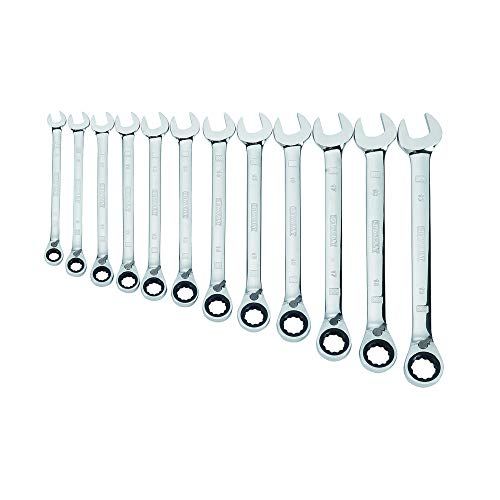
A ratcheting wrench also has a closed head, but a ratchet mechanism lets the handle return without turning the fastener backward. Keep the head seated and pump the handle through the available arc. Common designs use a 72-tooth mechanism, which needs about 5 degrees of movement to engage the next tooth. That can help where a standard wrench cannot swing far enough to make useful progress.
Which is faster in practice?
On a long run of clean, accessible fasteners, the ratcheting wrench usually wins. The advantage is most noticeable when each fastener needs many rotations: wheel or engine-bay work, furniture assembly, or a run of nuts on a bracket. Not having to reseat the wrench after every stroke saves time and reduces hand movement.
The advantage shrinks when the fastener is already loose and only needs a few turns, or when the handle has a clear 60- to 90-degree swing. A standard box end can move a fastener quickly in a broad arc, and a practiced user can reseat it without much delay. If access permits a socket and ratchet, that may be faster still; this comparison matters most when the wrench head must fit over the fastener but a socket setup will not.
Neither wrench is automatically faster in a cramped spot. A ratcheting head still needs enough clearance for the handle to move through its reset arc. If the handle can move only a couple of degrees, a fine-tooth ratchet may advance the fastener where a coarse one cannot, but progress will be slow. A flex-head or short wrench can improve access, though it may sacrifice leverage.
Quick comparison
| Factor | Box-end wrench | Ratcheting wrench |
|---|---|---|
| Repeated turning | Lift and reseat after each stroke | Turns on the working stroke; freewheels on return |
| Minimum swing | Depends on how many positions the head allows | Depends on ratchet tooth count and mechanism |
| Breaking loose tight fasteners | Simple, sturdy choice, especially with a 6-point head | Use cautiously; mechanism may be the weak point |
| Maintenance and durability | Few parts; easy to clean | More moving parts; dirt, corrosion or overload can cause failure |
| Price | Often cheaper | Usually costs more, especially as a set |
Strength, wear and failure modes
Use a regular box end or a socket to break loose a fastener that is seized, rusted or tightened hard. A ratcheting wrench is designed to turn conveniently, not to replace a breaker bar. Applying a long cheater pipe or hammering the handle can strip or crack the ratchet mechanism. If the tool slips or skips, stop; continuing can round the fastener or damage the wrench.
Head shape matters too. A 6-point box end contacts the flats of a compatible hex fastener and is less prone to rounding it under high torque. A 12-point head offers more positions for reseating, useful when access is tight, but can be less secure on a damaged or very tight fastener. Check that the wrench fits snugly before leaning on it.
Ratcheting mechanisms can also stop engaging if packed with grit, corroded or worn. Keep the head reasonably clean and follow the maker’s maintenance instructions. A standard box end has no pawls or gears to jam, though a cheap, poorly fitting wrench can still spread or damage the fastener under excessive force.
What to buy
If you regularly work on machines, vehicles or assemblies with many fasteners, a ratcheting set can pay for itself in saved hand motions. Choose the sizes you actually use, and look for a stated tooth count and a head that fits your available clearance. A metric ratcheting combination wrench set suits metric hardware; buy an SAE set only if your fasteners require it. Combination sets have an open end at one side and a ratcheting box end at the other, which is handy for positioning a fastener before turning it down.
For occasional home repairs, a conventional combination-wrench set is often enough. If you mostly need a tool to hold a nut, make a few adjustments or loosen ordinary hardware, paying extra for a ratchet in every size may not save meaningful time. A metric combination wrench set with 6-point box ends is a sensible lower-cost choice for accessible or stubborn fasteners.
If you buy ratcheting wrenches, do not assume they replace your other tools. Keep a standard box end or socket for initial loosening and final tightening, then use the ratcheting wrench for the repeated turning in between. For critical joints, finish to the specified torque with a torque wrench rather than judging tightness by feel.
A practical decision rule
Choose ratcheting if you will turn the same sizes repeatedly, there is enough handle movement to use the mechanism, and speed matters more than minimum cost. Choose a standard box end if use is occasional, the budget is tight, or the work involves high breakaway torque and rough conditions. For many toolboxes, having both is the useful answer: the box end handles force; the ratcheting wrench handles repetition.