What's inside
As an Amazon Associate I earn from qualifying purchases. This post may contain affiliate links at no extra cost to you.
Small-engine fasteners are where an ordinary wrench set starts to show its weaknesses. Lawn mowers, pressure washers, snow blowers, generators, and chainsaws use a mix of small hex bolts, recessed nuts, long studs, and fasteners surrounded by plastic or sheet metal. A ratcheting wrench can save time, but only if it fits the fastener closely and has enough clearance to swing.
For most repair benches, the best choice is a compact metric-and-inch set with a 72-tooth or finer ratcheting box end, a slim head, and sizes from roughly 1/4 to 3/4 inch and 6 to 19 mm. A reversible lever is useful, but it adds thickness and another part that can collect dirt. Before buying, check whether you work mostly on metric equipment, older American-made machines, or both.
As an Amazon Associate we earn from qualifying purchases at no extra cost to you.



Our Top Picks


The best type for small-engine work
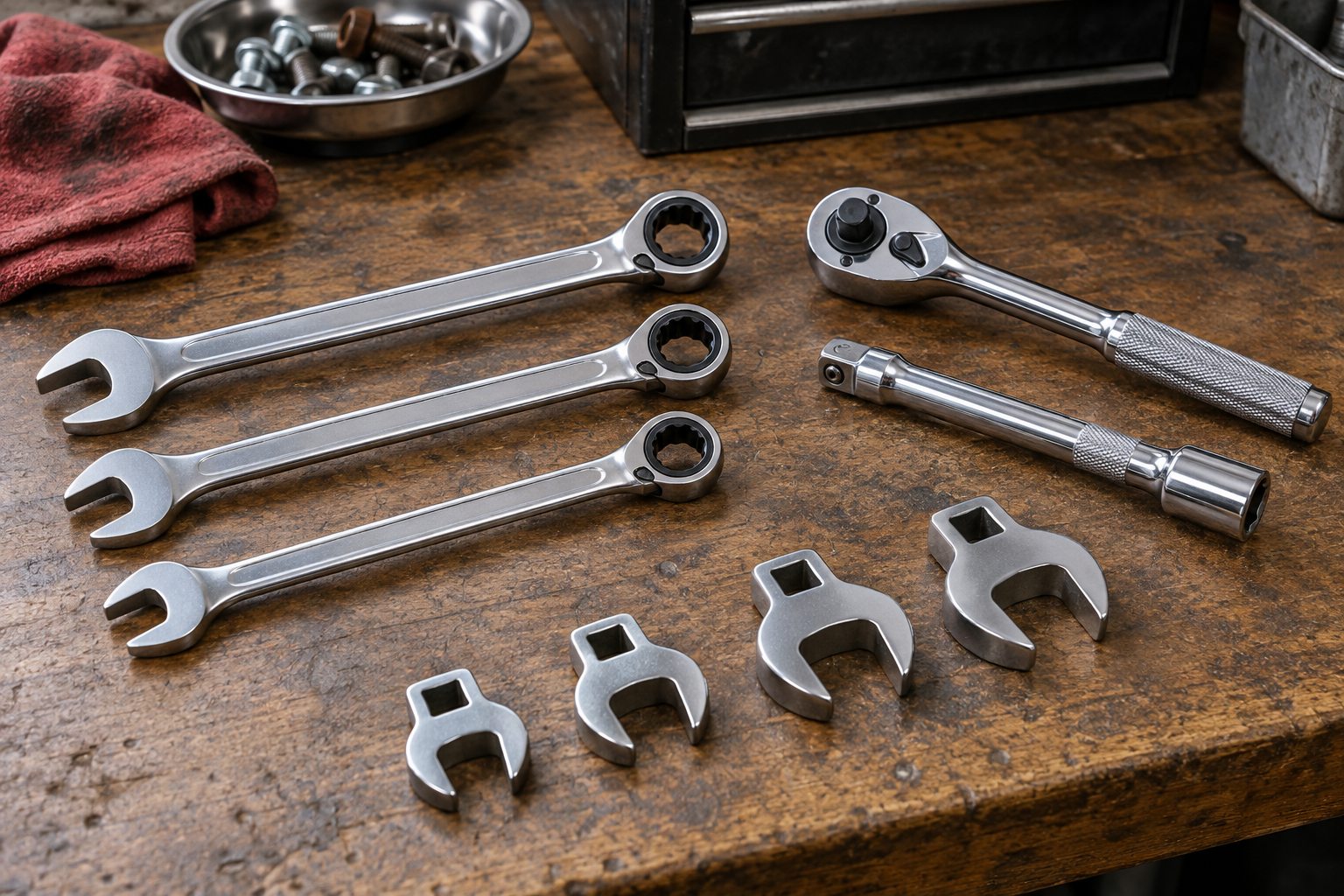
A slim, non-reversible ratcheting wrench set is usually the best balance. The ratcheting mechanism is built into the box end, while the open end works like a conventional wrench. This design is thinner than most reversible models and fits around carburetor nuts, muffler shields, engine shrouds, and bracket fasteners.
Look for a 72-tooth mechanism or finer. A 72-tooth wrench needs about 5 degrees of swing before it engages again; a 90-tooth wrench needs about 4 degrees. That difference matters around a recoil starter or under a fuel tank, but it does not turn a wrench into a substitute for a socket. If you have less than 2 inches of room to move, a fine-tooth ratchet wrench is noticeably easier to use.
A metric and SAE ratcheting wrench set is the safest purchase for a mixed collection of small engines. Sets covering 8–19 mm and 1/4–3/4 inch handle most external engine fasteners. Smaller 6 and 7 mm sizes are valuable on carburetor hardware, guards, and brackets, but they are less common in full-size structural fasteners.
What matters more than the tooth count
| Feature | What it changes | What to look for |
|---|---|---|
| Box-end profile | Determines access around recessed or obstructed nuts | Slim head with a shallow offset |
| Ratcheting angle | Determines how far the handle must move to engage | 72 teeth minimum; 90 teeth for tight spaces |
| Drive direction | Affects convenience and thickness | Fixed-direction for maximum clearance; reversible for convenience |
| Open-end grip | Controls rounding when the box end will not fit | Precision jaws with limited flare |
| Finish and markings | Controls identification and corrosion resistance | Permanent size markings on both sides |
| Set coverage | Determines whether you need a second set | 6–19 mm and 1/4–3/4 inch for mixed work |
Head thickness is often more important than tooth count. A bulky 90-tooth wrench may still be useless if it cannot pass between a carburetor and an intake tube. Compare the thickness at the box end, not just the overall length. A short 5-inch wrench gives better control on small fasteners, while a 9-inch wrench provides more leverage but makes it easier to over-torque a small bolt.
When a cheaper set is fine
A budget set is reasonable if you use it occasionally, work on clean fasteners, and mainly need the ratcheting function to remove already-loosened nuts. For a mower blade guard, air-filter housing, or engine cover, a basic chrome-vanadium set can last for years.
The common failure modes are a sloppy box end, a ratchet that skips under load, and chrome flaking inside the mechanism. Skipping is especially dangerous on a partly rounded fastener because it can remove the remaining corners. Test a new wrench on a known-good nut before using it on a difficult repair. If the box end rocks visibly on the fastener, return the set.
A budget metric and SAE ratcheting wrench set makes sense for light maintenance, but avoid sets that skip 1/4-inch sizes, omit 15 mm, or use vague size markings. Those omissions are more annoying than saving a few dollars. A cheaper set is not fine for using a wrench as a hammer, breaking loose seized bolts, or working on high-temperature exhaust hardware every week.
When a better set earns its price
Pay more for a professional-grade set when you regularly service commercial mowers, generators, or engines exposed to water and fertilizer. Better sets generally have tighter box-end tolerances, smoother mechanisms, stronger open ends, and clearer markings. The benefit is not simply speed. A close-fitting box end is less likely to round a rusty 10 mm or 3/8-inch fastener.
For frequent repairs, consider a flex-head metric and SAE ratcheting wrench set. The hinged head can approach a fastener at an angle and is useful around engine frames. The trade-off is significant: the hinge makes the head thicker, can fold while you are positioning it, and gives you another joint to clean. It should not be your only set. A fixed-head set is better for final loosening and tightening when clearance allows.
How to use one without damaging fasteners
Use the box end whenever possible. Brush dirt from the fastener, seat the wrench fully, and keep the handle aligned with the bolt rather than cocked sideways. For removal, apply steady pressure instead of bouncing the handle. If the ratchet skips, stop immediately and switch to a six-point socket or a non-ratcheting box wrench.
Do not use a ratcheting wrench with a cheater pipe. Small-engine fasteners are often 6 or 8 mm, and their tightening torque may be only 7–18 lb-ft. A long handle can stretch or shear the bolt before it feels tight. For reassembly, snug the fastener with the wrench, then use the engine maker’s torque specification when one is provided.
Keep the set clean and dry. Rinse fertilizer residue from the wrench, dry it, and place a drop of light oil into the ratcheting mechanism occasionally. Store it in a roll or marked tray; mixing similar 10 mm and 3/8-inch sizes is an easy way to damage a fastener. For most owners, a slim fixed-head combination set in both measurement systems remains the most useful starting point, with flex-head or premium tools added only when the work justifies them.