What's inside
As an Amazon Associate I earn from qualifying purchases. This post may contain affiliate links at no extra cost to you.
Our Top Picks


The short answer
For a brake line fitting that is still in decent shape, a flare-nut wrench is the safer choice. Its closed end surrounds most of the hex, spreading force across more flats than an ordinary open-end wrench. That reduces the chance of rounding the fitting when it takes real effort to loosen.
An open-end wrench can be fine for a snug fitting, light tightening, or occasional work when access is awkward. It is cheaper and already common in many toolboxes. But once a brake fitting is corroded or stubborn, the extra contact of a flare-nut wrench is worth having. Neither wrench can rescue a fitting whose flats are already badly rounded.
As an Amazon Associate we earn from qualifying purchases at no extra cost to you.

Why brake line fittings are easy to damage
Brake line fittings are typically made of relatively soft metal, and the hex can be narrow. Years of water, road salt, and heat cycles can seize the fitting to the line or to its port. Meanwhile, the steel brake line itself is easy to twist or kink if the fitting will not turn independently.
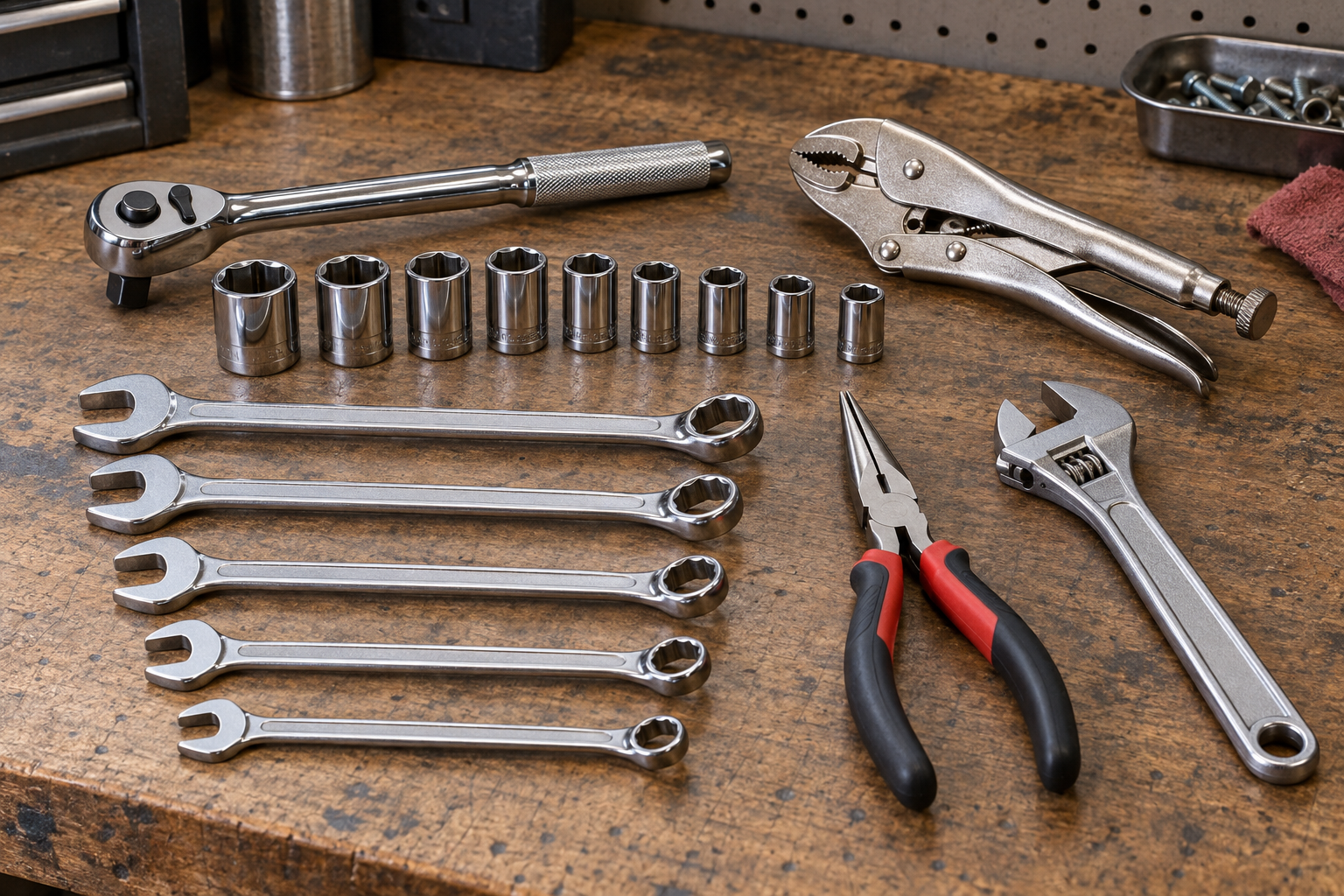
An open-end wrench contacts the fitting at two sides and has gaps that let it slip onto the hex. Under high force, a loose or poorly sized wrench may ride up and deform the corners. A flare-nut wrench has a slot to pass over the tube, but otherwise surrounds more of the hex. That extra support helps keep the tool seated and lowers the risk of rounding the fitting.
“Lowers the risk” is not “prevents damage.” A wrench that is the wrong size, not fully seated, or pulled at an angle can still round a fitting. Corrosion can also make the fitting fail before the wrench does.
Flare-nut wrench vs. open-end wrench
| Factor | Flare-nut wrench | Open-end wrench |
|---|---|---|
| Contact on hex | Wraps around most of the fitting, with a slot for the tube | Contacts two sides of the hex |
| Risk of rounding | Lower when properly sized and seated | Higher on tight or corroded fittings |
| Best use | Loosening or tightening brake and fuel line nuts | Accessible, lightly loaded fasteners and general work |
| Cost and versatility | Usually costs more; specialized for line fittings | Usually cheaper; useful across many fasteners |
| Access | Must fit over the tube; head can be bulkier | Can approach from the side, which sometimes fits tight spaces |
Which tool should you buy?
If you work on your own brakes, buy a correctly sized flare-nut wrench before you need one. A single wrench in the fitting size used on your vehicle may be enough; a set is more convenient if you service several vehicles or other hydraulic lines. Check the service information or measure the fitting rather than assuming a common size. Metric and inch sizes can be close enough to seem to fit while still damaging the flats.
A metric flare-nut wrench set is a sensible choice for vehicles with metric fittings. For mixed work, look for a set that covers the sizes you actually encounter, with snug-fitting jaws and a slot narrow enough to retain as much contact as possible. Do not buy a large set solely for a one-time job if a local parts store can lend or rent the right wrench.
An open-end wrench is a reasonable budget option for a fitting that turns easily, especially if you already own the exact size and can keep it square on the nut. It is also useful for holding a hex on some line fittings while another tool turns a mating component. For repeated brake work or any fitting you expect to be tight, though, the modest extra cost of a brake line flare-nut wrench buys better protection where it matters.
How to use it without rounding the fitting
Start with the vehicle safely supported and the correct fitting identified. Clean dirt and loose rust from the hex with a small wire brush. If the fitting is visibly swollen, badly corroded, or already rounded, stop and plan for replacement or a more involved repair rather than applying more force blindly. Brake lines are safety-critical; a damaged line or leaking connection must not be put back into service.
Choose the exact wrench size, push it fully onto the fitting, and keep the tool square to the flats. Pull steadily rather than jerking. If space permits, position your hand so the wrench cannot strike you when the fitting breaks loose. Avoid adding a long pipe to the handle: it multiplies force and can snap a fitting, twist the line, or turn a small problem into a line replacement.
Penetrating oil may help on an exposed threaded connection, but give it time and keep it off friction surfaces. Do not heat a brake fitting near rubber hoses, fuel lines, wiring, or fluid. If the line starts twisting with the nut, stop immediately. The line may be seized to the fitting; continuing can kink or fracture it.
Once loosened, use the flare-nut wrench for initial movement, then switch to fingers if the fitting turns freely. That helps reveal cross-threading early. When reconnecting, start the threads by hand and use the vehicle maker’s torque specification where one is provided. Do not use the wrench to force a misaligned fitting into place.
When an open-end wrench is enough
There is no need to replace a full set of good open-end wrenches just because you occasionally work on brakes. If a fitting is clean, accessible, undamaged, and only needs a small adjustment, a precise open-end wrench can do the job. The same is true for noncritical fasteners where slipping would not damage a soft fitting or compromise a sealed hydraulic connection.
For an old brake fitting that refuses to move, the decision is different: use the flare-nut wrench, and stop if it begins to slip. A six-point socket may work on a fitting with an exposed hex and no line passing through it, but access and the tube often rule it out. The useful rule is simple: choose the tool that fits fully and squarely, and do not spend the fitting’s remaining corners trying to prove the cheaper wrench can handle it.