What's inside
As an Amazon Associate I earn from qualifying purchases. This post may contain affiliate links at no extra cost to you.
Our Top Picks
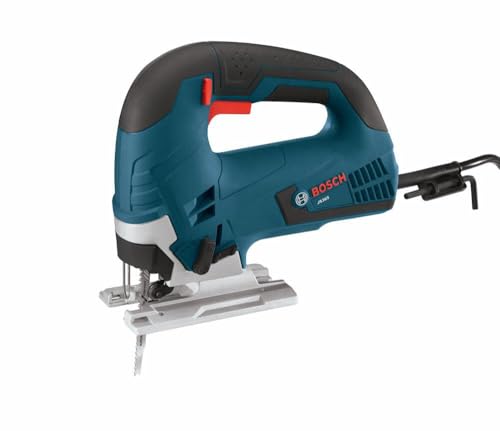


Short answer: Makita for control, Bosch for value
For cleaner bevel cuts, the Makita 4350FCT has the edge if you want its tool-free bevel adjustment and are willing to spend more. The Bosch JS365 is a capable, less expensive choice, but its bevel setup is less convenient and either saw can leave a rough or wandering edge if the blade, work support, or feed rate is wrong.
Neither saw guarantees a square, splinter-free cut by itself. Both are corded jigsaws with orbital settings and variable speed, built for general woodworking rather than precision bevel work on thick stock. If most of your cuts are straight and at 90 degrees, the Bosch may be the better value. If you regularly change bevel angles, the Makita’s adjustment system is the more useful distinction.
As an Amazon Associate we earn from qualifying purchases at no extra cost to you.


At a glance
| Feature | Bosch JS365 | Makita 4350FCT |
|---|---|---|
| Power | 6.5 amps | 6.3 amps |
| Maximum cutting capacity in wood | 3-1/2 inches | 5-5/16 inches |
| Bevel range | Up to 45 degrees, left or right | Up to 45 degrees, left or right |
| Bevel adjustment | Allen-key adjustment | Tool-less lever adjustment |
| Blade change | Tool-less | Tool-less |
| Best fit | Occasional bevels and value-minded buyers | Frequent angle changes and thicker stock |
Specifications can vary by region or package, so check the listing before buying. Cutting capacity is a maximum, not a promise of a clean, square cut through a board that thick.
Bevel control and cut quality
A bevel cut asks more of a jigsaw than a 90-degree cut. The blade is tilted relative to the shoe, so it can deflect sideways as it works through the material. That deflection becomes more noticeable in thick stock, tight curves, or when you push the saw too hard. A clean bevel depends on setting the shoe accurately and keeping it firmly against the work.
The Makita’s tool-less bevel adjustment is its clearest advantage here. You can loosen the lever, set the angle, and retighten it without hunting for an Allen key. That is handy when a project involves several angles or a test cut followed by a small correction. It does not automatically make the cut more accurate: check the shoe against a reliable angle gauge, then cut scrap and verify the result.
The Bosch also bevels both directions to 45 degrees, but adjusting it takes an Allen key. For a single bevel setting, that is a small inconvenience rather than a deal-breaker. Make sure the shoe is locked firmly after adjustment; a shoe that shifts under load can spoil the angle and leave the cut face uneven.
For either saw, use a sharp blade intended for the material and cut direction. A coarse blade is faster but leaves a rougher edge; a fine-tooth blade can improve the finish but may cut slowly and burn if you force it. For a visible bevel in plywood or hardwood, make a test cut in matching offcut material and inspect the edge before committing to the finished piece.
Handling, speed, and capacity
The JS365 draws 6.5 amps and the 4350FCT 6.3 amps, so their nominal motor ratings are close. The Makita has the larger listed wood-cutting capacity, but neither should be treated as a substitute for a circular saw when making long, dead-straight bevels. A jigsaw blade can bend, especially in thick material. Let the saw advance at its own pace and keep the base flat on the work.
Both offer variable speed and orbital action. Orbital action helps move through wood faster, but it generally makes a rougher cut. Turn it down or off for cleaner edges, curves, and more controlled bevels. Slower speed can help with some plastics and metals, though blade choice and the material manufacturer’s guidance matter. Keep the work clamped; a shifting board can pull the saw off line or pinch the blade.
If the bevel is visible and must be consistent along a long edge, a circular saw with a guide or a table saw is usually a better tool. A jigsaw is more appropriate for short bevels, cutouts, and work where the cut line is not perfectly straight.
Which one should you buy?
Choose the Makita 4350FCT if you change bevel angles often, value quick adjustments, or expect to cut thicker material within a jigsaw’s practical limits. Its tool-less shoe adjustment makes setup less fiddly, but you should still verify the angle and expect blade deflection to limit accuracy on thick cuts.
Choose the Bosch JS365 if you bevel only occasionally and want to spend less. Its Allen-key adjustment is perfectly workable for a fixed angle, and the saw has enough power for typical home projects. Put some of the savings toward a good assortment of blades suited to your materials; blade choice often affects the finish more than the small difference in motor rating.
For shoppers comparing options, browse Bosch JS365 listings and Makita 4350FCT listings, and confirm the exact model and included accessories before ordering.
How to get a cleaner bevel with either saw
First, mark the cut and clamp the work securely with the waste side supported. Set the bevel on the saw, lock the shoe, and check the angle with a square or bevel gauge. Make a short test cut in a scrap from the same material. If the angle is off, adjust the shoe rather than trying to steer the saw through the work.
Use a sharp blade with enough length to clear the material throughout the stroke. Start the saw before the blade touches the work, keep the shoe fully planted, and avoid twisting the handle to correct a wandering line. If the blade starts leaning or the motor slows, ease off the feed. For plywood, painter’s tape over the cut line may reduce surface tear-out, but it will not prevent the blade from deflecting underneath.