What's inside
As an Amazon Associate I earn from qualifying purchases. This post may contain affiliate links at no extra cost to you.
Our Top Picks

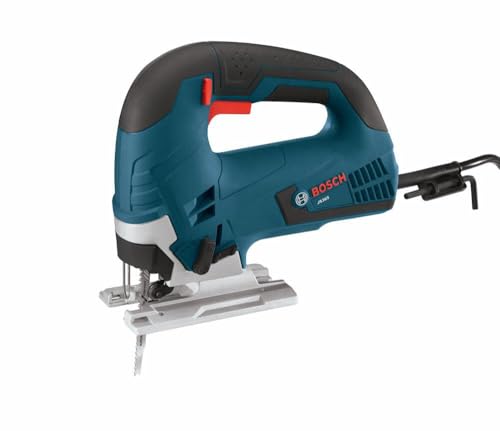


Bosch JS365 vs Makita JV0600K: Comparing Corded Jigsaws for Straight Cuts
The Bosch JS365 and Makita JV0600K are 6.5-amp corded jigsaws aimed at the same jobs: cutting plywood, dimensional lumber, laminate, and light metal without stopping to charge a battery. Both have variable speed, orbital action, tool-free blade changes, and 45-degree bevel capability.
For straight cuts, the differences are less about raw power and more about control. A jigsaw is not a substitute for a circular saw or track saw when you need a long, perfectly straight edge. The blade flexes, the shoe can wander, and aggressive orbital action can pull the tool off a marked line. Still, either saw can make accurate short and medium-length cuts when paired with a sharp blade, a guide, and a steady feed rate.
As an Amazon Associate we earn from qualifying purchases at no extra cost to you.



Key specifications
| Feature | Bosch JS365 | Makita JV0600K |
|---|---|---|
| Motor | 6.5 amps | 6.5 amps |
| Stroke length | 1 inch | 7/8 inch |
| Variable speed | 500–3,100 strokes per minute | 500–3,100 strokes per minute |
| Orbital settings | Four settings, including straight cutting | Three orbital settings plus straight cutting |
| Maximum wood capacity | About 2-1/2 inches at 90 degrees | About 3-9/16 inches at 90 degrees |
| Bevel range | Up to 45 degrees left or right | Up to 45 degrees left or right |
| Weight | About 5.3 pounds | About 5.2 pounds |
Published capacities can vary slightly by blade and material, but the practical point is clear: the Makita has the deeper rated wood cut. The Bosch’s longer one-inch stroke gives it a more substantial cutting feel, while the Makita’s shorter stroke can feel a little smoother in thinner stock.
Which one cuts straighter?
Neither tool automatically produces a straight line. The Bosch JS365 has a sturdy aluminum shoe and a useful blade guide arrangement that helps keep the blade tracking under moderate pressure. It feels planted when cutting 3/4-inch plywood and shelf stock. The Makita JV0600K also tracks well, and its low-vibration operation makes it easy to hold on a line for longer cuts.
In hands-on use, blade choice matters more than the small design differences between these saws. A narrow scroll blade follows curves but deflects easily. For a straight cut, use a wider, finer-toothed blade intended for wood, and clamp a straightedge to the workpiece. Keep the shoe flat, let the blade do the cutting, and do not force the saw when the motor pitch drops.
Set orbital action to zero for the cleanest and most controlled straight cut. Orbital action moves the blade forward on the upstroke, which speeds rough cutting but also increases vibration, splintering, and the tendency to wander. For fast cuts in construction lumber, a medium orbital setting is useful. For finished plywood, laminate, or a cut that will be visible, straight action is usually the better choice.
Where the Bosch JS365 stands out
The Bosch has a slightly longer stroke and a very solid overall feel. That extra stroke helps clear chips quickly in thicker wood, particularly with a coarse blade. Its variable-speed trigger and speed dial provide good control when starting a cut or working near a fragile edge. The four-position orbital selector also gives more fine adjustment than the Makita.
The Bosch is a good fit for a shop or remodeling user who regularly cuts plywood, flooring, countertops, and lumber but wants more control than a basic entry-level jigsaw provides. Its shoe angle adjustment is straightforward, although you should verify the angle with a square after setting it; jigsaw shoes can shift if the locking screw is not tight.
Its main limitation is capacity. A rated 2-1/2-inch wood cut is enough for most sheet goods and typical boards, but it leaves less margin when cutting thick stock. The blade can also deflect near the bottom of a deep cut, especially if you push sideways to correct the line.
Where the Makita JV0600K stands out
The Makita’s strongest practical advantage is its deeper wood-cut rating. That makes it more capable for thick framing lumber, stair treads, and occasional rough cuts through stacked material, provided the blade is long enough and remains rigid. Its compact body and balanced grip are comfortable for extended work, and the low-vibration design helps reduce hand fatigue.
The JV0600K is also a sensible choice when the price is lower than the Bosch. It has enough power for normal DIY work, and its three orbital levels cover the settings most users actually need. The shorter stroke is not a serious disadvantage for plywood, trim, or countertop cutouts.
One failure mode to watch for is using the Makita’s deeper capacity as an excuse to cut thick stock too aggressively. A long blade can twist or bow, leaving the top of the cut straight while the bottom exits several millimeters off line. Make relief cuts in waste material, use a coarse blade for speed, and finish the visible edge with a router, sander, or hand plane when accuracy matters.
Which jigsaw should you buy?
Choose the Bosch JS365 corded jigsaw if you value a planted feel, a longer stroke, and more orbital adjustment. It is the better choice for frequent general remodeling and shop use, especially when you will make many controlled cuts in plywood and solid wood.
Choose the Makita JV0600K corded jigsaw if it costs noticeably less or if deeper wood capacity matters more than the Bosch’s heavier-duty feel. For occasional shelves, sink cutouts, flooring, and basic repairs, the cheaper Makita is entirely adequate. There is no reason to pay extra for the Bosch if your cuts are short and you already use a straightedge.
Whichever saw you buy, budget for a small selection of quality jigsaw blades for straight wood cuts. A dull or inappropriate blade will create more trouble than the difference between these two tools. For long, repeatable straight cuts, add a clamped guide or use a circular saw instead. That is the real upgrade in accuracy.