What's inside
As an Amazon Associate I earn from qualifying purchases. This post may contain affiliate links at no extra cost to you.
Our Top Picks
 SKIL 10" Dual Bevel Sliding Compound Miter Saw-MS6305-0010''35.43 x 22.44 x 14.17 inches39.4 poundsCheck on Amazon


Quick answer: which saw makes cleaner trim cuts?
For clean trim, the Bosch GCM12SD and DeWalt DWS780 can both produce excellent cuts. The bigger difference is setup and dust control than cutting quality: Bosch uses a compact axial-glide mechanism that saves space behind the saw, while DeWalt uses conventional sliding rails and projects a cut-line shadow with its XPS light. Either saw can leave tear-out or a ragged edge if the blade is dull, the workpiece shifts, or the cut is rushed.
Choose the Bosch if you need a slider close to a wall or value its smooth, compact glide. Choose the DeWalt if you want a clear shadow line without aligning a laser. If your work is occasional baseboard and casing, the cheaper saw is often enough; spend the difference on a sharp fine-tooth blade and dust extraction.
As an Amazon Associate we earn from qualifying purchases at no extra cost to you.


Bosch GCM12SD vs DeWalt DWS780 at a glance
| Feature | Bosch GCM12SD | DeWalt DWS780 |
|---|---|---|
| Blade | 12-inch | 12-inch |
| Slide system | Axial-glide arms; no long rails extending behind the saw | Traditional sliding rails |
| Cut-line aid | Laser guide | XPS LED shadow line |
| Best fit | Tight shop space and smooth sliding action | Fast visual alignment and broad jobsite familiarity |
| Main practical concern | Laser alignment and dust collection still need attention | Rails need room behind the saw; dust collection is imperfect |
Both are corded 12-inch compound sliding miter saws with capacity for common trim and framing cuts. Exact capacity depends on the angle and workpiece orientation, so check the manufacturer’s capacity chart before buying for a particular molding profile. Neither saw replaces a stable stand or support when cutting long stock.
What actually makes a trim cut clean?
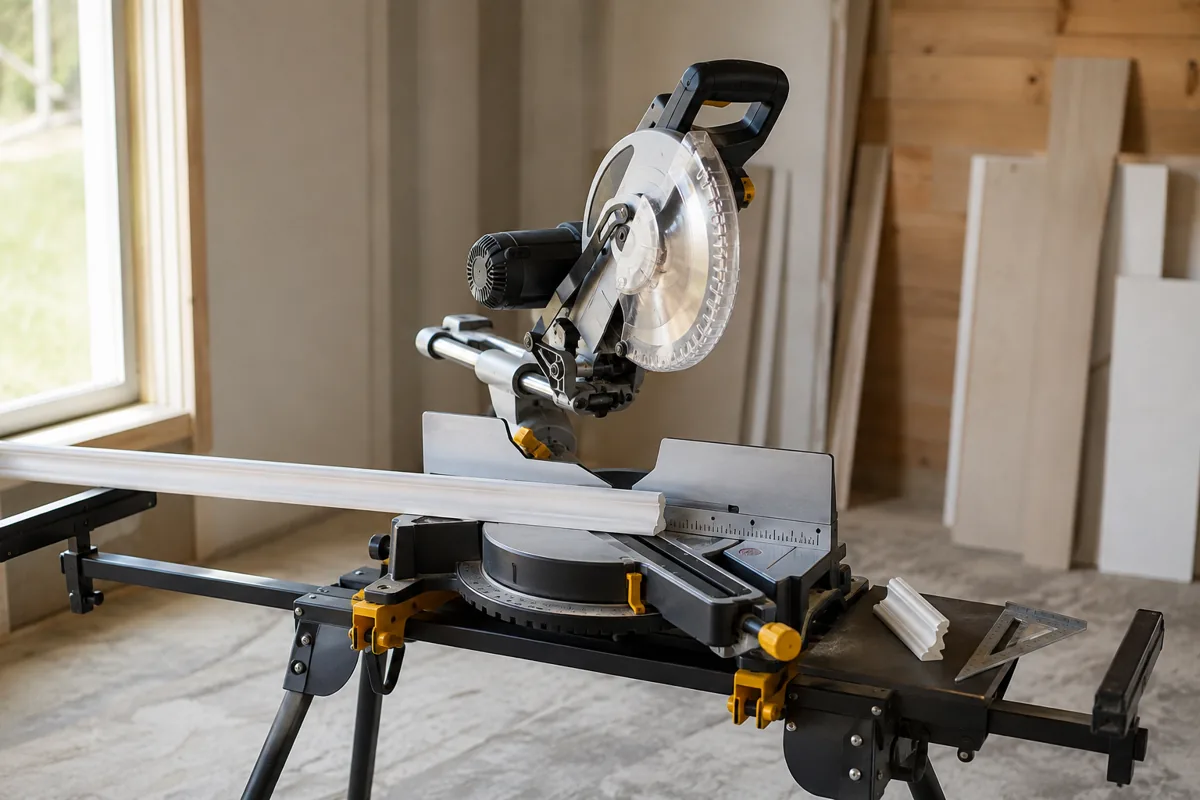
A sharp blade with a high tooth count is the first upgrade to consider. The general-purpose blade supplied with a saw is useful for mixed work, but a fine-tooth crosscut blade is better suited to painted casing, hardwood trim, and small molding. More teeth usually give a smoother edge, though they also cut more slowly and can burn material if you feed too slowly or the blade is dirty. Check the blade’s stated compatibility and arbor size before ordering.
Support the work so it stays flat against the fence and table. Even a small gap behind a baseboard can let it rock, shifting the cut and leaving a poor joint. Clamp narrow pieces where practical, keep hands clear of the blade path, and wait for the blade to stop before lifting it from the cut. A slow, steady pull through the work helps; forcing the saw can worsen tear-out and make the cut less predictable.
For clean edges on delicate trim, use a backer board or sacrificial fence when appropriate. Cutting with the finished face oriented to reduce visible tear-out can also help, but the best orientation varies with the profile and whether the blade is cutting on the upstroke. Make a test cut on offcut material before committing an expensive length.
Where the Bosch GCM12SD earns its place
The Bosch’s axial-glide arms let the saw move without long rails projecting behind it. That is useful in a small shop, against a wall, or on a crowded workbench. Its motion feels different from a conventional slider, but a properly adjusted saw should travel smoothly and stay square. The mechanism does not make the saw portable: at roughly 65 pounds, it is still a substantial tool to lift and move.
Bosch’s laser gives a visible reference, but a laser is only helpful if it is aligned with the blade and easy to see in the room’s lighting. Check it against a test cut instead of assuming the beam marks the exact kerf. The blade removes material; the beam may indicate one edge of that cut, so place it consistently on the waste side.
Like most miter saws, the Bosch can throw dust forward and around the work area even when connected to a vacuum. A shop vacuum and a well-fitting port can reduce cleanup, but do not expect a near-dust-free cut. For indoor trim work, pair extraction with suitable respiratory protection and keep the work area clean.
Where the DeWalt DWS780 stands out
The DWS780’s XPS light casts the blade’s shadow onto the workpiece. The shadow shows the kerf more directly than a laser line and remains useful without separate beam alignment. It can be easier to read when making repeated cuts, though bright ambient light and dust can still reduce visibility. Check the shadow on scrap before relying on it for a final cut.
Its conventional rails are familiar and provide substantial crosscut capacity, but they need clearance behind the saw as the head moves. That can make the DeWalt awkward on a shallow bench pushed against a wall. The rails and sliding assembly also add surfaces that collect dust; keep the mechanism clean and follow the manual’s maintenance guidance rather than lubricating it with products the manufacturer does not recommend.
Dust collection is a weak point on both saws. A miter saw dust hood can catch debris that escapes the rear port, but it takes space and works best when the hood is close to the cut.
Which one should you buy?
Buy the Bosch if the saw must sit near a wall, the axial-glide layout fits your shop, or you prefer its operating feel. Buy the DeWalt if you want the XPS shadow line and have room for its rails. At similar prices, the cut quality alone is not a strong reason to favor one over the other; condition, warranty, stand compatibility, and local service matter more.
If the saw will cut a few rooms of pine or MDF casing each year, a less expensive 10-inch slider can be perfectly adequate. A 10-inch sliding miter saw may also be lighter and easier to store. Confirm its crosscut capacity against the widest stock you plan to use; buying a 12-inch saw is not useful if you rarely need the extra capacity.
Whichever saw you choose, budget for a suitable fine-tooth blade if clean trim is the priority. A 12-inch fine-tooth crosscut blade can do more for the finished edge than switching between these two saws. Verify the blade’s diameter, arbor, and speed rating before installation, and unplug the saw before changing it.
Before cutting installed trim, check the saw’s miter and bevel settings with a square and make test cuts. A small angle error can open a visible gap across a long casing joint. If the test cut is not square, adjust the saw using its manual, then recheck. For accurate, repeatable trim work, setup and stock support—not the logo on the saw—are what keep joints tight.