What's inside
As an Amazon Associate I earn from qualifying purchases. This post may contain affiliate links at no extra cost to you.
Our Top Picks
 BOSCH T101AO 5-Piece 3-1/4 In. 20 TPI Clean3-1/4'' 20 TPI - 5 pcs0 x 0 x 0 Inches0.02 poundsCheck on Amazon


Best all-around: a narrow, fine-tooth scrolling blade
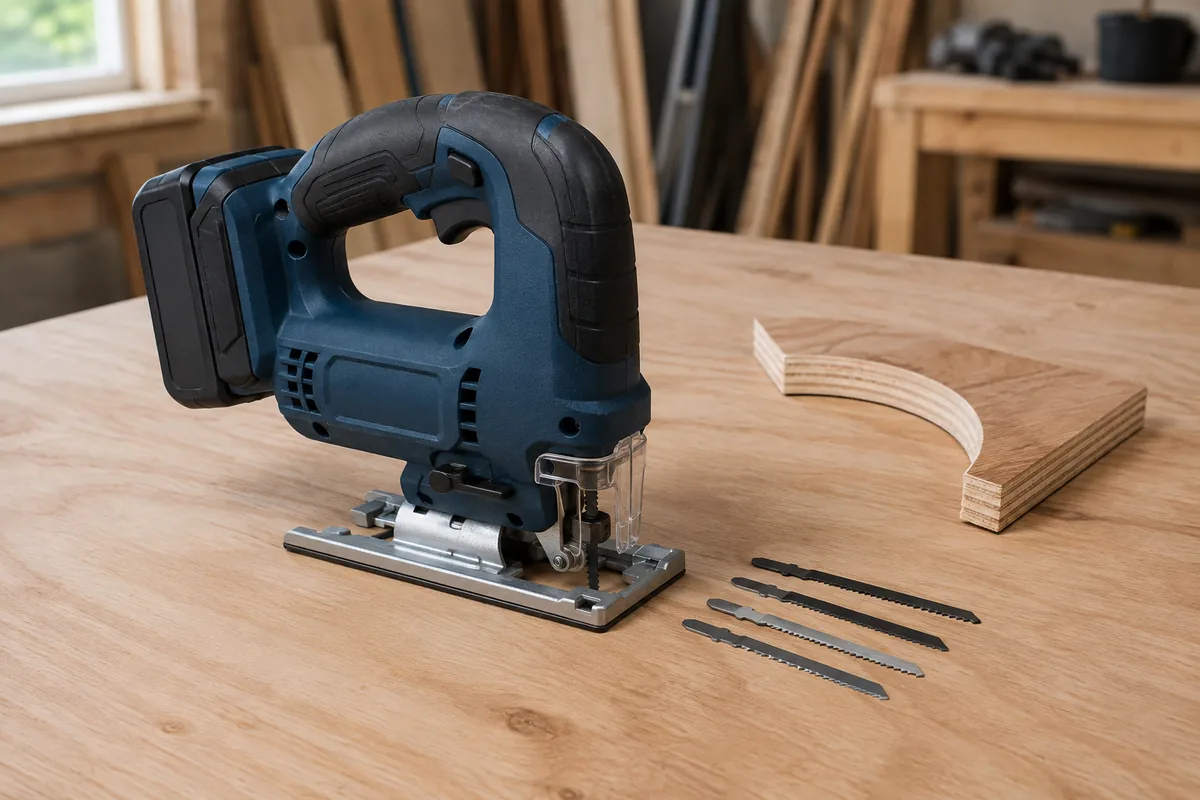
For tight curves in ¾-inch plywood, start with a narrow jigsaw blade made for scrolling or tight-radius cuts, with fine teeth and a blade length that suits your saw. A blade around 3/16 inch wide is a useful starting point; narrower blades turn more sharply, but they also flex more easily and are easier to steer off the line. Look for a clean-wood or plywood blade with roughly 10–12 teeth per inch (TPI), rather than a coarse blade intended for fast, rough cuts.
A good general category to compare is narrow scrolling jigsaw blades, 10–12 TPI. Check that the shank matches your saw: most blades use either a T-shank or a U-shank, and they are not interchangeable unless the tool accepts both. Also confirm the blade’s usable cutting depth covers ¾-inch stock.
As an Amazon Associate we earn from qualifying purchases at no extra cost to you.


“Scrolling” does not mean the blade will pivot in place like a drill bit. The blade still needs room to travel through the wood, and forcing a tight turn will bend it, widen the kerf, or break it. Let the saw advance slowly and follow the curve with the whole tool.
Blade types compared
| Blade type | Curve control | Edge quality in plywood | Best use |
|---|---|---|---|
| Narrow scrolling, 10–12 TPI | Best of these options for tight curves | Relatively clean, with some tear-out possible | Small-radius shapes and visible edges |
| Standard wood-cutting, 6–8 TPI | Fair on broad curves; awkward on small ones | Faster, usually rougher | Large curves and cuts that will be sanded |
| Down-cut, fine-tooth | Depends on width; often less nimble than a scrolling blade | Can reduce tear-out on the top face | Finished top surfaces, when the blade width suits the curve |
| Metal-cutting blade | Usually poor for this job | Slow and prone to heat buildup | Not a sensible plywood choice |
To compare options, look at blade width before tooth count. A fine-tooth blade can leave a cleaner edge, but if it is too wide for the curve, it will bind or cut a larger-radius path than you intended. A cheaper multipack is fine if its narrowest blade has the right shank, enough length, and a suitable tooth count. You do not need a premium set for a one-off project.
What to buy for your cut
For curves with a radius of about 1 inch or more, a narrow scrolling blade should be manageable with steady feed. If the design has corners or very tight transitions, drill a relief hole at each inside corner or cut in from the edge where possible. A jigsaw blade cannot make a sharp internal corner without overcutting, and trying to twist it until it does can buckle the blade.
If the curve is broad and the edge will be painted, a standard wood blade is often cheaper and faster. It may wander less than an extremely narrow blade because it is stiffer, though it will not turn as tightly. Compare a fine-tooth clean-wood jigsaw blade with a scrolling blade if you need one blade for both gentle curves and straight cuts. The broader blade is the more practical choice when the radius is generous.
For a face that must remain clean, a down-cut blade may help keep chips from lifting off the top. Its teeth cut on the downstroke, however, so the workpiece can be pushed upward. Clamp the plywood firmly and keep the saw’s base plate flat. A down-cut blade is not automatically the best curve blade; choose one narrow enough for the radius, or use a scrolling blade and put the show face down if that suits your setup.
How to cut without breaking the blade
Support the plywood close to the cut and clamp it so it cannot vibrate. Mark the line clearly, then make a short test cut in scrap from the same ¾-inch plywood. Set the saw to zero orbital action or its lowest setting. Orbital action speeds straight cuts, but it pushes the blade forward on each stroke and makes a curved cut harder to control.
Run the saw at a moderate speed and use light forward pressure. The blade should cut at its own pace; if you have to lean hard on the saw, it is probably dull, the feed is too fast, or the curve is too tight for that blade. Keep the base plate flat and rotate the saw gradually through the curve. Do not steer by twisting the handle while the blade is trapped in the kerf.
Common warning signs are a curve that keeps drifting outward, burn marks, a blade that gets hot, or a kerf that is much wider than expected. Stop rather than forcing the turn. Back out carefully, make relief cuts into the waste area, or switch to a narrower blade. If the plywood’s veneer chips at the edge, try painter’s tape over the line, a fresh blade, or a cut from the opposite face. Test first: reversing the workpiece can change which side receives the cleaner cut.
The practical pick
For most tight curves in ¾-inch plywood, buy a compatible narrow scrolling blade in the 10–12 TPI range and test it on scrap. Choose the narrowest blade that remains stable in your hands and fits the curve; ultra-narrow blades are not automatically better if you cannot keep them on line. A standard fine-tooth wood blade is the budget-friendly choice for broad curves, while a down-cut blade is worth considering when top-face tear-out matters more than easy handling.
For replacements, compare 3/16-inch wood-cutting jigsaw blades by shank style, cutting length, and tooth spacing—not by package count alone. A fresh, correctly fitted blade and patient feed usually matter more than paying extra for a large assortment.