What's inside
As an Amazon Associate I earn from qualifying purchases. This post may contain affiliate links at no extra cost to you.
A wire welder for aluminum needs two things a steel-only MIG doesn’t: a soft-wire feeding system that won’t birdsnest the soft aluminum wire, and a machine with enough output and duty cycle to handle aluminum’s high thermal conductivity. For most buyers, that means either a MIG welder with a spool gun (the flexible, lower-cost option) or a push-pull gun setup for production work. Below we compare the best options in 2026 by drive system, input power, thickness capacity, and what each setup actually requires.
As an Amazon Associate we earn from qualifying purchases at no extra cost to you.


Our Top Picks



Why Aluminum Is Hard on a Wire Welder
Aluminum MIG wire is soft — roughly like pushing cooked spaghetti through a garden hose. In a standard MIG torch lead (10–12 ft), the wire buckles inside the liner and tangles at the drive rolls (“birdsnesting”). Steel liners also gall against aluminum wire and contaminate the weld.
The second problem is thermal. Aluminum conducts heat away about four times faster than mild steel, so you need higher amperage and wire speed than thickness alone suggests. And aluminum MIG requires 100% argon shielding gas — CO2 or C25 mixes used for steel won’t work.
Practical ways to feed aluminum wire:
- Spool gun: A small wire spool (typically 1 lb / 4-inch) sits in the torch handle, so wire only travels ~8 inches. The common solution for home and light fabrication.
- Push-pull gun: A motor in the gun pulls while the cabinet feed rolls push. Handles longer leads and larger spools; standard for production shops.
- Short push setup: Standard gun with a nylon/Teflon liner, U-groove drive rolls, and a short lead. Works for occasional thin aluminum but is the most finicky route.
The Picks at a Glance
| Welder | Input Power | Output Range | Aluminum Capacity | Aluminum Feed Method | Machine Weight | Best For |
|---|---|---|---|---|---|---|
| Miller Multimatic 220 AC/DC | 120V / 240V | 30–230A (MIG) | Up to 3/8″ (240V) | Optional spool gun | 56 lb | All-around home/pro shop |
| Lincoln Power MIG 211i | 120V / 240V | 20–175A | Up to 3/16″ | Optional spool gun | 41 lb | First aluminum welder, light fab |
| Hobart Handler 210 MVP | 120V / 240V | 25–140A (120V), 25–210A (240V) | Up to 1/4″ | Optional spool gun | 79 lb | Budget-conscious dual-voltage buyers |
| ESAB Rebel EMP 205ic | 120V / 240V | 5–200A | Up to 1/4″–3/8″ | Push-pull / spool gun options | 49 lb | Mixed-material shop, frequent aluminum |
| Miller Millermatic 252 | 208/240V only | 30–300A | Up to 1/2″ | Spool gun or push-pull | 207 lb | Heavy fabrication, trailer and boat work |
Miller Multimatic 220 AC/DC — Best Overall
The Multimatic 220 does MIG, TIG (AC for aluminum TIG if you want it), and stick off either voltage. Its Auto-Set mode asks for material type, thickness, and wire diameter, then dials in voltage and wire speed — genuinely useful for aluminum, where settings are less forgiving. Paired with the Spoolmate spool gun, it handles 4043 and 5356 wire cleanly to about 3/8″ on 240V. The tradeoff is price: this sits at the top of the prosumer range, and the spool gun is a separate purchase.
Lincoln Power MIG 211i — Best for Beginners
Inverter-based and light at 41 lb, the 211i is easy to carry to a job or around a garage. It accepts Lincoln’s Magnum PRO 100SG spool gun and handles aluminum to roughly 3/16″ on 240V — enough for automotive repair, railings, and most hobby fabrication. Duty cycle (around 20% at 130A on 240V) is honest for the class but will pause long weld beads on thicker stock.
Hobart Handler 210 MVP — Best Value Dual-Voltage
Transformer-based, heavier, and simpler than inverter rivals, but the Handler 210 MVP runs the Hobart SpoolRunner 100 spool gun and delivers 210A — more aluminum capacity per dollar than the 211i. It lacks auto-set refinement, so you’ll learn to set voltage and wire speed from the door chart. For buyers who want real 1/4″ aluminum capability without inverter pricing, it’s the pragmatic pick.
ESAB Rebel EMP 205ic — Best for Frequent Aluminum Work
The Rebel’s sMIG (“smart MIG”) adaptive mode constantly fine-tunes arc characteristics, which noticeably reduces burn-through on thin aluminum sheet. It supports both spool-gun and push-pull configurations, so it can grow into semi-production use. Multi-process (MIG/TIG/stick) and ~49 lb make it a strong one-machine shop solution.
Miller Millermatic 252 — Best for Thick Aluminum
If your work is boat hulls, trailers, or structural aluminum over 3/8″, a 300A-class machine is the honest answer. The 252 runs both the Spoolmatic spool gun and push-pull guns, and its duty cycle (60% at 200A) means no waiting between beads on heavy plate. It needs a dedicated 240V circuit and floor space — this is a shop machine, not a portable.
Decision Matrix: Which Setup Fits You
| Your Situation | Recommended Path |
|---|---|
| Occasional aluminum (a few times a month), mostly under 1/8″ | Dual-voltage 140–200A MIG + spool gun (211i or Handler 210) |
| Only 120V available, thin aluminum sheet | Any dual-voltage unit on 120V + spool gun; expect ~1/8″ max realistic capacity |
| Mixed steel/aluminum work weekly, some TIG interest | Multiprocess machine (Multimatic 220, Rebel 205ic) |
| Boat/trailer fabrication, 1/4″ and up, production pace | 250–300A machine (Millermatic 252) + push-pull gun |
| Under ~$1,000 total budget | 140A-class MIG + short-lead conversion (nylon liner, U-groove rolls) — workable but finicky |
How to Weld Aluminum with a Wire Welder: Setup Steps
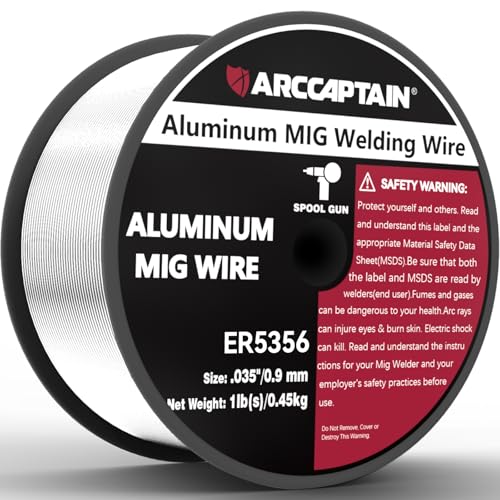
- Wire: Load 4043 (easier to feed, better cosmetics) or 5356 (stronger welds, slightly stiffer, feeds better through long leads). Use 0.030″ or 0.035″ diameter — 0.023″ aluminum wire jams constantly.
- Drive rolls: Swap to U-groove or knurled-V rolls sized for aluminum. Steel V-groove rolls crush soft wire and shed metal shavings into the liner.
- Liner: If pushing wire through a standard gun, install a nylon or Teflon liner and keep the lead as straight and short as possible.
- Gas: 100% argon at 20–30 CFH. No CO2 blends.
- Contact tips: Use aluminum-rated tips (often one size larger ID) — aluminum expands when hot and seizes in steel-sized bores.
- Drive tension: Set lighter than steel — just enough to feed without deforming the wire.
- Technique: Push (forehand) travel only, 10–15° push angle. Pulling traps oxide in the weld and gives black soot. Keep stickout ~3/4″.
- Prep: Wire-brush with a dedicated stainless brush and degrease. Aluminum oxide melts at ~3,700°F while the base metal melts at ~1,200°F — skip this and the weld won’t wet in.
Ownership Realities and Common Mistakes
What wears first on an aluminum wire setup, in rough order: contact tips (aluminum seizes and burns them back — buy in bulk), the spool gun’s inlet guide and liner, then drive rolls. A spool gun holds only ~1 lb of wire, so a weekend trailer project can burn through several spools at 2–3x the per-pound cost of larger steel spools — factor that into cost per project, not just machine price.
Common mistakes to avoid:
- Running C25 gas out of habit — aluminum needs pure argon.
- Buying a cheap “aluminum-capable” flux-core machine. There is no practical flux-core aluminum wire for MIG; aluminum self-shielded wire exists but performs poorly. You need gas.
- Undersizing the machine for aluminum. A welder rated for 1/4″ steel typically tops out near 3/16″ aluminum — plan a size up.
- Pulling the gun instead of pushing, then blaming the wire for black, porous welds.
- Buying a spool gun that doesn’t match the machine’s control connector. Spool guns are generally brand-specific; verify compatibility before purchase.
FAQ
Can a regular wire welder weld aluminum without a spool gun?
Yes, on paper — with U-groove rolls, a nylon liner, a short straight lead, and 0.035″ 5356 wire. In practice it jams often enough that anyone doing aluminum more than occasionally should budget for the spool gun.
Is a spool gun or TIG better for aluminum?
MIG with a spool gun is faster and easier to learn, ideal for 1/8″ and up. TIG gives cleaner welds on thin sheet and visible joints but is much slower and has a steep learning curve. Many shops run both.
How much does a complete aluminum wire welding setup cost?
Expect roughly $700–$1,200 for a dual-voltage MIG plus $250–$500 for a spool gun, plus an argon cylinder, gas regulator, aluminum-rated consumables, and wire. Multiprocess and 300A machines run higher — commonly $2,000–$4,000+ before the gun.
What’s the thinnest aluminum I can MIG weld?
With a good machine and short-arc settings, about 14–16 gauge (0.063″) is the realistic floor. Below that, burn-through is hard to control and TIG is the better tool.