What's inside
- Top 3 Picks
- Top 3 Picks
- Quick Comparison
- How We Chose
- 1. Houcho.com Suisin Inox Western-Style 240mm – Best Overall
- 2. HOSHANHO 10-Inch Sushi Knife – Best Budget
- 3. kanngou 27cm AUS-8 Sujihiki – Best Budget for Maximum Reach
- 4. MASAMOTO AT Sujihiki 240mm – Best for Brisket and Cooked Meat
- 5. Yoshihiro VG10 46-Layer Hammered Damascus 240mm – Best Premium
- 6. Yoshihiro VG10 16-Layer Hammered Damascus 240mm – Best Damascus Value
- 7. Tojiro DP Sujihiki 270mm – Best Long Mid-Range Slicer
- 8. KYOKU Samurai Series 10.5-Inch Yanagiba – Best Budget Single-Bevel
- 9. MASAMOTO VG Sujihiki 270mm – Best Premium for Volume Brisket
- 10. Yoshihiro Kurouchi Blue Steel Sujihiki Kiritsuke 240mm – Best Carbon Edge with Stainless Protection
- 11. Kimura 8-Inch Chef Knife – Best Compact All-Rounder
- 12. Yoshihiro SLD Kurouchi Sujihiki Kiritsuke 270mm – Best Long Kiritsuke Slicer
- How to Choose
- Frequently Asked Questions
- Closing Recommendation by Situation
- Top 3 Picks
- Top 3 Picks
- Quick Comparison
- How We Chose
- 1. Houcho.com Suisin Inox Western-Style 240mm – Best Overall
- 2. HOSHANHO 10-Inch Sushi Knife – Best Budget
- 3. kanngou 27cm AUS-8 Sujihiki – Best Budget for Maximum Reach
- 4. MASAMOTO AT Sujihiki 240mm – Best for Brisket and Cooked Meat
- 5. Yoshihiro VG10 46-Layer Hammered Damascus 240mm – Best Premium
- 6. Yoshihiro VG10 16-Layer Hammered Damascus 240mm – Best Damascus Value
- 7. Tojiro DP Sujihiki 270mm – Best Long Mid-Range Slicer
- 8. KYOKU Samurai Series 10.5-Inch Yanagiba – Best Budget Single-Bevel
- 9. MASAMOTO VG Sujihiki 270mm – Best Premium for Volume Brisket
- 10. Yoshihiro Kurouchi Blue Steel Sujihiki Kiritsuke 240mm – Best Carbon Edge with Stainless Protection
- 11. Kimura 8-Inch Chef Knife – Best Compact All-Rounder
- 12. Yoshihiro SLD Kurouchi Sujihiki Kiritsuke 270mm – Best Long Kiritsuke Slicer
- How to Choose
- Frequently Asked Questions
- Closing Recommendation by Situation
As an Amazon Associate I earn from qualifying purchases. This post may contain affiliate links at no extra cost to you.
Our Top Picks
 Yoshihiro VG10 46 Layers Hammered Damascus Sujihiki Japanese9.5"19 x 3.5 x 3.1 inches0.95 poundsCheck on Amazon
 Yoshihiro VG10 16 Layer Hammered Damascus Stainless Steel9.5"14.4 x 0.06 x 1.5 inches0.41 poundsCheck on Amazon



Top 3 Picks
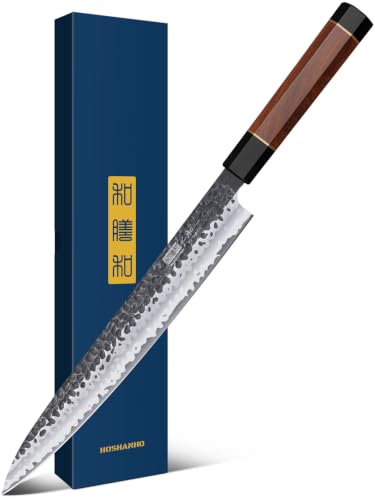
The best overall sujihiki for most home cooks who slice regularly is the Houcho.com Suisin Inox 240mm — a genuine Sakai-made blade in a Western handle that balances easy maintenance with a thin, precise geometry and a price that sits in the middle of the market. If you want to spend as little as possible while still getting a functional slicer, the HOSHANHO 10-inch delivers the shape and reach of a sujihiki at a budget tier. If slicing is the centerpiece of your cooking and you want the longest edge life and the nicest fit and finish, the Yoshihiro VG10 46-Layer Hammered Damascus 240mm is the premium pick.
Top 3 Picks
Best overall: Houcho.com Suisin Inox Western-Style 240mm. A Sakai-manufactured blade with a thin, hard Inox stainless core, a comfortable Western handle, and enough length to slice a whole brisket or a large fish fillet in single strokes. It suits cooks who want Japanese geometry without the fragility of a carbon blade.
Best budget: HOSHANHO 10-Inch Sushi Knife. A long, thin blade with a rosewood handle at a budget price. It covers the basic slicer job — portioning raw fish, cutting roasts, trimming — without asking you to treat it like a museum piece.
Best premium: Yoshihiro VG10 46-Layer Hammered Damascus 240mm. VG10 core steel clad in 46 layers of hammered Damascus, a rosewood handle, and a saya. The extra layers and the hammered finish reduce sticking, and the steel holds an edge noticeably longer than entry-level stainless.
Quick Comparison
| Product | Best for | Key specs | Price tier |
|---|---|---|---|
| Houcho.com Suisin Inox Western-Style 240mm | Best overall for most cooks | 240mm blade, Inox stainless, Western handle, Sakai-made | Mid-range |
| HOSHANHO 10-Inch Sushi Knife | Budget slicing and fish work | 10-inch (~254mm) blade, rosewood handle, stainless | Budget |
| kanngou 27cm AUS-8 Sujihiki | Longest reach at low cost | 270mm blade, AUS-8 steel, Japanese-style handle | Budget |
| MASAMOTO AT Sujihiki 240mm | Brisket and cooked-meat slicing | 240mm blade, Japanese-made, AT stainless | Mid-range |
| Yoshihiro VG10 46-Layer Hammered Damascus 240mm | Premium edge retention and finish | 240mm blade, VG10 core, 46 layers, rosewood handle, saya | Premium |
| Yoshihiro VG10 16-Layer Hammered Damascus 240mm | Damascus looks at a mid price | 240mm blade, VG10 core, 16 layers, stainless cladding | Mid-range |
| Tojiro DP Sujihiki 270mm | Long professional-style slicer | 270mm blade, VG10 core, DP cladding, Western handle | Mid-range |
| KYOKU Samurai Series 10.5-Inch Yanagiba | Budget single-bevel sashimi | 10.5-inch (~267mm) blade, wenge wood handle, Japanese steel | Budget |
| MASAMOTO VG Sujihiki 270mm | Professional-volume brisket work | 270mm blade, VG stainless, Japanese-made | Premium |
| Yoshihiro Kurouchi Blue Steel Sujihiki Kiritsuke 240mm | Carbon-steel edge with a kiritsuke profile | 240mm blade, Blue steel core, stainless clad, ebony handle | Premium |
| Kimura 8-Inch Chef Knife | Compact all-rounder for small kitchens | 8-inch (~203mm) blade, high-carbon molybdenum stainless, Japan-made | Budget |
| Yoshihiro SLD Kurouchi Sujihiki Kiritsuke 270mm | Long kiritsuke slicer for heavy use | 270mm blade, SLD steel, kurouchi finish, ebony handle, saya | Premium |
How We Chose
This roundup is built from published specifications, manufacturer descriptions, and well-documented characteristics of the steels and blade profiles involved — not from physical testing. The selection criteria were: blade length relative to common cutting tasks (240mm for home slicing, 270mm for large cuts and volume work); steel class and its practical consequences for edge retention and corrosion resistance; handle style and how it interacts with maintenance habits; and the upgrade path each knife represents.
We also factored in the reality of ownership. A sujihiki is a specialty tool, so the useful question is not “which is best” but “which matches how often you slice and how willing you are to care for the blade.” A hard carbon-steel knife rewards attention; a stainless Western-handle knife forgives neglect. Both belong on this list because both suit different buyers.
Finally, we mapped the list to price tiers rather than specific prices, because knife pricing moves constantly with stock, exchange rates, and retailer promotions. A budget knife can be a better purchase than a premium one if your slicing volume is low — and the reverse is true if you break down whole fish or brisket every week.
1. Houcho.com Suisin Inox Western-Style 240mm – Best Overall
As an Amazon Associate we earn from qualifying purchases at no extra cost to you.
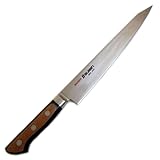
The Suisin Inox is the knife that makes the fewest demands on its owner while still behaving like a proper Japanese slicer. It is genuinely manufactured in Sakai, the Osaka-area knife-making center with centuries of forged-blade history, and it uses Inox stainless steel — a family of alloys chosen for corrosion resistance first and toughness second. That combination makes it the natural pick for someone who wants a Japanese slicer but does not want to think about rust every time they set the knife down wet.
At 240mm the blade is the sweet spot for home use. It is long enough to draw through a whole pork loin or a side of salmon in one motion, but short enough to maneuver on a normal-sized cutting board in a normal-sized kitchen. The Western-style handle — a full-tang design with riveted scales — feels familiar to anyone coming from European knives and gives a secure grip even with wet or greasy hands, which matters more than most buyers expect when slicing cooked meat.
Key specs
- Blade length: 240mm (9.4 inches)
- Steel: Inox stainless (corrosion-resistant, mid-to-high hardness class)
- Handle: Western-style, full tang with riveted scales
- Manufacture: genuine Sakai, Japan
- Profile: sujihiki — long, narrow, double-bevel slicer
Strengths
The Inox steel is the headline feature for practical cooks. It takes a fine edge, holds it reasonably well for a stainless alloy, and does not require the immediate wipe-down ritual that carbon steel demands. The thin blade geometry behind the edge means less wedging when you push through a dense roast, and the narrow profile produces clean, drag-free slices rather than the torn edges you get from a thick chef’s knife.
The Western handle also deserves credit for durability. Wooden Japanese handles are beautiful but can shrink, crack, or loosen if they are repeatedly soaked; a riveted Western handle is essentially maintenance-free. For a knife that will be used on cooked meat as often as raw fish, that robustness is a real advantage.
Pros
- Genuine Sakai manufacture with a well-established reputation
- Corrosion-resistant Inox steel — forgiving of normal kitchen use
- 240mm length handles most home slicing tasks in one stroke
- Western handle is comfortable and low-maintenance
- Double-bevel edge is easier to sharpen than single-bevel designs
- Mid-range price tier for a Japanese-made blade
Cons
- Less edge retention than premium VG10 or carbon-steel blades
- Western handle is heavier and less traditional than a wa handle
- Not the ideal choice for traditional single-bevel sashimi presentation
- Inox is a broad steel description rather than a single published alloy
How it compares
Against the Yoshihiro VG10 16-Layer, the Suisin gives up some edge retention and the visual appeal of Damascus cladding, but it wins on price, on ease of sharpening for a beginner, and on handle durability. Against the MASAMOTO AT 240mm, both are mid-range Japanese-made 240mm slicers; the Suisin leans toward corrosion resistance and Western ergonomics, while the Masamoto leans toward a more traditional Japanese-knife feel. If you are buying your first sujihiki and you want it to stay sharp with modest effort and never rust, the Suisin is the safer choice.
2. HOSHANHO 10-Inch Sushi Knife – Best Budget
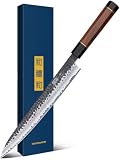
The HOSHANHO is the entry point to the sujihiki shape. At 10 inches it gives you roughly 254mm of blade — longer than most 240mm Japanese slicers — and it pairs that length with a rosewood handle that adds a bit of warmth and grip. It is aimed squarely at cooks who want to try long-blade slicing without committing a large budget to the experiment.
Because it sits in the budget tier, the sensible way to think about it is as a task-specific tool rather than a lifetime investment. It will handle fish portioning, roast carving, and general trimming competently. What it will not do is hold a razor edge through months of heavy professional use, and its fit and finish will not match a hand-forged Japanese blade.
Key specs
- Blade length: 10 inches (approximately 254mm)
- Steel: stainless (budget-tier alloy class)
- Handle: rosewood
- Profile: sujihiki / sashimi slicer, double-bevel
- Price tier: budget
Strengths
The extra length is the most useful feature. A 10-inch blade gives you a longer draw stroke, which means fewer sawing motions and cleaner cuts on large items. The rosewood handle is a pleasant upgrade over plain plastic at this price, and its density gives it a slightly more premium feel in the hand than the cost would suggest.
Stainless construction keeps maintenance simple: no patina, no rust anxiety, no oiling. For a first slicer, that removes the single biggest reason beginners damage their knives.
Pros
- Long 10-inch blade at a budget price
- Rosewood handle looks and feels better than typical budget grips
- Stainless steel is low-maintenance
- Good way to test whether you actually use a long slicer before spending more
- Light enough for extended slicing sessions
Cons
- Budget steel class means shorter edge life between sharpenings
- Fit and finish will not match mid-range or premium Japanese knives
- Thicker geometry behind the edge can wedge in dense foods
- Less rigidity in the blade than higher-tier slicers
How it compares
Next to the kanngou 27cm AUS-8, the HOSHANHO is slightly shorter but uses a rosewood handle and a more conventional slicer silhouette. The kanngou offers more reach and a named steel (AUS-8, a well-regarded mid-tier stainless known for a good balance of toughness and edge retention), which gives it an edge on paper for buyers who know steel names. Against the Kimura 8-Inch, the HOSHANHO is the dedicated slicer while the Kimura is a compact all-purpose chef knife — different tools for different jobs. If your priority is the lowest possible cost for a true long slicer, the HOSHANHO and kanngou compete directly; if you want a named, respected steel at budget price, lean kanngou.
3. kanngou 27cm AUS-8 Sujihiki – Best Budget for Maximum Reach

The kanngou is the budget option for cooks who need real length. A 27cm (270mm) blade puts it in the same size class as professional slicers, which makes it suited to long cuts of brisket, whole fish, and large roasts where a 240mm blade would require two strokes. It uses AUS-8 steel, a Japanese stainless alloy that has earned a solid reputation as a mid-tier steel with better edge retention than generic budget stainless.
The trade-off for the extra length at this price is refinement. A 270mm budget blade will have more flex than a forged premium slicer, and the handle and finish will be functional rather than beautiful. But for the specific job of slicing large items in single strokes, length is the spec that matters most — and this knife delivers it cheaply.
Key specs
- Blade length: 270mm (27cm)
- Steel: AUS-8 stainless
- Profile: sujihiki, double-bevel
- Handle: Japanese-style
- Price tier: budget
Strengths
AUS-8 is the reason to consider this knife over a no-name budget slicer. It is a reasonably tough stainless steel that takes a keen edge and resists chipping better than very hard, brittle alloys — a good match for a long, thin blade that will see some lateral stress when cutting around bones. The 270mm length also means you can slice a whole brisket across the grain in one clean pass, which is the entire point of owning a sujihiki.
Pros
- 270mm blade at a budget price — the longest reach per dollar on this list
- AUS-8 steel is a known, respected mid-tier alloy
- Stainless and low-maintenance
- Toughness-oriented steel resists chipping on a thin, long blade
- Single-stroke slicing on large cuts
Cons
- More blade flex than a forged premium slicer
- Fit and finish are basic
- Edge retention below VG10 or carbon-steel blades
- 270mm can feel unwieldy in a small kitchen or on a small board
How it compares
Against the Tojiro DP Sujihiki 270mm — the direct size match on this list — the kanngou is the budget alternative and the Tojiro is the mid-range one. The Tojiro uses a VG10 core with stainless cladding, which generally means better edge retention and a stiffer, more precisely finished blade. The kanngou wins on price and offers AUS-8 toughness; the Tojiro wins on steel quality, rigidity, and consistency. Choose the kanngou if you want to test the 270mm format cheaply, and the Tojiro if you already know you want a long slicer to keep for years.
4. MASAMOTO AT Sujihiki 240mm – Best for Brisket and Cooked Meat
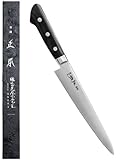
Masamoto is one of the most respected names in Japanese knife-making, and the AT series is its approachable stainless line. The AT Sujihiki at 240mm is built with cooked-meat slicing in mind — brisket, roast beef, ham, poultry — which is a slightly different job from raw-fish sashimi. Cooked meat is denser and often has a crust, so a slicer needs to be thin enough to glide but stiff enough not to deflect.
The AT stainless steel in this knife is designed to hold a fine edge while resisting corrosion, which makes it a practical daily-use blade rather than a fussy specialty tool. Made in Japan and finished to Masamoto’s standards, it occupies the same mid-range tier as the Suisin but with a different set of priorities.
Key specs
- Blade length: 240mm (9.4 inches)
- Steel: AT stainless
- Profile: sujihiki, double-bevel
- Origin: made in Japan
- Price tier: mid-range
Strengths
Masamoto’s reputation rests on consistent heat treatment and geometry, and that shows up in how a blade feels through food. The 240mm length is ideal for a brisket flat or a rib roast — long enough for a full pass, short enough for control. The stainless construction means you can slice hot meat without worrying about reactive-steel discoloration or flavor transfer, which is a genuine concern with carbon blades.
The edge geometry is the other advantage. A well-ground sujihiki separates meat fibers rather than crushing them, and on a cooked roast that difference is visible in the slice — clean and intact rather than ragged and juice-lossy.
Pros
- Masamoto brand reputation for consistent quality
- 240mm length optimizes brisket and roast slicing
- Stainless steel suits hot, acidic, or wet cooked foods
- Made in Japan
- Double-bevel edge sharpens easily
- Balanced for controlled long strokes
Cons
- Mid-range pricing for a relatively plain stainless blade
- Less edge retention than VG10 or carbon core options
- Not a single-bevel knife, so not the traditional sashimi choice
- No cladding or Damascus finish for visual appeal
How it compares
Against the Houcho.com Suisin Inox 240mm, the two are close in size and tier. The Suisin offers a Western handle and Sakai manufacture; the Masamoto offers a Japanese-knife-house pedigree and a steel tuned for edge quality. If you slice cooked meat more than fish, the Masamoto’s slightly stiffer, more controlled feel may suit you better; if you want the most forgiving handle and corrosion resistance, the Suisin edges ahead. Against the MASAMOTO VG 270mm in this list, the AT is the shorter, more nimble version at a lower tier — choose the AT if 240mm fits your board and your cuts, and step up to the VG if you routinely handle very large pieces.
5. Yoshihiro VG10 46-Layer Hammered Damascus 240mm – Best Premium

The Yoshihiro 46-layer is the top of this list’s Damascus family and the clearest premium recommendation. It pairs a VG10 stainless core — one of the most widely respected high-hardness stainless knife steels — with 46 layers of hammered Damascus cladding on each side, a rosewood handle, and a saya (wooden sheath). The hammered surface is not just decorative: the dimpling reduces surface contact with food, which lowers sticking when you slice sticky items like raw fish or dense cooked meat.
VG10 is the reason to pay the premium. It takes a very fine edge and holds it longer than the stainless steels used in mid-range knives, which means fewer sharpenings and more consistent performance over months of use. The trade-off is that high-hardness steel is less forgiving of abuse — lateral twisting, cutting on hard surfaces, or hacking through bone can chip it.
Key specs
- Blade length: 240mm (9.5 inches)
- Core steel: VG10 stainless
- Cladding: 46 layers hammered Damascus
- Handle: rosewood, with saya included
- Profile: sujihiki, double-bevel
- Price tier: premium
Strengths
Edge retention is the defining benefit. A VG10 blade at this hardness will outlast a budget stainless slicer several times over between sharpenings, which matters most if you slice frequently. The 46-layer cladding adds corrosion resistance on top of the already-stainless core, so the knife is effectively rust-proof with normal care.
The saya is a practical inclusion that protects the blade in a drawer or during transport, and the hammered finish is functional as well as attractive. The rosewood handle is comfortable and, at this tier, generally well-fitted.
Pros
- VG10 core delivers strong edge retention
- 46 layers of Damascus cladding for corrosion resistance and looks
- Hammered finish reduces food sticking
- Includes a saya for safe storage
- Rosewood handle with a comfortable, balanced feel
- 240mm length suits most home and semi-pro slicing
Cons
- Premium price tier
- VG10 can chip if twisted or used on hard surfaces
- Damascus cladding requires care not to scratch or over-polish
- Rosewood handles need occasional oiling to prevent drying
- Overkill if you slice only occasionally
How it compares
Against the Yoshihiro VG10 16-Layer, the 46-layer version is the same core steel with more cladding layers, which translates into a slightly thicker, more visually elaborate blade and a higher price. Performance-wise the two are close; the 46-layer wins on aesthetics and on the hammered anti-stick surface, while the 16-layer is the better value if you care only about cutting. Against the Yoshihiro SLD Kurouchi Kiritsuke 270mm, the SLD knife uses a different steel class and a kiritsuke profile — a longer, flatter blade suited to push-cutting — while this 240mm sujihiki is the more conventional pull-slicer. Buy the 46-layer if you want a classic premium sujihiki; buy the SLD kiritsuke if you want maximum length and a different cutting motion.
6. Yoshihiro VG10 16-Layer Hammered Damascus 240mm – Best Damascus Value

The 16-layer version is Yoshihiro’s value proposition in the Damascus family: the same VG10 core as the 46-layer model, but with fewer cladding layers and a correspondingly lower mid-range price. It keeps the hammered finish and the stainless-clad construction, so it delivers most of the premium knife’s cutting performance at a friendlier tier.
For a buyer who wants VG10 edge retention and a Damascus look without paying the top price, this is the sensible middle step. The 240mm blade covers the same home and light-professional tasks as its more expensive sibling.
Key specs
- Blade length: 240mm (9.5 inches)
- Core steel: VG10 stainless
- Cladding: 16 layers hammered Damascus, stainless
- Profile: sujihiki, double-bevel
- Price tier: mid-range
Strengths
The core steel is the key point: VG10 in a 16-layer package performs essentially like VG10 in a 46-layer package when it comes to edge retention and cutting. The extra layers in the premium model add thickness, visual depth, and price, not cutting ability. So this knife is arguably the smartest value in the Yoshihiro Damascus range.
The stainless cladding protects the core from corrosion and makes the blade easy to maintain, while the hammered surface helps release food.
Pros
- VG10 core at a mid-range price
- Stainless cladding for corrosion resistance
- Hammered finish reduces sticking
- Lighter and slimmer than the 46-layer version
- Sharpens to a fine edge and holds it well
- Good upgrade from budget stainless
Cons
- Fewer cladding layers — less visual drama than the 46-layer
- VG10 still requires careful handling to avoid chipping
- No saya included in the base configuration
- Handle material and finish may vary by configuration
How it compares
The direct comparison is with the Yoshihiro VG10 46-Layer described above. Mechanically they are near-twins; the difference is cladding count, price, and appearance. If you value the anti-stick hammering and the VG10 edge, this knife delivers both for less. Against the Tojiro DP 270mm, the Yoshihiro is shorter but uses a Damascus-clad VG10 construction with a hammered surface, while the Tojiro offers more length and a Western handle. Pick the Yoshihiro for the Damascus look and 240mm control; pick the Tojiro for length and a familiar handle.
7. Tojiro DP Sujihiki 270mm – Best Long Mid-Range Slicer

Tojiro’s DP series is one of the most widely recommended mid-range Japanese knife lines, largely because it offers a VG10 core with stainless cladding at a price well below premium forgers. The DP Sujihiki at 270mm is the long slicer of the family, and it is the natural choice for cooks who need serious reach — whole fish, large briskets, big roasts — without stepping into premium territory.
The Western handle gives it a familiar feel and a durable, low-maintenance grip, while the VG10 core provides the edge retention that distinguishes the DP line from budget stainless knives.
Key specs
- Blade length: 270mm (10.5 inches)
- Core steel: VG10 stainless
- Cladding: stainless (DP construction)
- Handle: Western-style
- Profile: sujihiki, double-bevel
- Price tier: mid-range
Strengths
The combination of VG10 and 270mm is the whole story. You get the edge retention of a high-hardness stainless core plus the single-stroke coverage of a long blade — a pairing that is hard to find at mid-range pricing. The stainless cladding keeps maintenance simple, and the Western handle is robust and comfortable for extended use.
Tojiro’s reputation for consistent geometry means the blade tends to be thin behind the edge and to cut without wedging, which is exactly what a slicer should do.
Pros
- 270mm length for single-stroke slicing of large cuts
- VG10 core at a mid-range price
- Stainless cladding — low maintenance
- Durable Western handle
- Well-regarded, widely available line
- Thin geometry cuts cleanly without wedging
Cons
- 270mm may be too long for small kitchens or boards
- Western handle is heavier and less traditional
- No Damascus finish or saya
- VG10 requires care to avoid chipping
How it compares
Against the kanngou 27cm AUS-8, this is the same length at a higher tier. The Tojiro’s VG10 core holds an edge longer than AUS-8 and the blade is generally stiffer and better finished; the kanngou is the budget way to get 270mm. Against the MASAMOTO VG 270mm, both are 270mm mid-to-premium slicers. The Masamoto VG leans premium and carries the Masamoto name and Japanese-made pedigree; the Tojiro DP is the more affordable workhorse with a Western handle. If you want maximum length with VG10 steel and don’t need a traditional handle, the Tojiro is the value pick.
8. KYOKU Samurai Series 10.5-Inch Yanagiba – Best Budget Single-Bevel
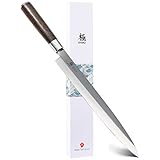
The KYOKU Samurai Series is technically a yanagiba rather than a sujihiki, and that distinction matters. A yanagiba is a traditional single-bevel Japanese knife designed specifically for slicing raw fish for sashimi and sushi. Its single-bevel geometry produces extremely clean cuts with minimal cell damage, which is why it is the classic sashimi tool. It is less versatile than a double-bevel sujihiki for general kitchen work, but for its specific purpose it is unmatched.
At 10.5 inches with a wenge wood handle and Japanese steel, this is an affordable way to try the single-bevel sashimi format. The wenge handle is a dense dark wood that gives the knife a traditional look.
Key specs
- Blade length: 10.5 inches (approximately 267mm)
- Steel: Japanese steel (budget tier)
- Handle: wenge wood
- Profile: yanagiba — single-bevel sashimi slicer
- Price tier: budget
Strengths
The single-bevel edge is the defining advantage for raw fish. It allows a slice that severs cleanly through muscle fibers with almost no tearing, which is the difference between a professional-looking sashimi plate and a ragged one. The long blade supports the single, unbroken drawing stroke that sashimi technique requires.
The wenge handle and traditional silhouette make it a visually convincing addition to a Japanese knife collection at a budget price.
Pros
- True single-bevel yanagiba geometry for clean sashimi cuts
- Long 10.5-inch blade supports full-stroke slicing
- Attractive wenge wood handle
- Budget price for a traditional Japanese profile
- Sharp out of the box in most configurations
Cons
- Single-bevel is harder to sharpen than a double-bevel sujihiki
- Left-handed users generally need a dedicated left-handed grind
- Less versatile than a sujihiki for cooked meat and general tasks
- Budget steel means shorter edge life
- Not a substitute for a sujihiki if you slice mostly roasts
How it compares
Against the HOSHANHO 10-Inch, both are budget long slicers, but the HOSHANHO is a double-bevel sujihiki and this KYOKU is a single-bevel yanagiba. If your goal is raw-fish presentation, the yanagiba wins on cut quality. If your goal is general slicing — brisket, roasts, fish — the sujihiki is more forgiving and easier to maintain. Against the Kimura 8-Inch, they are different tools entirely: the KYOKU is a specialized sashimi knife, the Kimura a compact all-purpose chef’s knife. Buy the KYOKU only if sashimi is a regular part of your cooking and you are willing to learn single-bevel sharpening.
9. MASAMOTO VG Sujihiki 270mm – Best Premium for Volume Brisket
The Masamoto VG 270mm is the professional-volume answer in this list. It combines the longest practical sujihiki length with Masamoto’s VG stainless steel, made in Japan, for cooks who break down and slice very large cuts regularly — whole packer briskets, large fish, big roasts — and need a blade that stays sharp through the work.
VG steel at this tier is formulated for a good balance of edge retention and toughness, and the 270mm length gives you the full-length drawing stroke that produces clean, even slices across a wide piece of meat.
Key specs
- Blade length: 270mm (10.6 inches)
- Steel: Masamoto VG stainless
- Profile: sujihiki, double-bevel
- Origin: made in Japan
- Price tier: premium
Strengths
The combination of length, steel, and make is aimed at people who slice a lot. The 270mm blade slices a full brisket across the grain in one pass, which protects the crust and keeps the slices uniform. Masamoto’s heat treatment and grinding produce a blade that takes a keen edge and keeps it through a long session.
The stainless VG steel means the knife can handle hot, juicy meat without reactivity issues, and the Japanese-made construction reflects the brand’s long-established standards.
Pros
- 270mm blade ideal for large brisket and roasts
- Masamoto VG stainless steel for edge retention
- Made in Japan to a respected standard
- Stainless — suits hot and wet cooked foods
- Full-length strokes produce uniform slices
- Suited to regular, high-volume slicing
Cons
- Premium price tier
- 270mm is long for small kitchens and boards
- Not a single-bevel sashimi knife
- Overkill for occasional home slicing
- Japanese-style handle requires more careful maintenance than a Western one
How it compares
Against the MASAMOTO AT 240mm, this is the bigger, more premium sibling. If your cuts fit within 240mm, the AT is more nimble and cheaper; if you routinely handle very large pieces, the VG 270mm is the better tool. Against the Tojiro DP 270mm, both are 270mm VG-core-class slicers in different tiers. The Masamoto is the premium choice with Japanese-made pedigree and the Masamoto name; the Tojiro DP is the mid-range equivalent with a Western handle. Choose Masamoto if you want the top of the mid-to-premium range for volume work; choose Tojiro if you want most of the performance for less.
10. Yoshihiro Kurouchi Blue Steel Sujihiki Kiritsuke 240mm – Best Carbon Edge with Stainless Protection

This Yoshihiro is a hybrid in the most useful sense. It uses a Blue steel core — a Japanese carbon steel class known for taking an exceptionally fine edge and holding it — but clads it in stainless steel, so the reactive carbon is protected while the exposed cutting edge retains carbon-steel sharpness. The “kurouchi” refers to the black, unpolished forged finish left on the upper blade, a traditional look that also adds a layer of protection.
The profile is a kiritsuke slicer: longer and flatter than a standard sujihiki, with a shape that supports both slicing and push-cutting. The ebony handle is a dense, dark, premium wood. At 240mm it stays in the versatile home-to-semi-pro range.
Key specs
- Blade length: 240mm (9.5 inches)
- Core steel: Blue steel (carbon), stainless-clad
- Finish: kurouchi (black forged)
- Handle: ebony
- Profile: sujihiki kiritsuke slicer
- Price tier: premium
Strengths
The Blue steel edge is the main event. Carbon steels of this class can be sharpened to a finer, more aggressive edge than most stainless alloys, and they hold it well. The stainless cladding is the practical counterpoint: only the very edge is reactive, so maintenance is far easier than with a fully carbon blade.
The kiritsuke profile adds versatility — it can slice like a sujihiki and push-cut like a chef’s knife — and the ebony handle is both durable and attractive.
Pros
- Blue steel core takes and holds an exceptionally keen edge
- Stainless cladding protects the reactive carbon core
- Kiritsuke profile adds push-cutting versatility
- Kurouchi finish is traditional and protective
- Dense ebony handle
- 240mm length suits most tasks
Cons
- Premium price tier
- The exposed edge still requires prompt drying to avoid discoloration
- Carbon-steel edge is more brittle than tough stainless
- Kurouchi finish can wear or scratch with heavy use
- Kiritsuke profile is less familiar to cooks used to standard slicers
How it compares
Against the Yoshihiro VG10 46-Layer, the key difference is steel philosophy: VG10 is hard stainless with great edge retention and near-zero maintenance, while this Blue steel knife offers a potentially finer edge but demands more care. Against the Yoshihiro SLD Kurouchi Kiritsuke 270mm, this is the shorter sibling in the same kurouchi kiritsuke family — the SLD steel is a semi-stainless with strong wear resistance, and the 270mm version gives more reach. If you want carbon-edge sharpness with stainless convenience and a versatile profile, this 240mm is the balanced middle of the group.
11. Kimura 8-Inch Chef Knife – Best Compact All-Rounder

The Kimura is the smallest knife on this list, and it is included deliberately: not every buyer needs a 240–270mm slicer, and a compact Japanese-made chef’s knife is the right answer for small kitchens, small boards, and cooks who want one good knife rather than a drawer of specialized tools. At 8 inches (approximately 203mm) it is closer to a gyuto in proportion, but it is thin, sharp, and made in Japan from high-carbon molybdenum stainless steel — a class of steel known for taking a keen edge while resisting corrosion better than plain carbon.
It is not a sujihiki, and it will not slice a whole brisket in one stroke. What it will do is handle the overwhelming majority of daily kitchen work — vegetables, proteins, herbs, trimming — with a sharp, light, easy-to-maintain blade at budget pricing.
Key specs
- Blade length: 8 inches (approximately 203mm)
- Steel: high-carbon molybdenum stainless
- Origin: made in Japan
- Profile: chef’s knife (gyuto-style)
- Price tier: budget
Strengths
High-carbon molybdenum stainless is a genuinely useful steel class: it sharpens easily, holds a decent edge, and does not rust the way plain carbon does. Combined with an 8-inch blade, that makes the Kimura a low-fuss daily driver. The Japanese-made origin is a meaningful plus at this price, since it suggests tighter quality control than generic budget knives.
Its size is the other advantage. In a small kitchen, a 270mm slicer is a liability; an 8-inch knife that you can use for everything is an asset.
Pros
- Compact 8-inch blade suits small kitchens and boards
- High-carbon molybdenum stainless — sharp, low-maintenance
- Made in Japan at a budget price
- Versatile enough for most daily tasks
- Light and easy to control
Cons
- Not a true sujihiki — limited reach for large cuts
- Shorter edge life than VG10 or carbon-core knives
- Budget fit and finish
- Will not produce single-stroke slices on brisket or whole fish
How it compares
Against every 240mm+ slicer on this list, the Kimura trades length for versatility. Compared with the HOSHANHO 10-Inch, the HOSHANHO is the better slicer and the Kimura is the better all-rounder — if you can only own one knife and you cook a wide range of food, the Kimura is the safer single purchase; if slicing is your priority, the HOSHANHO is. Against the KYOKU Yanagiba, the comparison is even starker: the KYOKU is a specialized sashimi tool, while the Kimura is a generalist. Buy the Kimura if you need one sharp Japanese knife that fits a small space.
12. Yoshihiro SLD Kurouchi Sujihiki Kiritsuke 270mm – Best Long Kiritsuke Slicer

This is the longest knife in the roundup and the most specialized. The Yoshihiro SLD Kurouchi Kiritsuke combines a 270mm blade with SLD steel — a semi-stainless tool steel known for excellent wear resistance and edge retention — a kurouchi black forged finish, an ebony handle, and a saya. The kiritsuke profile is long and relatively flat, supporting both long slicing strokes and push-cutting.
It is aimed at cooks who slice large volumes of meat and fish and who want a blade that stays sharp for a long time. SLD is a step up in wear resistance from standard knife steels, which is why it appears in high-end professional blades.
Key specs
- Blade length: 270mm (10.5 inches)
- Steel: SLD (semi-stainless tool steel)
- Finish: kurouchi (black forged)
- Handle: ebony, with saya included
- Profile: sujihiki kiritsuke
- Price tier: premium
Strengths
SLD steel is the standout feature. Its wear resistance means the edge lasts significantly longer than a typical stainless knife’s before it needs attention, which is a real advantage for anyone processing large cuts regularly. The semi-stainless formulation also means it resists corrosion much better than plain carbon while retaining excellent sharpening response.
The 270mm length and kiritsuke profile make it a powerful slicing and push-cutting tool, and the included saya is a practical addition at this tier. The kurouchi finish and ebony handle give it a distinct, traditional appearance.
Pros
- SLD steel offers excellent wear resistance and edge retention
- Semi-stainless — more corrosion-resistant than carbon
- 270mm blade for maximum slicing reach
- Kiritsuke profile supports slicing and push-cutting
- Ebony handle and saya included
- Kurouchi finish for a traditional look
Cons
- Premium price tier
- 270mm is long and can be unwieldy in small spaces
- Requires more care than fully stainless blades to avoid staining
- SLD is harder to sharpen than simple stainless steels
- Kiritsuke profile may feel unfamiliar to new users
How it compares
Against the Yoshihiro Kurouchi Blue Steel Kiritsuke 240mm, this is the longer, more wear-resistant sibling. The Blue steel knife can take a slightly finer edge and has a more traditional carbon feel; the SLD knife holds its edge longer and resists corrosion better. Against the MASAMOTO VG 270mm, both are premium 270mm slicers, but the Masamoto is a conventional double-bevel sujihiki in stainless steel, while this Yoshihiro is a semi-stainless kiritsuke with a different profile and a saya. Choose the Yoshihiro SLD if you want maximum edge life and a kiritsuke shape; choose the Masamoto VG if you want a classic stainless sujihiki with simpler maintenance.
How to Choose
Choosing a sujihiki comes down to four variables: blade length, steel type, edge geometry, and handle style. Each has a concrete trade-off, and the right answer depends on what you actually cut and how much maintenance you are willing to do.
Blade length: match the longest thing you cut
The rule of thumb is that your blade should be long enough to complete your most common cut in a single stroke. A slicer that forces two strokes creates a visible seam and a ragged slice, which defeats the purpose of owning the knife.
| Blade length | Best for | Board size needed | Watch out for |
|---|---|---|---|
| 203mm (8 in) | Small kitchens, general prep, single-knife owners | Standard 12×18 in board | Too short for brisket or whole fish |
| 240mm (9.4–9.5 in) | Home slicing: roasts, salmon sides, pork loin | 12×18 in or larger | Can feel long in very small spaces |
| 254mm (10 in) | Longer home cuts, larger fish | 18×24 in recommended | Budget steel common at this length |
| 267mm (10.5 in) | Sashimi, large roasts, sashimi-style single strokes | 18×24 in | Single-bevel versions need special sharpening |
| 270mm (10.6 in) | Whole packer brisket, whole fish, volume work | 18×24 in minimum | Unwieldy in small kitchens; more flex in budget builds |
If you cook for two and slice a roast once a month, 240mm is the right answer and anything longer is dead weight. If you break down whole fish or smoke briskets, 270mm pays for itself in cleaner slices. If you have a small kitchen and a crowded drawer, an 8-inch compact knife may genuinely serve you better than a dedicated slicer.
Steel type: the real determinant of edge retention
Steel choice affects three things: how long the edge lasts, how easily it sharpens, and how much care it needs. The practical hierarchy looks like this.
| Steel class | Edge retention | Sharpening ease | Maintenance | Typical tier |
|---|---|---|---|---|
| Budget stainless (generic) | Low | Very easy | Very low — rust-resistant | Budget |
| AUS-8 | Moderate | Easy | Low — rust-resistant | Budget |
| Inox / AT / high-carbon molybdenum stainless | Moderate to good | Easy | Low — rust-resistant | Mid-range |
| VG10 | High | Moderate | Low — stainless, but chips if abused | Mid to premium |
| Blue steel (stainless-clad) | High to very high | Moderate | Moderate — exposed edge can discolor | Premium |
| SLD (semi-stainless) | Very high | Harder | Moderate — better corrosion resistance than carbon | Premium |
Edge retention is not free. As steel hardness and wear resistance rise, the edge becomes more brittle and less tolerant of lateral twisting, cutting on glass or stone, and hacking through bone. A VG10 or SLD blade will outlast budget stainless several times over, but it can chip if you use it like a cleaver. For most home cooks, mid-range stainless offers the best balance: enough edge retention to be satisfying, enough toughness to forgive occasional mistakes.
There is also a sharpening trade-off. Simple stainless steels are quick to bring back on a whetstone or a pull-through sharpener. Harder premium steels take longer to sharpen but need it less often. If you do not plan to maintain your knives, a lower-tier steel that you touch up frequently will outperform a premium steel you never sharpen.
Edge geometry: double-bevel vs single-bevel
A sujihiki is a double-bevel knife, meaning both sides of the edge are ground symmetrically. A yanagiba is single-bevel: one flat side, one ground side. The practical differences:
- Cut quality on raw fish: single-bevel wins. The asymmetric grind produces cleaner separation of muscle fibers.
- Versatility: double-bevel wins. A sujihiki can slice meat, fish, and even do some general prep work.
- Sharpening: double-bevel is much easier for a beginner. Single-bevel requires maintaining a flat back and a consistent bevel angle, and it must be sharpened on one side only.
- Handedness: single-bevel knives are ground for right-handed use; left-handed users need a left-handed grind, which is less common and often more expensive.
If your priority is sashimi presentation and you are willing to learn single-bevel sharpening, a yanagiba is the right tool. For everything else — brisket, roasts, salmon sides, general slicing — choose a double-bevel sujihiki.
Handle style and maintenance realities
Handle choice affects comfort, weight, and how much care the knife needs.
- Western handles (riveted full tang) are heavier, very durable, and essentially maintenance-free. They suit cooks who value robustness and a familiar grip.
- Japanese wa handles are lighter and shift the balance toward the blade. Traditional wooden wa handles can loosen or crack if repeatedly soaked, and some need occasional re-seating.
- Rosewood is a common upgrade wood: dense, comfortable, and attractive, but it benefits from occasional oiling to prevent drying.
- Ebony is denser and darker, very durable, and typical of premium knives.
The most common mistake owners make is leaving a knife wet in the sink or on the board. Even stainless knives can develop spots, and carbon or semi-stainless edges will discolor quickly. Dry the blade after use, and store it on a magnetic strip, in a saya, or in a drawer guard — not loose with other metal tools.
A worked example: cost per year of ownership
Suppose you slice large cuts about twice a week — roughly 100 sessions a year. A budget slicer might need sharpening every 6–8 sessions and will realistically last a few years before the blade thins too much. A premium VG10 or SLD knife might need sharpening every 20–30 sessions and last considerably longer.
If sharpening costs the equivalent of a few units of currency each time (or a few minutes of your own time), the budget knife implies many more touch-ups per year, while the premium knife implies far fewer. Over several years the premium knife’s higher purchase price is partly offset by lower maintenance frequency — but only if you actually slice at that volume. At one roast a month, the premium knife’s advantage in edge retention never gets exercised, and the budget or mid-range knife is the better financial decision.
The same logic applies to blade length. Paying for 270mm only makes sense if you regularly cut items longer than 240mm. Otherwise you are carrying extra length, extra weight, and extra cost for no benefit.
Frequently Asked Questions
What is a sujihiki knife actually for?
A sujihiki is a long, narrow Japanese slicing knife designed to cut meat and fish in single, clean strokes. Its length and thin profile let you draw the blade through a roast or fillet without sawing, which produces even slices and preserves texture. It is not a general-purpose chef’s knife, though it can handle light prep work.
Is a sujihiki the same as a yanagiba?
No. A sujihiki is double-bevel, meaning both sides are ground symmetrically, which makes it versatile and easier to sharpen. A yanagiba is single-bevel and designed specifically for raw fish, producing cleaner sashimi cuts but requiring more skill to sharpen and generally being right-handed only.
What blade length should I buy?
Match the blade to your longest common cut. Most home cooks are well served by 240mm, which handles roasts, pork loin, and salmon sides in one stroke. Step up to 270mm if you regularly cut whole brisket or large fish. Choose 8 inches or less if you have a small kitchen and do not slice large items often.
How often will I need to sharpen a sujihiki?
It depends on steel class and use. Budget stainless may need attention every several sessions, while VG10, Blue steel, and SLD blades can go 20–30 sessions between sharpenings with regular honing. A sujihiki slices soft foods, so edges tend to last longer than on a knife used for chopping and board contact.
Do I need to worry about rust?
Fully stainless blades — Inox, AUS-8, VG10, and similar — are effectively rust-proof with basic care. Carbon and semi-stainless edges, including Blue steel and SLD, can discolor or spot if left wet, so dry the blade promptly after use. Even stainless knives should not be left soaking in a sink.
Can I use a sujihiki instead of a chef’s knife?
For slicing, yes — it is better. For chopping, dicing, and rock-cutting herbs, no. A sujihiki’s long, narrow blade and thin edge are not built for vertical chopping or twisting. Most cooks who own one keep a chef’s knife or gyuto for general prep alongside it.
Is a premium sujihiki worth the extra cost?
It is if you slice frequently and value edge retention. Premium steels such as VG10, Blue steel, and SLD hold an edge far longer than budget stainless and often come with better fit and finish. If you slice only occasionally, a mid-range stainless sujihiki like the Suisin Inox or Masamoto AT offers the better balance of cost and capability.
What should I avoid doing with a sujihiki?
Avoid cutting on glass, stone, or ceramic surfaces, which will roll or chip a thin edge. Do not twist the blade while it is in food, do not hack through bone, and do not leave it wet. For hard or frozen foods, use a heavier knife — a thin slicing blade is not built for that kind of stress.
Closing Recommendation by Situation
If you want one slicer that does everything well for years: the Houcho.com Suisin Inox 240mm. It is the best overall balance of Japanese manufacture, corrosion resistance, comfortable handling, and mid-range price.
If you are buying your first slicer on a tight budget: the HOSHANHO 10-Inch or the kanngou 27cm AUS-8. Choose the HOSHANHO for a rosewood handle and a slightly shorter blade, or the kanngou for maximum 270mm reach and a named steel.
If you slice brisket, roasts, and cooked meat most often: the MASAMOTO AT 240mm for home-size cuts, or the MASAMOTO VG 270mm if you handle large pieces regularly.
If you want the best edge retention and finish: the Yoshihiro VG10 46-Layer Hammered Damascus 240mm, with the 16-layer version as the value alternative.
If you need a long, professional-style slicer at mid-range pricing: the Tojiro DP 270mm.
If sashimi is your focus: the KYOKU Samurai Series 10.5-Inch Yanagiba is an affordable entry to single-bevel technique — but commit to learning single-bevel sharpening first.
If you want carbon-steel edge quality with stainless convenience: the Yoshihiro Kurouchi Blue Steel Kiritsuke 240mm, or the Yoshihiro SLD Kurouchi Kiritsuke 270mm if you want more length and even greater wear resistance.
If your kitchen is small and you want a single sharp Japanese knife: the Kimura 8-Inch. It is not a sujihiki, but for a compact space and a generalist cook, it may be the smarter purchase.