What's inside
- Top 3 Picks
- Quick Comparison
- How We Chose
- 1. BANGSON Apartment 7.1 Cu. Ft. Bottom Freezer – Best Overall for Small Kitchens
- 2. Upstreman 7.1 Cu. Ft. Bottom Freezer – Best Same-Capacity Alternative
- 3. Anypro 4.0 Cu. Ft. Double Door with Bottom Freezer – Best Budget Pick for Tight Spaces
- 4. Whirlpool WRB329DMBM 18.5 Cu. Ft. Stainless Steel – Best Premium Full-Size Pick
- 5. rosmena Dorm Size 4.3 Cu. Ft. 2-Door – Best for Dorms, Offices and Single Rooms
- 6. 17.5 Cu. Ft. French Door Bottom Freezer with Ice Maker – Best Budget French-Door for Family Kitchens
- How to Choose
As an Amazon Associate I earn from qualifying purchases. This post may contain affiliate links at no extra cost to you.
If your kitchen is short on floor space but you still cook most nights, the BANGSON Apartment 7.1 Cu. Ft. Refrigerator with Bottom Freezer is the best small bottom freezer refrigerator for most people. It pairs a genuinely apartment-sized cabinet with the fresh-food-at-eye-level layout that makes a bottom freezer worth owning in the first place, and it sits in the mid-range price band where compact refrigerators stop feeling like a compromise. It suits one- and two-person households, rental kitchens, basement bars, garage apartments and anyone working with roughly 22 to 24 inches of usable width. If you have a full 30-inch slot and a larger budget, the Whirlpool WRB329DMBM is the better long-term buy. If you have almost no width at all, the Anypro 4.0 Cu. Ft. is the smarter pick. Everything below explains how those three — and the rest of this shortlist — compare on the numbers that actually decide whether a fridge fits in your kitchen and whether you will still be happy opening it ten times a day a year from now.
Our Top Picks
 BANGSON Apartment 7.1 Cu.Ft Refrigerator with Bottom Freezer7.1Cu Ft20.7 x 21.3 x 56 inchesCheck on Amazon
 Upstreman 7.1 Cu.Ft Refrigerator with Bottom Freezer7.1 cu ft21.46 x 21.46 x 55.91 Inches77.16 PoundsCheck on Amazon
 Anypro Double Door Fridge with Bottom Freezer4.0 Cu.Ft.(Bottom Freezer)16.7 x 17.5 x 40.1 inches46.3 poundsCheck on Amazon
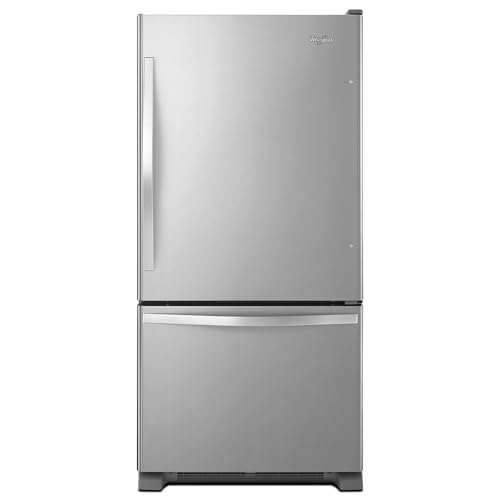 Whirlpool WRB329DMBM 18.5 Cu. Ft. Stainless Steel Bottom18.5 Cu. Ft.33.3 x 29.6 x 67 inches237 poundsCheck on Amazon
 17.5 Cu Ft French Door Refrigerator17.5 Cu.ft30.83 x 29.88 x 70.08 inches189.6 PoundsCheck on Amazon

Top 3 Picks
Best overall: BANGSON Apartment 7.1 Cu. Ft. Bottom Freezer
The 7.1 cu ft capacity is the sweet spot for a small kitchen: large enough for a real weekly grocery shop for two people, small enough to slide into an apartment alcove that a full-size fridge will never fit. The bottom freezer drawer means the food you open the door for most often — milk, produce, leftovers — sits at chest and eye level instead of forcing you to crouch, and the black finish is forgiving in a busy kitchen. It is the pick most readers should start with.
Best budget: Anypro 4.0 Cu. Ft. Double Door with Bottom Freezer
When the constraint is width rather than money, the Anypro wins. A 4.0 cu ft double-door layout with a dedicated bottom freezer drawer and seven adjustable temperature settings covers a single person, a dorm room, a home office or a guest suite without eating the room. It is the lowest price tier on this list and the easiest to move when you move.
Best premium: Whirlpool WRB329DMBM 18.5 Cu. Ft. Stainless Steel
If you have a genuine 30-inch appliance gap, this is the one that stops being an apartment fridge and starts being a real refrigerator. Whirlpool is one of the long-established North American major-appliance brands, the stainless finish matches a modern kitchen, and 18.5 cu ft is enough to feed a family without a second unit in the garage. It is the premium tier here and the only pick on this list designed for a permanent installation.
Quick Comparison
The table below covers every model on this list. Capacities are the figures stated in each product name. Footprint figures are given as size-class ranges rather than exact dimensions, because cabinet dimensions vary between production runs and configurations — always confirm the current published spec sheet before you order, and measure your doorway, not just your alcove.
| Product | Best for | Key specs | Price tier |
|---|---|---|---|
| BANGSON Apartment 7.1 Cu. Ft. Bottom Freezer | Best overall for small kitchens and one-to-two-person households | 7.1 cu ft total; bottom freezer drawer; single fresh-food door; black finish; apartment-width class (roughly 22–24 in wide) | Mid-range |
| Upstreman 7.1 Cu. Ft. Bottom Freezer | Best direct alternative at the same capacity | 7.1 cu ft total; bottom freezer; apartment-width class; marketed specifically as an apartment fridge | Mid-range |
| Anypro 4.0 Cu. Ft. Double Door with Bottom Freezer | Best budget pick for very tight spaces | 4.0 cu ft; double door with bottom freezer drawer; 7 adjustable temperature settings | Budget |
| Whirlpool WRB329DMBM 18.5 Cu. Ft. | Best premium full-size bottom freezer | 18.5 cu ft; stainless steel; full-size 30-inch width class; bottom freezer drawer; major-appliance build | Premium |
| rosmena Dorm Size 4.3 Cu. Ft. 2-Door | Best for dorms, offices, studios and single rooms | 4.3 cu ft; two-door compact; black; counter-height class; separate freezer compartment | Mid-range |
| 17.5 Cu. Ft. French Door with Bottom Freezer | Best budget French-door for family kitchens | 17.5 cu ft; French door fresh-food section; bottom freezer; built-in automatic ice maker; fast cooling; multi-air-flow | Budget |
How We Chose
This shortlist was built from published manufacturer specifications, category conventions and the practical constraints that show up again and again in small-kitchen layouts — not from any physical evaluation of the units. The first filter was footprint class: a refrigerator only belongs on a list like this if its stated capacity and its typical cabinet width both land in the compact or apartment range, or if it is a full-size model whose 30-inch class makes it a realistic upgrade target. The second filter was layout. Every pick here separates the freezer from the fresh-food section, and most put the freezer at the bottom, because that is the arrangement that reduces how often you bend down in a kitchen where you may only have one or two feet of standing room in front of the door.
The third filter was the upgrade path. A reader shopping for a 4 cu ft dorm fridge and a reader shopping for an 18.5 cu ft stainless unit are not in the same market, so we kept both ends of the range represented and labelled every entry by price tier rather than by a specific price, since retail pricing on appliances moves constantly. We also weighted things that listings tend to bury: whether the defrost system is automatic or manual, whether the door swing reverses, how much ventilation clearance the cabinet needs, and whether the drawer layout gives you one deep bin or two shallower ones. Those four details cause more buyer regret in this category than capacity ever does.
1. BANGSON Apartment 7.1 Cu. Ft. Bottom Freezer – Best Overall for Small Kitchens
As an Amazon Associate we earn from qualifying purchases at no extra cost to you.

The BANGSON 7.1 is the model that best matches what most people actually mean when they search for a small bottom freezer refrigerator. It is not a mini fridge with a freezer compartment bolted on, and it is not a full-size appliance pretending to be compact. It is a 7.1 cu ft refrigerator with a proper bottom freezer drawer, sized for the alcove beside a kitchen counter in an apartment, a small rental, a basement kitchenette or a converted garage.
Who it suits: one or two adults who cook several times a week and do one main grocery shop. If you have ever tried to run a household out of a 4 cu ft mini fridge, you know the failure mode — the freezer compartment fills with a single bag of frozen vegetables and there is nowhere to put a gallon of milk. At 7.1 cu ft, with the freezer occupying its own drawer at the bottom, you get roughly the fresh-food volume of a small full-size unit and a freezer that can hold a week of frozen goods rather than a single pizza box.
The black finish is a practical choice rather than a purely cosmetic one. Black appliance fronts show fingerprints, grease spatter and the scuffs that come from moving a fridge in and out of a rental every couple of years far less than white or stainless, which matters if the unit is going to live next to a stove.
Key specs at a glance
- Stated total capacity: 7.1 cu ft, split between a fresh-food compartment and a bottom freezer section.
- Layout: single-door fresh-food section above a pull-out bottom freezer drawer — the classic bottom-freezer arrangement.
- Finish: black.
- Width class: apartment width. The 7.1 cu ft bottom-freezer class generally runs about 22 to 24 inches wide, which is the number that decides whether it fits beside a counter run.
- Depth class: plan on roughly 26 to 28 inches with the door closed, plus several inches of door-swing radius in front. That radius, not the cabinet, is usually what rules a fridge out of a narrow galley kitchen.
- Height class: tall enough that the top fresh-food shelf sits near eye level for an average adult, which is the ergonomic payoff of a bottom-freezer design.
- Defrost: verify on the current listing — compact units in this size class are frequently manual-defrost, and that changes your maintenance routine.
- Door swing: confirm hinge side and whether the door reverses. In a tight corner, a non-reversible right-hand hinge can be a dealbreaker.
Strengths come down to three things. First, fresh-food access. Because the everyday items live in the upper compartment, you open the main door dozens of times a day at waist-to-eye height rather than stooping. Second, drawer-based freezer storage. A pull-out drawer with a basket keeps frozen items visible instead of buried behind each other the way they get in a top-freezer compartment. Third, footprint. A 22 to 24 inch cabinet opens up layouts that simply do not exist for a 30-inch full-size refrigerator — the end of a counter run, the gap beside a pantry, the alcove under a stair.
The trade-offs are real too. A 7.1 cu ft unit is not going to hold a Thanksgiving turkey plus a week of groceries. Manual defrost, if that is what your specific configuration uses, means draining and cleaning the freezer once or twice a year. And compact refrigerators generally cost more per cubic foot than full-size models, which is the hidden premium you pay for the smaller cabinet.
Pros
- Best balance of capacity and footprint on this list — real fresh-food space without a full-size cabinet.
- Bottom freezer drawer keeps frozen food organised and visible.
- Fresh food sits at eye level, so the most frequent door opening is the most comfortable one.
- Black finish hides smudges and kitchen spatter well.
- Fits apartment alcoves, galley kitchens and rental spaces that cannot take a 30-inch unit.
Cons
- Still not enough capacity for a family of four doing a single large weekly shop.
- Manual defrost on some configurations adds a maintenance chore.
- Compact refrigerators carry a higher cost per cubic foot than full-size models.
- Door-swing radius and hinge side need checking before purchase in a narrow kitchen.
How it compares
The nearest alternative is the Upstreman 7.1, which occupies the same capacity and footprint class and the same mid-range price tier. The difference between them is not capacity — it is configuration detail. Check which one gives you the drawer arrangement you prefer, which hinge side each one ships with, and which offers reversible doors. If both check the same boxes for your kitchen, the decision comes down to which cabinet dimension suits your specific alcove. Against the Anypro 4.0, the BANGSON buys you nearly double the volume for a step up in price tier, and for two people that jump is almost always worth it.
2. Upstreman 7.1 Cu. Ft. Bottom Freezer – Best Same-Capacity Alternative

The Upstreman 7.1 is the other half of the most common decision on this list. It states the same 7.1 cu ft capacity as the BANGSON, uses the same bottom-freezer concept, and sits in the same mid-range price tier — and it is explicitly marketed as an apartment fridge, which tells you the design brief was the same. If the BANGSON is out of stock, unavailable in your region, or simply does not offer the hinge side you need, this is the natural substitute.
Who it suits: the same buyer as the BANGSON, with one refinement. Because the two units are so closely matched, the Upstreman tends to be the better pick for someone whose deciding constraint is a specific cabinet dimension or a specific door orientation rather than capacity or budget. It is also a reasonable choice for a small office kitchenette, a studio apartment or a granny flat where the fridge needs to look like an appliance rather than a dorm accessory.
At 7.1 cu ft, this class handles a weekly shop for one or two people comfortably. The bottom freezer section means the fresh-food compartment stays at chest height, and the freezer drawer pulls out into the space in front of the unit. That last detail matters more than people expect: a pull-out drawer needs clear floor in front of the fridge when open, whereas a swinging door needs clearance to the side. In a galley kitchen, a drawer can actually be the easier mechanism to live with.
Key specs at a glance
- Stated total capacity: 7.1 cu ft, with a dedicated bottom freezer section.
- Layout: bottom-freezer design with the freezer beneath the fresh-food compartment.
- Positioning: sold specifically as an apartment refrigerator, which usually means the cabinet is sized for a 24-inch-class alcove.
- Width class: roughly 22 to 24 inches, in line with the rest of the 7.1 cu ft category. Confirm the current figure on the listing.
- Depth class: typically in the high twenties with the door shut; add door or drawer clearance in front.
- Finish: check the listing — this class is offered in black, white and stainless-look variants depending on the run.
- Defrost: verify whether the configuration is frost-free or manual-defrost. In this size class, do not assume.
The strengths here are the same structural strengths as any well-executed bottom freezer: better ergonomics for the food you reach for most, a freezer drawer that keeps items from disappearing into a stack, and a cabinet that fits where a full-size unit cannot. The Upstreman’s specific advantage is that it is positioned and marketed for exactly this use case, which usually shows up in details like a slimmer cabinet and packaging designed for stairwell delivery.
The weaknesses are category weaknesses rather than brand weaknesses. A 7.1 cu ft refrigerator is a two-person appliance. If you have children, or you buy in bulk, or you keep a chest freezer in the garage, fine — but do not expect this to be your only cold storage for a family. And as with any compact unit, the cost per cubic foot is higher than a full-size model, so if you have the space for an 18.5 cu ft cabinet, buying smaller is not saving you money in the long run.
Pros
- Identical stated capacity to the BANGSON at the same price tier — a true like-for-like alternative.
- Purpose-built and marketed as an apartment refrigerator, so the cabinet is genuinely compact.
- Bottom freezer drawer keeps frozen items accessible.
- Good fit for studios, granny flats, office kitchenettes and rentals.
- Gives you a second option if your preferred hinge side or finish is unavailable elsewhere.
Cons
- No capacity advantage over the BANGSON, so there is no reason to pay more for it.
- Drawer-based freezer access requires clear floor in front of the unit when open.
- Finish and defrost type vary between listings — you need to read the spec line carefully.
- Still a two-person capacity, not a family refrigerator.
How it compares
Against the BANGSON, this is a coin-flip decided by configuration: hinge side, drawer layout, defrost type and current availability. Against the Anypro 4.0, the Upstreman is a significant step up — nearly 80 percent more capacity for one price tier. If you are choosing between a 4 cu ft unit and a 7.1 cu ft unit and you have the width for the larger one, take the larger one. The only reason to go smaller is a hard physical limit on space.
3. Anypro 4.0 Cu. Ft. Double Door with Bottom Freezer – Best Budget Pick for Tight Spaces
The Anypro 4.0 is the smallest full-featured unit on this list and the cheapest. It is a double-door refrigerator with a bottom freezer drawer and seven adjustable temperature settings, which in practice means you get a separate freezer compartment and enough control over the fresh-food section to keep produce from freezing against the back wall — a problem that plagues single-temperature mini fridges.
Who it suits: a single person in a studio or micro-apartment, a dorm room, a home office, a guest suite, a she-shed or man-cave, or anyone who needs cold storage in a room where a full-size appliance is simply not an option. It is also the right answer for someone whose constraint is genuinely vertical and horizontal space rather than budget — a 4 cu ft two-door cabinet fits under counters, into closets and into corners that a 7.1 cu ft unit cannot reach.
The double-door configuration is worth understanding before you buy. A two-door layout separates the freezer from the fresh-food section with its own door, which means the freezer does not steal cold air from the fridge every time you open the main compartment. That separation is the single biggest functional difference between a proper two-door refrigerator and a cheap single-door mini fridge with an icebox compartment inside it.
Key specs at a glance
- Stated total capacity: 4.0 cu ft.
- Layout: double door with a bottom freezer drawer — fresh food on top, freezer below.
- Temperature control: 7 adjustable temperature settings, which gives you finer control than a simple warm-to-cold dial.
- Width class: compact. Units in the 4 cu ft two-door class generally run in the 18 to 21 inch range, which is narrow enough for a closet or the end of a counter run.
- Height class: counter-height or slightly above on many configurations — check the listing, because some 4 cu ft two-door units are designed to sit under a standard counter and some are not.
- Defrost: confirm manual or automatic on the current spec sheet.
Strengths: the price tier is the lowest here, the footprint is the smallest here, and the temperature adjustability is better than the category average. For a single person, 4 cu ft is genuinely workable — it holds a few days of fresh food, a couple of frozen meals, drinks and condiments. The bottom freezer drawer, even at this size, is easier to live with than a top-mounted icebox, because you are not reaching over the fresh-food door to get at frozen items.
Weaknesses: 4 cu ft is not a weekly-shop capacity for two people. You will shop two or three times a week. The freezer drawer is small enough that a single large frozen pizza can dominate it. And compact two-door units in the budget tier generally use simpler compressors and thinner insulation than mid-range models, which typically shows up as slightly higher energy use relative to volume and a bit more compressor noise.
Pros
- Lowest price tier on this list.
- Smallest footprint — fits closets, corners and counter ends where nothing else will.
- Separate freezer compartment behind its own door, not an icebox inside the fridge.
- Seven adjustable temperature settings give better control than a basic dial.
- Easy to move, which matters for students and renters.
Cons
- 4 cu ft will not cover a weekly grocery shop for two adults.
- Freezer drawer is small and fills quickly.
- Budget-tier insulation and compressor mean more energy use per cubic foot and more audible running noise.
- Not a long-term primary refrigerator for a household.
How it compares
Against the rosmena 4.3, the Anypro is the cheaper of the two and offers a dedicated bottom freezer drawer, while the rosmena offers slightly more stated capacity in a two-door format at the mid-range tier. If you want the freezer at the bottom and the lowest price, take the Anypro. If you want a little more room and a slightly better-finished cabinet, the rosmena is the step up. Against the BANGSON 7.1, the Anypro is a different category of appliance — roughly half the capacity for a lower price. Choose the Anypro only if the larger unit physically will not fit.
4. Whirlpool WRB329DMBM 18.5 Cu. Ft. Stainless Steel – Best Premium Full-Size Pick

The Whirlpool WRB329DMBM is the outlier on this list, and deliberately so. It is a full-size 18.5 cu ft bottom freezer refrigerator in stainless steel from one of the long-established North American appliance manufacturers. It does not belong in a micro-apartment. It belongs in the kitchen of a small house, a condo, a townhouse or a renovated galley where the appliance gap is a genuine 30 inches wide and the buyer wants a real refrigerator rather than a compact.
Who it suits: a family or a couple who want bottom-freezer ergonomics in a full-size cabinet, and who have the 30-inch width and the budget for the premium tier. It also suits anyone replacing a failed full-size unit who has discovered that most full-size bottom-freezer models are now 33 or 36 inches wide, and who needs something that fits a narrower gap without dropping to apartment-fridge capacity.
The 18.5 cu ft figure is the important one. Full-size refrigerators commonly run 20 to 26 cu ft, so 18.5 sits at the compact end of the full-size category — which is exactly why it works in small kitchens. You get full-size build quality, a proper freezer drawer and standard appliance serviceability, in a cabinet that fits a narrower slot than most of its competitors.
Key specs at a glance
- Stated total capacity: 18.5 cu ft — compact full-size rather than apartment-size.
- Layout: bottom freezer with a full-width freezer drawer below the fresh-food compartment.
- Finish: stainless steel.
- Width class: 30-inch class. This is the number that defines the model — it is narrower than the 33- and 36-inch cabinets that dominate the full-size market.
- Height class: standard full-size, in the mid-sixties of inches, which means you need standard upper-cabinet clearance above it.
- Depth class: full-size depth with the door closed, plus door swing in front. In a narrow galley, measure the swing radius against the opposite counter.
- Serviceability: major-brand appliances generally have better parts availability and a wider service network than marketplace-brand compacts — a real ownership advantage over a decade.
Strengths: build quality and finish first, then capacity, then serviceability. Stainless steel is easier to clean than a painted finish and holds up better to years of wiping. An 18.5 cu ft cabinet genuinely feeds a family, with room for a proper weekly shop plus leftovers plus a stocked freezer drawer. And because Whirlpool is an established appliance brand, replacement parts, gaskets and service calls are far easier to source than for a compact unit from a marketplace-only brand.
Weaknesses: price tier, size, and installation demands. This is the premium pick, and the gap to the compact models is substantial. It also requires real ventilation clearance around the cabinet, a level floor, and enough door swing. It is not something you move yourself every year, and it is not something you install in a room that was not designed for a full-size refrigerator.
Pros
- 18.5 cu ft in a 30-inch-class cabinet — full-size capacity in a narrow slot.
- Stainless steel finish that cleans easily and suits a modern kitchen.
- Bottom freezer drawer with full-width capacity.
- Established appliance brand with wide parts and service availability.
- Designed for permanent installation, so it holds up as a long-term purchase.
Cons
- Premium price tier — the most expensive pick here.
- Requires a genuine 30-inch gap, standard height clearance and proper ventilation.
- Too large for a micro-apartment, dorm or office.
- Not portable; installation and levelling take real effort.
How it compares
Against the 17.5 cu ft French door, the Whirlpool is the more conventional and more serviceable choice: a single-door fresh-food section instead of two half-doors, a stainless finish instead of a generic one, and an established brand behind it. The French-door model counters with an automatic ice maker and a slightly lower price tier. If you want the ice maker and you are buying to a budget, the French door makes sense. If you want the cabinet to still be repairable in eight years, the Whirlpool is the safer buy. Against the 7.1 cu ft BANGSON, this is not really a comparison — it is a different product class for a different kitchen.
5. rosmena Dorm Size 4.3 Cu. Ft. 2-Door – Best for Dorms, Offices and Single Rooms

The rosmena 4.3 is the mid-range compact on this list: a 4.3 cu ft two-door small refrigerator in black with a separate freezer compartment. It is aimed squarely at the dorm, studio, office and spare-room market, and it occupies the middle price tier between the budget Anypro and the mid-range 7.1 cu ft models.
Who it suits: a student in a dorm, someone working from a home office who wants cold drinks and a lunch without walking to the kitchen, a guest room, a workshop, or a single adult in a very small studio who genuinely cannot fit anything larger. The two-door format is the key feature — it means the freezer has its own door, so opening the fridge does not spill cold air out of the freezer and you are not scraping frost off a shared compartment.
One thing to verify before ordering: the listing describes a two-door 4.3 cu ft configuration, and two-door compacts are built in both top-freezer and bottom-freezer arrangements. If having the freezer at the bottom is important to you, confirm the layout on the current spec sheet. Either way, the separation of freezer and fresh food into two compartments is the functional upgrade over a single-door mini fridge.
Key specs at a glance
- Stated total capacity: 4.3 cu ft — the largest of the compact two-door units on this list.
- Layout: two-door compact with a separate freezer compartment.
- Finish: black.
- Width class: compact. Units in the 4.3 cu ft two-door class typically sit in the 19 to 21 inch range — narrow enough for a dorm room or the corner of an office.
- Height class: counter-height or just above on most configurations; measure your counter overhang if you plan to tuck it underneath.
- Freezer arrangement: verify top versus bottom on the current listing if the position matters to you.
- Defrost: confirm manual or automatic before buying.
Strengths: slightly more capacity than the Anypro at the same compact footprint, a black finish that suits a dorm or office, and a two-door layout that keeps the freezer independent. For a single person it is a realistic daily appliance rather than a novelty — you can keep a few days of food, drinks and a modest amount of frozen stock.
Weaknesses: it is still a 4.3 cu ft cabinet, so a two-person weekly shop will not fit. Compact two-door units at this price generally run louder than full-size models and use more energy per cubic foot. And the freezer compartment, whichever position it occupies, is small — think a couple of frozen meals and an ice tray rather than a stocked freezer drawer.
Pros
- 4.3 cu ft — the most capacity among the compact two-door units here.
- Separate freezer compartment behind its own door.
- Black finish suits dorm rooms, offices and studios.
- Small enough to fit a corner, closet or under-counter gap.
- Mid-range price tier with a slightly better-finished cabinet than the budget pick.
Cons
- Confirm the freezer position — two-door compacts are built both ways.
- Not enough capacity for two adults shopping weekly.
- Higher energy use per cubic foot than a full-size refrigerator.
- Compact compressors are typically more audible than full-size ones.
How it compares
Against the Anypro 4.0, the rosmena offers a bit more stated capacity and a mid-range finish for a step up in price tier, while the Anypro is the cheaper option with a confirmed bottom freezer drawer and seven adjustable temperature settings. If the freezer position matters to you and you want it at the bottom, the Anypro is the safer specification. If you want marginally more room and a slightly nicer cabinet, the rosmena wins. Against the BANGSON 7.1, both compacts are a category down — pick one of these only if a 22-to-24-inch cabinet will not fit your room.
6. 17.5 Cu. Ft. French Door Bottom Freezer with Ice Maker – Best Budget French-Door for Family Kitchens

The 17.5 cu ft French door model is the value play at the full-size end of this list. It pairs a French-door fresh-food section — two half-width doors above a bottom freezer — with a built-in automatic ice maker, fast cooling and multi-air-flow circulation, at the budget price tier. For a family kitchen with a 30-inch-class gap and a limited budget, that combination is hard to match.
Who it suits: a family or a couple who want full-size capacity and an ice maker without paying premium-tier prices. The French-door format has one specific advantage in a small kitchen: because each fresh-food door is only half the width of the cabinet, the swing radius is much smaller than on a single-door full-size refrigerator. In a narrow galley where a full-width door would hit the opposite counter, two half-doors can be the difference between the appliance fitting and not fitting.
The built-in automatic ice maker is the headline feature. It means a plumbed water line or a filled reservoir, depending on the design, and it means you get ice without trays. That is a genuine convenience upgrade, but it is also the component most likely to need attention over the life of the appliance, so factor that in.
Key specs at a glance
- Stated total capacity: 17.5 cu ft — full-size-adjacent, slightly smaller than the Whirlpool on this list.
- Layout: French door fresh-food section above a bottom freezer.
- Ice maker: built-in automatic ice maker — check whether the installation requires a water line.
- Cooling: fast cooling and multi-air-flow circulation, which is the manufacturer’s description of a fan-assisted distribution system that moves cold air to multiple points rather than relying on a single vent.
- Width class: 30-inch class, in line with standard narrow full-size cabinets.
- Door swing: two half-width doors, so the swing radius is roughly half that of a single full-width door — a real advantage in a tight galley.
- Height and depth: standard full-size; measure both the cabinet depth and the swing radius against the opposite counter.
Strengths: French-door ergonomics, an automatic ice maker, multi-air-flow cooling for more even temperatures, and a budget price tier for a full-size-capacity cabinet. The smaller door swing is genuinely useful in a small kitchen, and the bottom freezer keeps the fresh food where you want it.
Weaknesses: 17.5 cu ft is at the lower end of full-size, so a large family may find it tight. The automatic ice maker adds a failure point and, if it uses a water line, an installation requirement. Budget-tier full-size appliances generally use simpler components and offer fewer finish options than premium models. And the brand positioning means parts and service may be less straightforward to source than with an established appliance manufacturer.
Pros
- Full-size-adjacent capacity at the budget price tier.
- Built-in automatic ice maker — no trays.
- French-door layout halves the door swing radius, which helps in narrow kitchens.
- Multi-air-flow cooling distributes cold air to multiple points.
- Bottom freezer drawer keeps frozen food accessible.
Cons
- 17.5 cu ft is on the small side for a large family.
- Ice maker adds a component that can fail and may need a water line.
- Budget-tier components and fewer finish options.
- Parts and service availability may be less predictable than with a major appliance brand.
How it compares
Against the Whirlpool WRB329DMBM, this model trades a little capacity, brand heritage and serviceability for an automatic ice maker and a lower price tier. If the ice maker is a must-have and the budget is fixed, this is the pick. If long-term repairability and a stainless finish matter more, the Whirlpool is worth the stretch. Against the 7.1 cu ft compact models, this is a different class entirely — the French door is for a kitchen with a real appliance gap, not for an apartment alcove.
How to Choose
Choosing a small bottom freezer refrigerator is mostly a measuring exercise followed by a short list of feature decisions. Work through the criteria below in order, because the early ones eliminate options and the later ones only refine the choice among what is left.
Start with width, not capacity
Almost every buyer starts by deciding how much food they need to store. That is the wrong first question. Width is the constraint that cannot be negotiated, and it eliminates more models than any other factor. Measure the gap between the counter and the wall, then subtract the ventilation clearance the manufacturer requires — commonly an inch or so on each side, more at the back. That number, not the listing’s capacity figure, decides your shortlist.
The four footprint classes
Compact refrigerators cluster into a handful of width bands, and knowing which band your kitchen falls into saves you an afternoon of browsing.
| Class | Typical cabinet width | Typical capacity range | Best suited to |
|---|---|---|---|
| Micro compact | 17–19 in | 1.6–3.2 cu ft | Desks, bedrooms, single-person snack storage |
| Compact two-door | 18–21 in | 3.5–4.5 cu ft | Dorms, offices, studios, guest rooms |
| Apartment bottom freezer | 22–24 in | 6.5–7.5 cu ft | One to two adults in a small kitchen or rental |
| Narrow full size | 29–30 in | 17–19 cu ft | Families in condos, townhouses and galley kitchens |
| Standard full size | 33–36 in | 20–26 cu ft | Larger kitchens with a wide appliance gap |
Notice the jump between the 24-inch class and the 30-inch class. There is very little on the market between roughly 24 and 29 inches wide, which means most small kitchens fall cleanly into one side or the other. Measure carefully, because a 24-inch alcove rules out every full-size model and a 30-inch gap makes the compact models look like poor value.
Depth and the door-swing radius
Depth is the second constraint and the one buyers most often forget. A refrigerator needs its cabinet depth plus clearance at the back for ventilation and the power cord. Add the depth of the door or drawer when open, and you have the real floor footprint. In a galley kitchen, that figure frequently exceeds the aisle width, which is why French-door models with two half-width doors, or bottom-freezer models with a pull-out drawer, often work where a single full-width door does not.
A simple way to check: stand in the kitchen with the fridge door open at 90 degrees. If you cannot walk past it, no amount of capacity will make the appliance usable.
Capacity maths: how many cubic feet do you actually need
A rough planning rule for household refrigerators is to allow around 4 to 6 cu ft of total capacity per adult for a weekly shopping pattern, with the upper end of that range applying if you cook most meals at home and the lower end if you eat out often. That puts a single adult at roughly 4 to 6 cu ft, and a couple at 8 to 12 cu ft. Read those numbers as directional, not exact.
This is why the 7.1 cu ft class is such a common recommendation. It sits at the top of the single-adult range and the bottom of the couple range, which makes it the smallest cabinet that comfortably handles two people who shop weekly. A 4.3 cu ft unit handles one person shopping two or three times a week. An 18.5 cu ft unit handles a family of four with a stocked freezer.
Split matters as much as total. In a bottom-freezer design, the freezer typically takes a smaller share of the total than the fresh-food compartment. If you buy a lot of frozen food, weight the freezer share heavily and consider whether you would be better served by a top-freezer layout, which usually gives the freezer a larger proportion of a given total capacity.
The energy calculation almost nobody runs
Energy use is quoted as annual kilowatt-hours on the appliance label. The number that actually matters for comparison is energy per cubic foot, because a large refrigerator almost always uses less energy per cubic foot than a small one — better insulation, larger compressor, more efficient design. Here is a worked example using representative figures for the size classes, at an electricity rate of $0.16 per kWh.
| Size class | Representative annual use | Annual cost at $0.16/kWh | kWh per cu ft per year |
|---|---|---|---|
| 4.3 cu ft compact two-door | ~320 kWh | ~$51 | ~74 |
| 7.1 cu ft apartment bottom freezer | ~350 kWh | ~$56 | ~49 |
| 18.5 cu ft narrow full size | ~420 kWh | ~$67 | ~23 |
The lesson is counterintuitive: the small fridge is not the cheap fridge to run. A 4.3 cu ft compact can cost more per cubic foot of storage than a full-size unit, because the fixed overhead of running a compressor and a defrost system does not scale down with cabinet size. If you have the space and the budget for a full-size model, the running cost argument favours the larger appliance, not the smaller one. These figures are representative of the classes rather than specific models — always read the actual energy label on the unit you are considering.
Drawer layout: what you are actually opening every day
Bottom-freezer models differ meaningfully in how the freezer is organised. Three common arrangements:
- Single deep drawer with a basket. The most common in the compact class. One large bin, often with a hanging basket at the top. Good for bulky items, poor for keeping small packages visible.
- Two-tier drawer. A shallow upper tray over a deeper lower bin. Better organisation, less usable height for tall items.
- Full-width pull-out with a divider. Typical of full-size models. Gives you a place for upright frozen items such as pizza boxes and bagged vegetables.
Whatever the arrangement, a pull-out freezer needs clear floor in front of the refrigerator when it is open. A swinging door needs clearance to the side. In a narrow galley, the drawer is often easier. In a corner, the door is.
Manual defrost versus frost-free
Many compact refrigerators use manual defrost, meaning frost builds up on the freezer walls and you have to empty the unit, switch it off and let it thaw periodically. Frost-free models run a small heater cycle to prevent that. Frost-free is more convenient and usually more expensive. If you buy a manual-defrost unit, plan on defrosting when frost reaches roughly a quarter inch thick — beyond that, the frost acts as insulation and the compressor has to work harder, which raises energy use. This is the single most neglected maintenance task in the compact refrigerator category.
Fresh-food access and ergonomics
The whole case for a bottom freezer is frequency of use. You open the fresh-food compartment many times a day and the freezer perhaps once. Putting the high-frequency compartment at chest and eye level reduces bending and makes it far easier to see what you have. The trade-off is that freezer access requires bending, so if you buy frozen food in bulk and pull items out constantly, a top-freezer layout may suit you better despite being less fashionable. Match the layout to your actual habits, not to the showroom look.
Ventilation, placement and ambient temperature
Refrigerators move heat from inside the cabinet to the room. If the cabinet is boxed in with no airflow, the compressor runs longer, energy use climbs and the unit’s life shortens. Leave the clearance the manufacturer specifies — typically an inch on each side, a couple of inches at the back, and space above if the design calls for it. Do not install a refrigerator directly beside an oven, a radiator or a dishwasher, and do not put a standard indoor refrigerator in an unheated garage unless it is rated for that ambient temperature range. Many compact units are not.
Noise
Compact refrigerators generally run louder than full-size models, often in the low forties of decibels rather than the high thirties. If the unit will sit in a studio apartment or a bedroom-adjacent space, that difference is audible at night. Look for the decibel figure on the spec sheet if it is published, and treat a lower number as a genuine quality signal in the compact category.
Leveling, door reversal and installation
Level the unit before you load it. An unlevel refrigerator lets the door drift instead of closing firmly, which lets cold air escape and drives up energy use. Most models have adjustable front feet for this. If your kitchen layout means the door would open into a wall, check whether the hinge reverses before you buy — a reversible door is a common feature on compact models and rarer on full-size ones. For an ice-maker model, confirm whether the installation requires a plumbed water line and whether you have a supply nearby.
Common mistakes that lead to returns
- Measuring the alcove but not the doorway. A 30-inch refrigerator does not fit through a 29-inch door frame, and door frames are narrower than you think once the door itself is on its hinges.
- Ignoring handle protrusion. Handles add depth to the cabinet and width to the door swing. Include them in your measurements.
- Forgetting the swing radius. The most common reason a refrigerator is returned is that the door cannot open far enough to pull the crisper drawers out.
- Choosing capacity before width. This leads to a shortlist of models that physically will not fit.
- Assuming a small fridge is cheap to run. Per cubic foot, it usually is not.
- Overlooking defrost type. Manual defrost is fine if
Affiliate disclosure. As an Amazon Associate we earn from qualifying purchases at no extra cost to you. Prices accurate as of the date shown.Best Small Bottom Freezer Refrigerator for Small KitchensCheck price on AmazonRelated guides