What's inside
- Quick picks by venue and use
- What to match: wattage, driver size, and enclosure
- Notable powered subwoofers to consider
- Connectivity and crossover trade-offs
- How to size the system without chasing wattage
- Setup steps that prevent common problems
- Durability and ownership realities
- Final buying recommendation
As an Amazon Associate I earn from qualifying purchases. This post may contain affiliate links at no extra cost to you.
The best powered subwoofers for DJ sound systems are usually 15-inch models for small rooms, 18-inch models for larger dance floors, and high-output 18-inch units when you need low-frequency headroom rather than merely louder bass.
As an Amazon Associate we earn from qualifying purchases at no extra cost to you.


Our Top Picks
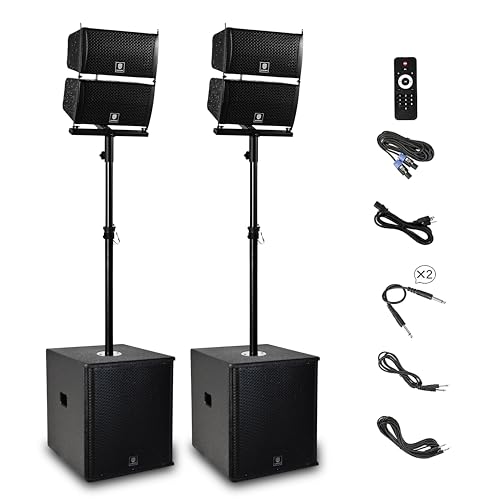
 PRORECK Club 4000 18-inch 4000W P.M.P.O Stereo DJ/Powered18 INCH23 x 24 x 24 inches88.2 poundsCheck on Amazon


Quick picks by venue and use
| Situation | Best starting point | Why it fits | Main compromise |
|---|---|---|---|
| Bedroom, small bar, or mobile DJ under about 100 guests | One powered 15-inch subwoofer | Compact transport, enough extension for dance music, and easier level matching | Less deep and less effortless than an 18-inch cabinet |
| Wedding, party, or club room with 100–250 guests | One powered 18-inch subwoofer | More cone area and headroom for kick drums and bass-heavy music | Heavier, larger, and more demanding of vehicle space |
| Large hall, outdoor event, or sustained high volume | Two matching 18-inch subwoofers | Higher output, more even bass coverage, and lower strain per cabinet | Much higher cost and transport requirements |
| Frequent setup by one person | 15-inch subwoofer with casters and ergonomic handles | Weight matters more than headline wattage during every load-in | May run out of low-end authority sooner in a large room |
What to match: wattage, driver size, and enclosure
Wattage is a headroom specification, not a direct room-size rating. A 2,000-watt peak label does not automatically make one subwoofer twice as loud as a 1,000-watt model. Manufacturers measure and describe amplifier power differently, while maximum acoustic output depends on the driver, enclosure, limiter, tuning, and cooling system. Compare maximum SPL and frequency response where available, but treat those figures as manufacturer specifications rather than a guarantee of identical real-world performance.
For DJ use, a 15-inch driver is often the sensible compromise when portability and cost matter. It can provide strong kick-bass energy while taking up less floor and vehicle space. An 18-inch driver generally moves more air and reaches the bottom octave with less effort, making it preferable for house, hip-hop, EDM, and large dance floors. It is not automatically tighter or better; a well-designed 15-inch cabinet can sound more controlled than a poorly matched 18-inch system.
Most powered DJ subwoofers use a bass-reflex enclosure, also called ported or vented. This design produces useful output efficiently around its tuning frequency, but it can become less controlled below that point. A sealed enclosure is typically more compact and can have a gradual low-frequency roll-off, but it requires more amplifier power for comparable output. For mainstream mobile DJ systems, powered bass-reflex cabinets are the common practical choice.
Notable powered subwoofers to consider
| Model | Driver | Published amplifier rating | Published weight | Useful distinction |
|---|---|---|---|---|
| Electro-Voice EKX-18SP | 18 inches | 1,300 W | Approximately 40.5 kg | Portable 18-inch format with DSP and cardioid-related system features |
| Yamaha DXS18XLF | 18 inches | 1,600 W | Approximately 49.9 kg | High-output extended-low-frequency design with configurable DSP |
| QSC KS118 | 18 inches | 3,600 W peak | Approximately 47.6 kg | Powerful single-box option with adjustable crossover and polarity controls |
| JBL PRX918XLF | 18 inches | 2,000 W peak | Approximately 40.7 kg | Networked DSP control and practical portability for its output class |
| RCF SUB 8003-AS MK3 | 18 inches | 2,200 W peak | Approximately 56 kg | High-output professional cabinet, but notably heavy for solo transport |
Published ratings are not directly interchangeable: some brands emphasize continuous power, while others highlight peak power. The table is useful for identifying size and ownership trade-offs, not for ranking models by wattage alone. Typical market pricing ranges from roughly $500–$1,000 for entry-level powered 15-inch subs, $900–$1,600 for capable midrange 18-inch models, and $1,500–$3,000 or more for professional high-output cabinets.
Connectivity and crossover trade-offs
A powered subwoofer should normally accept a balanced XLR input and provide an XLR high-pass or “top” output. The usual signal path is DJ mixer or controller output to subwoofer input, then subwoofer high-pass output to the left and right main speakers. This prevents the tops from reproducing deep bass they cannot handle efficiently.
Check whether the crossover is fixed, selectable, or fully adjustable. A fixed 100 Hz or 120 Hz setting is quick and dependable, but may not suit every pair of tops. Adjustable filters let you blend a compact 10-inch speaker differently from a 15-inch full-range cabinet. Useful controls include polarity reversal, delay, level, and preset EQ.
- Fixed crossover: simplest for occasional DJs and standardized systems.
- Selectable crossover: a good middle ground when you use two or three speaker sizes.
- Adjustable DSP: best for installed systems, unusual rooms, cardioid arrays, and careful alignment.
- Wireless or app control: convenient for adjustments at the audience position, but it should supplement, not replace, physical controls.
- Cardioid presets: valuable when two or more compatible subs can reduce bass behind the stage, though they require correct spacing, polarity, and delay.
How to size the system without chasing wattage
Start with the main speakers. If your tops are small 8-inch or 10-inch cabinets, one 15-inch subwoofer is often a balanced match. A large 18-inch subwoofer can overpower them unless its level is carefully limited. With 12-inch or 15-inch tops and a busy dance floor, one 18-inch subwoofer is generally the safer choice.
For larger rooms, two subs are often a better investment than one exceptionally powerful cabinet. Placing two subwoofers together increases coupling and output, while separating them across a wide stage can improve bass distribution but may create cancellations at some audience positions. If even coverage matters, test the intended locations with familiar bass-heavy tracks and walk the room before finalizing the setup.
As a practical calculation, suppose one event requires a subwoofer to average 25 hours of operation per year. A $1,200 cabinet costs about $48 per event before transport, repairs, and resale value. A $2,400 professional cabinet used for 100 events costs about $24 per event. The more frequently you work, the more reasonable it becomes to prioritize reliable connectors, cooling, DSP protection, casters, and service support over the lowest purchase price.
Setup steps that prevent common problems
- Place the subwoofer on the floor. Bass-reflex cabinets are designed to couple with the floor; placing one on a stand is unsafe and usually ineffective.
- Connect balanced XLR cables. Avoid unbalanced long runs, which are more vulnerable to hum and interference.
- Engage the high-pass output for the main speakers. This gives the tops more headroom and reduces muddy overlap.
- Set the crossover near the overlap point. Start around 80–100 Hz, then adjust by ear and according to the manufacturers’ recommended settings.
- Begin with the sub level below the tops. Raise it until the kick drum has weight, then stop before bass masks vocals or becomes boomy.
- Check polarity and delay. If bass becomes noticeably weaker near the crossover region, reverse polarity or adjust delay according to the DSP and speaker placement.
- Use limiters as protection, not as a mixing strategy. Repeated limiter activity means the system is being driven beyond a comfortable operating level.
Durability and ownership realities
The parts most likely to suffer are input connectors, power cables, casters, handles, grille fasteners, and the cabinet’s lower edges. A powerful subwoofer is still a transport item: use a padded cover, avoid dragging it over door thresholds, and secure it upright in the vehicle. Some professional models weigh more than 45 kg, so a two-person lift or loading ramp is not optional for safe regular use.
Keep the amplifier vents clear and remove dust with a soft brush or low-pressure air while the cabinet is unplugged. Do not block rear ventilation with curtains or cases. Inspect XLR sockets for looseness, listen for rattling at moderate volume, and check that the grille has not been pushed into the cone. A damaged grille or loose panel can create a buzz that sounds like a speaker fault.
Do not judge a subwoofer indoors by standing directly beside it. Room modes can create excessive bass in one location and almost none a few metres away. Set the system from the audience area, and save DSP presets for recurring venues rather than using one extreme EQ curve everywhere.
Final buying recommendation
Choose a powered 15-inch subwoofer when mobility, modest rooms, and budget are the priorities. Choose a powered 18-inch model when dance music, low-frequency extension, and headroom matter more than carrying convenience. For frequent professional work, select the model with the best combination of maximum output, DSP control, serviceability, connectors, and manageable weight—not simply the largest wattage number. If your events regularly exceed the capacity of one cabinet, two matched subs will usually deliver a more dependable and even result than continually pushing a single subwoofer harder.