What's inside
As an Amazon Associate I earn from qualifying purchases. This post may contain affiliate links at no extra cost to you.
For traditional door mortise-and-tenon joints, a 3/8-inch mortise chisel is the best all-around starting point. It suits many interior door joints, is strong enough for controlled mallet work, and removes waste faster than a narrow paring chisel. But the correct width depends on the mortise, the tenon thickness, and whether you are chopping hardwood or softwood. Choosing the chisel by habit alone is how you end up with bruised shoulders, split stock, or a mortise that is too loose.
As an Amazon Associate we earn from qualifying purchases at no extra cost to you.



Our Top Picks
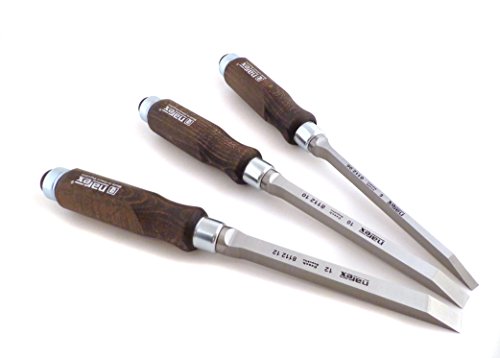
 Narex 4 Piece Richter Mortise Chisel SetOne Size Fits All0 x 0 x 0.1 inches2.2 poundsCheck on Amazon


The basic sizing rule
Choose a mortise chisel that is roughly one-third to one-half the width of the mortise. For a 3/8-inch chisel, a mortise between 3/8 and 1/2 inch wide is comfortable. The chisel should fit inside the mortise without rubbing both side walls during every cut.
For a traditional door joint, the mortise is often sized to match the tenon thickness. A common rule is to make the tenon about one-third of the door stile thickness. On a 3/4-inch interior door, that may produce a tenon around 1/4 inch thick. A 1/4-inch mortise chisel is then the natural choice. On a heavier 1-inch or 1-1/4-inch stile, a 3/8-inch or 1/2-inch tenon and matching chisel may be appropriate.
Do not use a chisel wider than the mortise simply because it removes more material. A wide blade driven into a narrow mortise can crush the walls, especially near the ends of the joint. It also encourages you to twist the handle when the blade binds. That is a common cause of chipped edges and inaccurate shoulders.
Mortise chisel widths compared
| Chisel width | Best use | Advantages | Limitations |
|---|---|---|---|
| 1/4 inch | Light interior doors, narrow rails and small tenons | Accurate in tight mortises; low risk of splitting | Slow in deep or wide mortises; easier to bend if abused |
| 5/16 inch | Small furniture-scale door joints and moderate hardwood work | Useful compromise between speed and control | Less common; may not be included in budget sets |
| 3/8 inch | General-purpose traditional door mortises | Strong, stable and fast enough for most work | Too large for narrow tenons and thin stock |
| 1/2 inch | Heavy doors, wide stiles and substantial exterior joints | Removes waste quickly; resists twisting | Can crush narrow mortise walls; requires heavier mallet blows |
The best choice for most traditional door joints
If you are buying one chisel specifically for door work, buy a 3/8-inch mortise chisel unless your plans clearly call for a smaller or larger tenon. A properly made 3/8-inch chisel has enough steel behind the edge to tolerate repeated chopping, while still fitting common interior door mortises.
For a set of doors or varied joinery, a traditional mortise chisel set is more useful than buying several general bench chisels. Look for widths such as 1/4, 3/8, and 1/2 inch. A set lets you match the tool to the joint rather than forcing every mortise into one size.
The cheaper option is fine if you are cutting a few softwood interior doors and can sharpen the tools yourself. Budget chisels may have rough handles or inconsistent factory edges, but those problems are usually fixable. They are less attractive when you are chopping dense oak, because poor heat treatment can leave an edge that rolls quickly or a blade that bends under a sideways load.
How to use the chisel without damaging the joint
Mark the mortise clearly and chop from both ends toward the center. Start about 1/8 inch inside the layout line, bevel facing the waste, and take shallow cuts. Once the waste is removed, pare back to the line. This protects the finished shoulder from the repeated impact of the mallet.
For a through mortise, work from both faces and meet in the middle. Chopping all the way through from one side often blows out the far face. On a typical 3-inch-deep door mortise, remove waste in stages rather than trying to reach full depth immediately. A practical sequence is to chop 1/4 to 1/2 inch deep, lever out the chips, then repeat.
Keep the chisel vertical when establishing the walls. The bevel helps you steer the cut, but it should not be used as a pry bar. If the blade is tight, stop and clear the waste. Twisting a chisel in a packed mortise can flare the opening at the top, leaving a loose tenon even when the bottom is correctly sized.
Mortise chisel or bench chisel?
A bench chisel can cut a small mortise, and it is acceptable for occasional work in pine or poplar. However, its thinner blade is more vulnerable to twisting and side loading. A dedicated mortise chisel has thicker sides, a shorter blade, and a handle designed for mallet blows. Those features matter when cutting several deep door mortises.
For occasional repairs, a bevel-edge bench chisel set may be the cheaper and more versatile purchase. It can clean shoulders, pare hinge gains, and handle general shop work. Choose a dedicated mortise chisel when the job involves repeated chopping, hard timber, or joints deeper than about 2 inches.
Using a mortiser or drill press
If you are using a hollow-chisel mortiser, match the chisel width to the planned mortise rather than selecting the largest cutter available. A 3/8-inch mortiser chisel usually makes a clean, manageable door mortise, but the machine still leaves rounded corners or compressed fibers that need cleanup. A drill press with a brad-point bit can remove most waste, followed by a properly sized mortise chisel.
For machine work, do not assume a wider chisel is faster overall. Larger cutters require more feed pressure and can scorch hardwood. A smaller cutter may drill a series of overlapping holes with less strain, then clean up quickly with a sharp hand chisel. A 3/8-inch hollow chisel mortiser bit is a sensible general-purpose size for many door projects.
Details that matter more than a tiny width difference
A sharp, square edge is more important than choosing 5/16 inch instead of 3/8 inch. The back should be flat enough to register against a layout line, and the cutting bevel should generally be around 25 to 30 degrees. The handle must tolerate mallet impacts without splitting or loosening. Hoops or a reinforced striking end are useful for heavy work, but not essential for light softwood doors.
Before cutting the actual door parts, test the chisel in scrap from the same timber. If the fibers crumble, the mortise walls split, or the blade needs excessive force, sharpen it or choose a narrower width. The right chisel is the one that reaches the required depth while leaving straight walls and crisp shoulders—not necessarily the one with the largest blade.