What's inside
As an Amazon Associate I earn from qualifying purchases. This post may contain affiliate links at no extra cost to you.
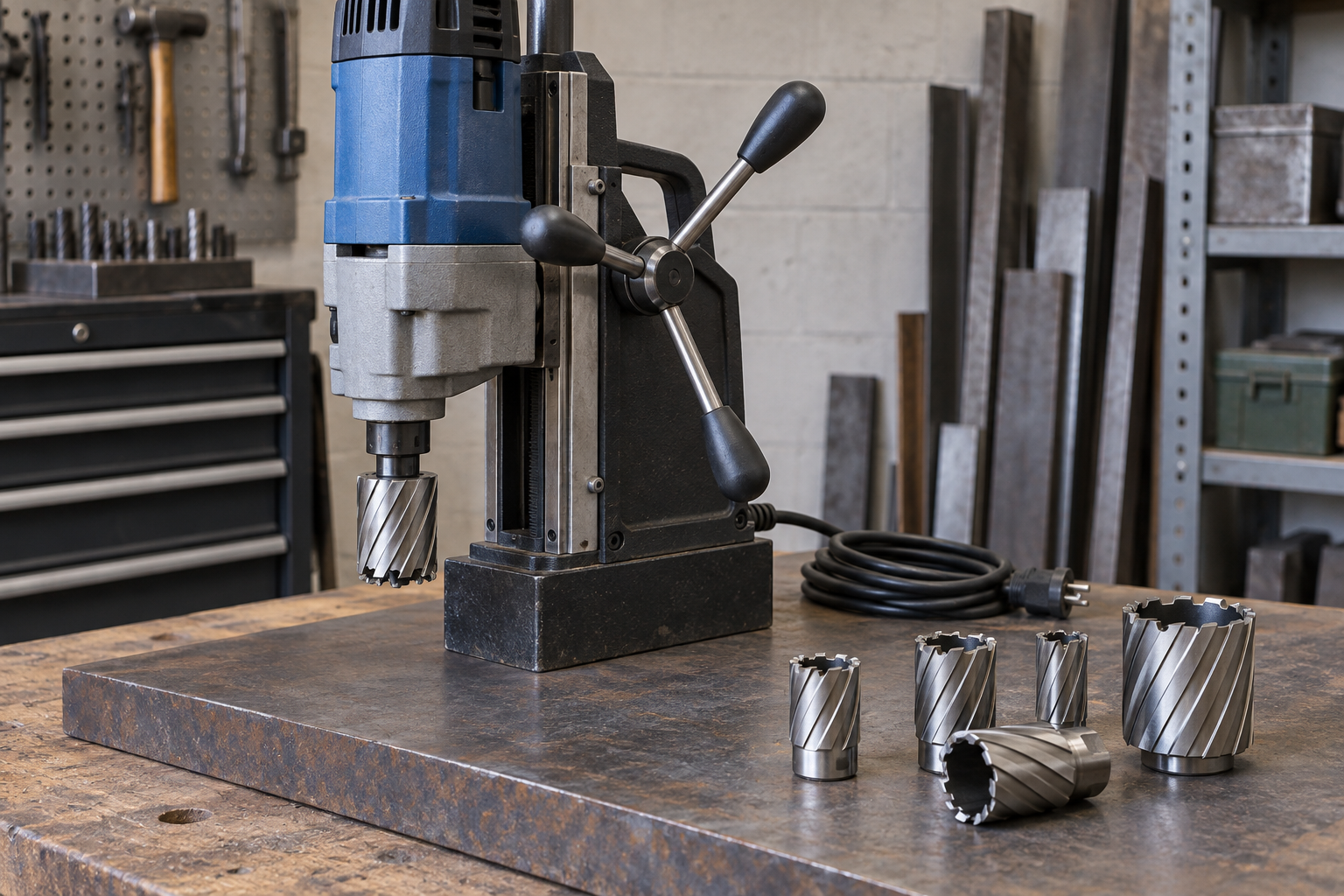
For bolt holes in a steel beam, an annular cutter removes a ring of metal rather than grinding out the entire hole. That usually means a cleaner edge, less cutting time and lower tool load than a twist drill of the same diameter. The best choice depends less on a brand name than on hole diameter, steel thickness, available machine, and whether you need one hole or a run of them.
As an Amazon Associate we earn from qualifying purchases at no extra cost to you.


Our Top Picks


What to buy for the job
For occasional structural-steel work, a high-speed-steel (HSS) annular cutter is usually the sensible starting point. It costs less than a carbide-tipped cutter and works well in mild steel when run at the correct speed with steady feed and cutting fluid. Choose a cutter with a working depth longer than the beam flange or web you are drilling; common depths are 1 inch and 2 inches. The cutter must pass through the full material thickness without its shank or pilot bottoming out.
Carbide-tipped cutters make sense for repeated holes, harder steel, or jobs where faster cutting matters and the machine can hold the cutter rigidly. They cost more and their cutting edges are less tolerant of chatter, a loose setup, or side loading. If the drill is hand-held or the beam is awkwardly positioned, HSS is generally the safer bet.
Compare HSS annular cutters for steel and carbide-tipped annular cutters by diameter, cutting depth and shank compatibility—not just by the number of pieces in a kit.
HSS or carbide: which fits?
| Type | Best use | Advantages | Watch-outs |
|---|---|---|---|
| HSS | Occasional holes in mild steel | Lower cost; more forgiving of minor vibration | Can dull or overheat quickly if run too fast or dry |
| Carbide-tipped | Repeated holes, harder material, production work | Fast cutting; holds an edge well when used correctly | Higher price; brittle teeth can chip from chatter or impact |
| Twist drill | Small holes or work without a magnetic drill | Fits ordinary drills; easy to find in small sizes | Large holes take more effort and make more waste chips |
A twist drill is still a reasonable choice for a small number of holes under roughly 1/2 inch, especially if you already have a suitable drill. For larger bolt holes, an annular cutter is usually quicker and leaves less material to remove. If the hole must meet a specified tolerance or be part of a structural connection, follow the project drawings and applicable fabrication requirements; a clean-looking hole alone does not establish that it is acceptable.
Check the machine before ordering
Most annular cutters are intended for a magnetic drill, which clamps to the steel and holds the cutter square. Check the machine’s arbor and cutter shank type before buying: common systems include Weldon-style shanks, but not every machine accepts every shank or cutter length. Some cutters also require a compatible pilot pin. Do not assume a cutter will fit because its diameter is right.
Use a machine rated for the cutter’s diameter and material. A 1-inch cutter removes a lot more steel per revolution than a 1/2-inch cutter; an underpowered drill may stall, while a fast drill can overheat the teeth. Follow the cutter and drill manufacturers’ speed guidance. As a rough starting point, HSS cutters in mild steel are commonly run at lower speeds than small twist drills; reduce speed as diameter increases. Do not use a fixed RPM as a substitute for the maker’s chart.
A magnetic drill needs clean, flat contact with the beam. Paint, heavy scale, gaps, or a curved surface can weaken its hold. Clean the contact area, secure the drill as directed, and use the safety strap where provided. On thin material, the magnet may not hold reliably; use a properly supported setup rather than trusting the magnet alone.
How to get a clean hole
Mark the center carefully and place the pilot point on it. Start the cutter at a controlled feed so the teeth establish a track instead of skating across the surface. Apply cutting fluid to the cutting area and keep the feed steady: too little pressure rubs and heats the teeth; too much pressure can stall the drill or break teeth. Clear chips when needed and keep hands away from the rotating cutter.
Expect a solid slug to drop when the cut breaks through. Keep it from falling onto someone or damaging equipment, and do not try to catch it by hand. Let the cutter stop before removing chips or checking the hole. A pilot pin helps center the cutter and eject the slug, but it is not a substitute for safe positioning.
Common signs of trouble are blue or discolored chips, squealing, a ragged hole, and a cutter that starts to wobble. Stop and check speed, lubrication, cutter condition, arbor fit, and workpiece stability. Continuing with a dull cutter often produces more heat without improving the hole. Replace damaged or chipped cutters rather than forcing them through the beam.
Buying checklist
Before checkout, confirm the bolt-hole diameter, steel thickness, cutter depth, shank, pilot-pin fit, and machine capacity. If your work includes several common diameters, a HSS annular cutter set with a compatible shank can be cheaper than buying cutters one at a time. But a set is poor value if it lacks the sizes you need or includes cutters too short for the beam.
For one or two holes in mild steel, a single HSS cutter and suitable cutting fluid are often enough. For frequent work or hard material, compare the cost of a carbide cutter with the time lost to slower cutting and replacement. Either way, the most important purchase is a cutter that matches the machine and the job—not the biggest assortment or the highest advertised speed.