What's inside
As an Amazon Associate I earn from qualifying purchases. This post may contain affiliate links at no extra cost to you.
Melamine shelving is easy to cut badly. The particleboard core cuts quickly, but the thin decorative coating chips when a tooth lifts it away from the core. A jigsaw can produce a clean, usable edge, but the blade choice matters more than motor power.
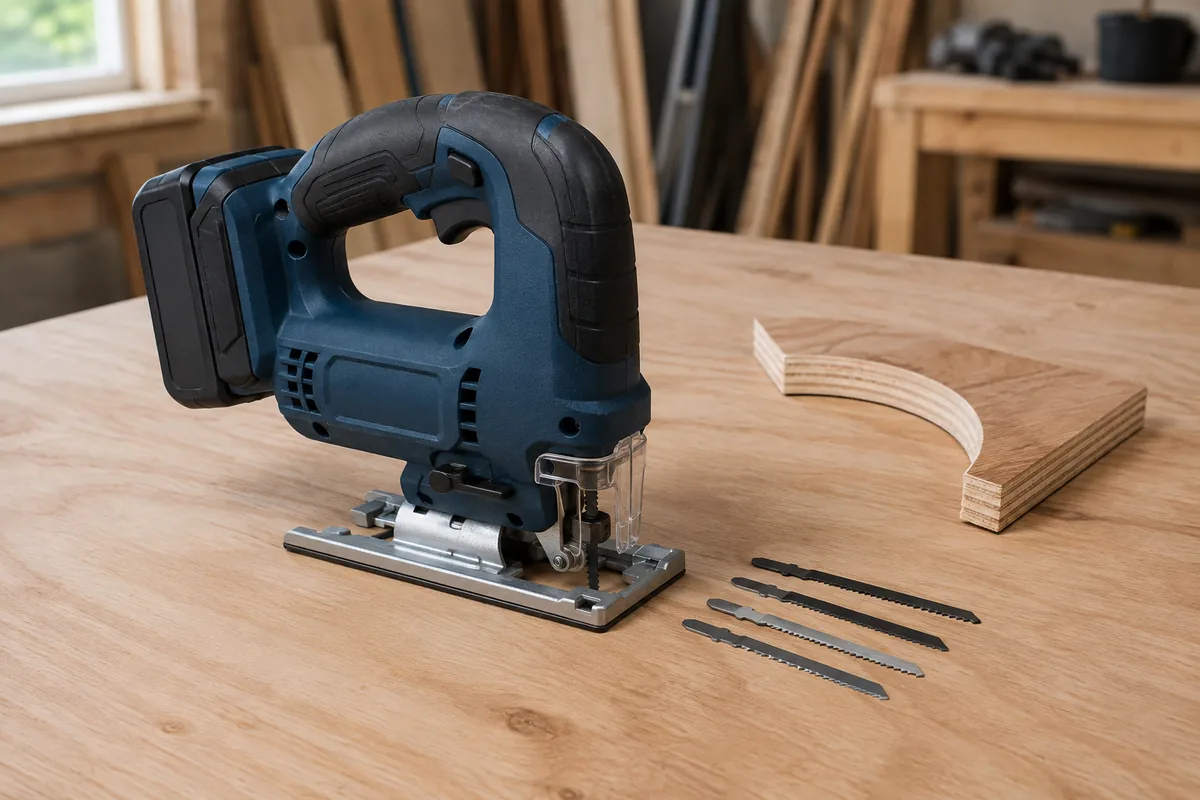
For the cleanest visible top edge, use a reverse-tooth jigsaw blade for melamine. Its teeth cut on the downstroke, pressing the laminate against the board instead of pulling it upward. If the finished face will be on the underside, a conventional fine-tooth laminate blade is often the better choice because it cuts more efficiently and leaves less marking on the work surface.
As an Amazon Associate we earn from qualifying purchases at no extra cost to you.


Our Top Picks
 BOSCH T308B 5-Piece 4-1/2 In. 12 TPI Extra4-1/2'' 12 TPI - 5 pcs0 x 0 x 0 Inches0.2 PoundsCheck on Amazon
 BOSCH T101B 4-Inch 10-Tooth T-Shank Jig Saw Blades4'' 10 V TPI - 5 pcs0 x 0 x 0 inches0.06 PoundsCheck on Amazon


The best blade type for melamine shelving
A fine-tooth, narrow-kerf blade is the safest general choice. Look for blades marketed for laminate, melamine, plywood, or clean wood cuts, rather than aggressive construction blades. A blade with roughly 10 to 14 teeth per inch is a useful range for typical 5/8-inch or 3/4-inch shelving. More teeth generally improve the edge, but they also cut more slowly and can heat up if you force the tool.
| Blade type | Best use | Visible-edge result | Main drawback |
|---|---|---|---|
| Reverse-tooth fine blade | Clean cut on the top face | Usually the best top-surface finish | Slow feed rate; may chip the underside |
| Down-cut laminate blade | Clean cut on the top face with controlled splintering | Very clean, especially on thin panels | Can leave a rough underside and reduced dust clearance |
| Fine-tooth standard wood blade | Clean cut when the finished face is underneath | Good on the bottom face | Often chips the top laminate |
| Coarse construction blade | Fast rough cuts hidden by trim | Usually unacceptable for exposed edges | Heavy chipping and torn core |
Reverse-tooth blades are the most forgiving option when the shelf will be cut with its finished face upward. A down-cut blade can be even cleaner on some melamine, but the downward-facing teeth push chips toward the base of the saw. That can make the tool harder to steer and can clog the cut in thicker material. Check the blade’s tooth direction before starting: the teeth should point toward the shoe for a normal blade, and away from the shoe for a reverse-tooth blade.
What to buy
Buy a small pack of fine-tooth laminate jigsaw blades rather than one premium blade. Melamine dulls blades quickly, especially when cutting through abrasive particleboard or hidden screws. A fresh blade is cheap insurance; once the teeth begin leaving brown burn marks or require pressure, the edge quality drops sharply.
Use the correct shank for your saw. Most current jigsaws accept T-shank blades, but older tools may use U-shank blades. The blade should lock firmly with no noticeable side-to-side play. A thicker blade tracks straighter, while an extra-thin blade turns more easily but can wander in a long shelving cut. For a straight crosscut, choose a blade with enough body to resist bending rather than the narrowest scroll-cut blade.
If the cut edge will be hidden behind edge banding or inside a cabinet, the cheaper option is fine. A basic fine-tooth wood blade, painter’s tape, and careful feeding can produce an acceptable result. Spend more on a reverse-tooth or specialty laminate blade when the cut edge will remain visible, particularly on white melamine where dark chips in the core stand out.
How to prevent splintering during the cut
Mark the cut on the back of the panel when possible, then place the finished face down and use a standard fine-tooth blade. This puts the blade’s upward cutting action on the hidden side. If the finished face must remain up for layout or support reasons, use the reverse-tooth blade instead.
Apply low-tack painter’s tape over the cut line and mark on the tape. The tape supports the coating and makes the line easier to see. It is helpful, but it does not replace a suitable blade. Remove it by pulling it back over itself, not straight upward, to reduce the chance of lifting the melamine surface.
Support the sheet on both sides of the cut and clamp a straightedge as a guide. The jigsaw shoe should stay fully supported throughout the cut. A loose offcut can vibrate during the final few inches, tearing the laminate even when the rest of the cut is clean. For a shelf, support the panel on sacrificial foam or evenly spaced scrap blocks so the blade will not strike the workbench.
Set the saw’s orbital action to zero. Orbital movement makes the blade travel forward on each stroke, which speeds up ordinary lumber cutting but increases chipping in melamine. Run the saw at a moderate-to-high speed and feed it slowly enough that the motor does not bog down. Do not force the blade sideways to stay on the line; release pressure, let it straighten, and resume the cut.
Common failures and better alternatives
A chipped first inch often results from starting directly on the edge. Start with the blade fully supported by the shoe, or make a short entry cut from the waste side. Chipping at the exit usually means the offcut was unsupported or the blade was pushed too quickly near the end.
Burn marks indicate excessive friction, a dull blade, or an overly slow feed. Replace the blade before trying to solve the problem with more speed. A blade that wanders can be bent, dull, too thin for the panel, or being pushed sideways. Do not expect a jigsaw to match the edge accuracy of a track saw or table saw over a long cut.
For the highest-quality visible edge, score the cut line with a sharp utility knife first, use a fresh reverse-tooth blade, and leave a fraction of a millimeter of waste for light sanding. Sand only with a fine block, around 180 to 220 grit, and keep the block flat. Aggressive sanding rounds the edge and exposes more of the dark particleboard core.
The practical pick
For most melamine shelving, choose a fresh fine-tooth reverse-tooth blade when the finished face must stay up. Pair it with zero orbital action, painter’s tape, full support, and a slow, steady feed. Choose a standard fine-tooth blade when you can cut with the finished face down. The cheaper blade is sufficient for hidden cuts, but a sharp specialty blade is worth the small extra cost when the edge is part of the finished cabinet.