What's inside
As an Amazon Associate I earn from qualifying purchases. This post may contain affiliate links at no extra cost to you.
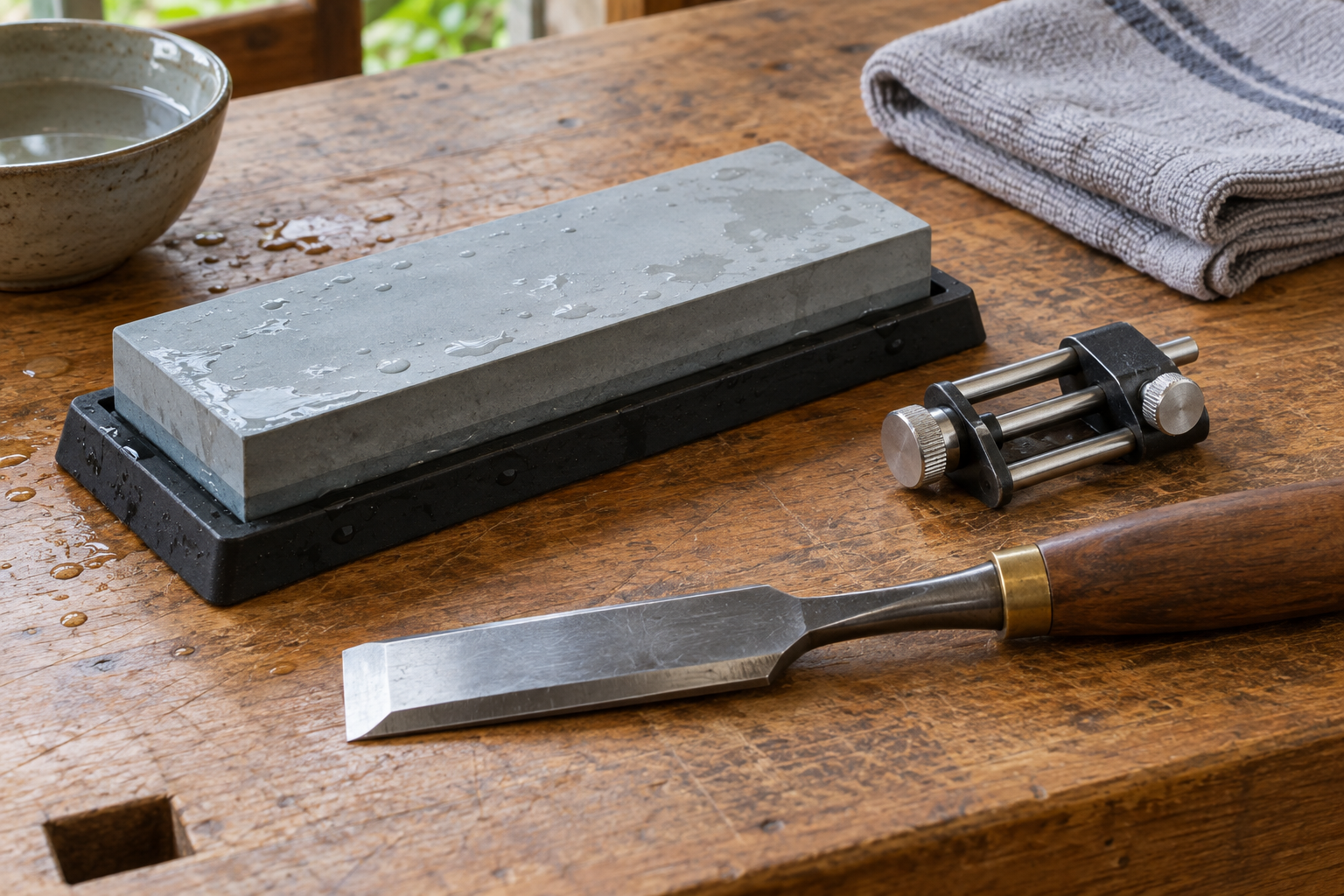
For sharpening bench chisels, diamond plates and waterstones can both produce a keen, durable edge. The better choice depends less on ultimate sharpness than on how often you sharpen, how much maintenance you will tolerate, and whether you need to remove steel quickly.
Diamond plates are fast, clean, and nearly maintenance-free. Waterstones give excellent feedback and a highly polished edge, but they require flattening and more care. Neither system is automatically better for every chisel or every workshop.
Diamond Plate vs. Waterstone at a Glance
| Factor | Diamond plate | Waterstone |
|---|---|---|
| Speed | Very fast, especially on damaged edges | Fast when fresh and properly soaked |
| Maintenance | Wipe clean; no flattening normally required | Must be flattened as it dishes |
| Edge feel | Hard, consistent, and somewhat scratchy | Softer feedback with clear tactile control |
| Best common grits | 325, 600, 1,200 | 800–1,000, 3,000–4,000, 6,000–8,000 |
| Cost over time | Higher initial cost; long service life if used correctly | Often cheaper initially; stones eventually wear away |
| Mess | Minimal water and metal swarf | Slurry, runoff, and a wet sharpening area |
Where Diamond Plates Work Best
A diamond plate is the practical choice when a chisel needs significant steel removal. A 325-grit plate can repair a nick, reshape a bevel, or establish a new secondary bevel far faster than a fine waterstone. For routine sharpening, a 600-grit plate followed by a 1,200-grit plate is a workable two-step setup.
Diamond plates also stay flat, which matters when flattening the back of a chisel. The first inch or two behind the cutting edge must be genuinely flat, not merely shiny. A plate makes that job straightforward, particularly on a new chisel with machining marks.
The main failure mode is excessive pressure. Diamond abrasive is bonded to a metal surface, and pressing hard can tear diamonds from the plate or wear a hollow into the tool’s surface. Use light pressure, plenty of water or lubricant recommended by the manufacturer, and let the abrasive cut. A quality plate should not be treated like a file.
Very coarse diamond plates can also leave deep scratches that take time to remove. A 300- or 325-grit plate is excellent for repair work but is unnecessarily aggressive for every sharpening session. If you want this approach, a 600- and 1,200-grit diamond sharpening plate set is more versatile than a single extra-coarse plate.
Where Waterstones Have the Advantage
Waterstones remove steel quickly because their abrasive continually breaks down, exposing fresh particles. That softness gives them a smooth cutting action and useful feedback. You can hear and feel when the chisel is flat, when the angle changes, and when the burr reaches the edge.
A typical bench-chisel progression is 1,000 grit for establishing the edge, 4,000 grit for refining it, and 8,000 grit for polishing. Many woodworkers can stop at 4,000 grit and get an edge that is more than sharp enough for general joinery. The 8,000-grit step improves the feel on paring cuts, but it does not compensate for a poor bevel or a rounded back.
Waterstones are also forgiving when sharpening by hand. Their surface gives slightly under the tool, and the slurry helps carry away swarf. A 1,000/4,000 waterstone sharpening set covers the needs of most bench chisels without buying a seldom-used ultra-fine stone.
The unavoidable drawback is dishing. A 1,000-grit stone may develop a hollow after only a few sharpening sessions, especially if you work the center of the stone. Flatten it before the hollow becomes obvious. A dished stone rounds the chisel’s edge and makes back-flattening inaccurate.
Technique Matters More Than the Abrasive
Most bench chisels sharpen well at a primary bevel of roughly 25 degrees and a secondary bevel of 30 degrees. The secondary bevel only needs to be about 1/32 inch wide. It reduces the amount of steel removed during future sharpening and is faster than repeatedly polishing the entire primary bevel.
On either abrasive, begin with the back flat on the surface. Work until the scratch pattern reaches the cutting edge, then sharpen the bevel while holding the angle consistently. A honing guide can make this easier, although freehand sharpening is faster once practiced.
Finish by removing the burr from the back and bevel. A wire edge left in place will fold over during the first cut and make a sharp chisel seem dull. Strop only lightly. Heavy stropping can round the edge, particularly on a chisel back.
Cost, Durability, and Everyday Ownership
Waterstones are usually the cheaper way to start. A basic combination stone can handle ordinary maintenance, and inexpensive stones are perfectly adequate if you flatten them regularly. The trade-off is buying or making a flattening system and keeping the stones from freezing, drying unevenly, or collecting grit.
Diamond plates cost more per sharpening surface, but they are convenient for a small shop or a worker who sharpens intermittently. They do not need soaking, and a plate can be ready in seconds. The diamond surface eventually wears, usually first in the area where you sharpen most often. It may still be useful afterward for rough work, but it will cut more slowly.
For flattening waterstones, a diamond stone flattening plate is faster and more reliable than sandpaper on glass. If you already own a flat diamond plate, it can sometimes serve this role, but check the manufacturer’s instructions before using it on a valuable stone.
Which One Should You Buy?
Choose diamond plates if you want minimal setup, regularly repair damaged edges, sharpen several tools in a session, or need a dependable flat surface for chisel backs. A coarse plate plus a medium or fine plate is enough for utility work, with stropping or a separate fine abrasive if you want more polish.
Choose waterstones if you value tactile feedback, want the lowest reasonable entry cost, and do not mind flattening stones. For most furniture and general woodworking, a 1,000/4,000 combination stone is the sensible starting point. Add an 8,000-grit stone only after your technique and maintenance are consistent.
If the chisel is already in good condition, the cheaper option is fine. The biggest improvement usually comes from a flat back, a consistent 30-degree secondary bevel, and complete burr removal—not from switching to a more expensive abrasive.