What's inside
As an Amazon Associate I earn from qualifying purchases. This post may contain affiliate links at no extra cost to you.
A fastener tucked behind an alternator, power-steering pump, or other engine accessory is awkward for two reasons: your hand has little room to swing, and the tool head has to reach around an obstruction. A flex-head ratchet helps by letting the handle work at an angle to the socket. It does not automatically make the fastener accessible, though. Head thickness, handle length, socket clearance, and the hinge’s ability to hold its position matter just as much.
As an Amazon Associate we earn from qualifying purchases at no extra cost to you.


Our Top Picks



What to buy for a tight engine bay
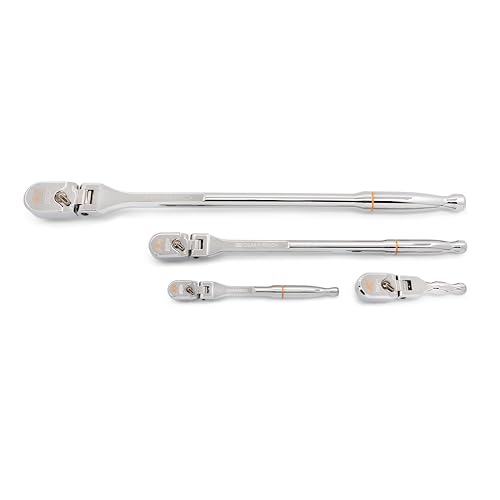
For most automotive work, a 3/8-inch-drive flex-head ratchet is the useful middle ground. It accepts common sockets, handles moderate fasteners, and is less bulky than a 1/2-inch ratchet. A 1/4-inch model can reach smaller hardware in very cramped spaces, but has less leverage; a 1/2-inch model offers more leverage but may not fit behind the accessory.
If access is the main problem, look for a slim head and a flex joint with enough friction to stay where you place it. A head that flops freely can fold back against the engine or bracket while you try to start a fastener. A locking flex head holds a selected angle more securely, but its locking mechanism can add bulk. Compare the head dimensions and hinge design rather than choosing by tooth count alone.
For a general-purpose option, compare 3/8-inch flex-head ratchets. If the fastener sits in a particularly narrow gap, a slim 1/4-inch flex-head ratchet may fit where a larger tool cannot.
Compare the main options
| Ratchet type | Best fit | Main trade-off |
|---|---|---|
| 3/8-inch flex head | Common accessory and bracket fasteners | Head may be too large for narrow gaps |
| 1/4-inch flex head | Small fasteners and restricted clearance | Limited leverage; easier to overload |
| 1/2-inch flex head | Larger fasteners with room to swing | Bulky head and socket package |
| Flex-head breaker bar | Breaking loose stubborn fasteners | Longer and less convenient for rapid turning |
| Fixed-head ratchet | Open access and repetitive turning | Handle angle cannot adapt around an obstruction |
Features that matter more than marketing claims
Head profile: Measure the gap between the fastener and nearby parts, then account for the socket as well as the ratchet head. A low-profile ratchet can still fail if a deep socket hits a pulley or bracket. A shallow socket may solve that problem, but only if it fully seats on the fastener.
Flex-joint control: A freely moving joint is quick to reposition, but it may not stay put under load. A locking joint is useful when the handle must remain at a precise angle. Check whether the lock can be operated easily with greasy hands and whether its housing adds width where clearance is tight.
Handle length and leverage: A longer handle gives more leverage, but needs more room to move. In a restricted bay, a compact handle may let you make a short stroke, sometimes only 10–20 degrees. That can still be effective with a fine-tooth ratchet, although fine teeth do not make a fastener safe to loosen with excessive force.
Drive size and strength: Choose the drive to suit the fastener and available space. Do not use a small ratchet as a substitute for a breaker bar on a seized fastener. The handle, pawl, square drive, or flex joint can fail under high load. Once the fastener breaks loose, the ratchet is useful for spinning it out quickly.
How to work the fastener without damaging anything
Start with a correctly sized, fully seated socket. If the fastener is hard to reach, use a short extension only when it improves alignment; a long extension can wobble and make the socket slip. Set the flex head so the handle clears the accessory through the usable part of its stroke. If it keeps collapsing, reposition it or use a locking head rather than trying to hold the hinge in place with your fingers.
Before applying force, confirm that the socket is square on the fastener and that the ratchet is set to loosen. Pull smoothly instead of jerking. If the fastener will not move with moderate force, stop and reassess: corrosion, threadlocker, a hidden retaining feature, or the wrong direction may be the cause. Use penetrating oil where appropriate and allow it time to work. For a stubborn fastener, switch to a suitable breaker bar if there is room, keeping the force controlled and away from hoses, wiring, and plastic parts.
Engine-bay fasteners are easy to drop. Place a rag or magnetic pickup below the work area when practical, and keep the ratchet and socket away from moving or hot parts. If the engine has recently run, let it cool before reaching near exhaust components. After removal, inspect the fastener and threads; a ratchet can remove a bolt, but it cannot correct damaged threads or a rounded head.
When the cheaper ratchet is enough
A basic 3/8-inch flex-head ratchet is a sensible buy if you work on your own vehicle occasionally and the joint holds its angle without excessive play. You do not need a premium finish or the highest advertised tooth count for every job. Pay more when you use the tool often, need a particularly slim head, want a dependable locking joint, or expect repeated high-load work. For a one-off, accessible fastener, a regular ratchet and short extension may be cheaper and less awkward than a flex-head model.
If the fastener is boxed in by brackets or sits close to a pulley, compare compact options such as compact locking 3/8-inch flex-head ratchets. When the joint still cannot clear the obstruction, a flex-head ratcheting wrench may fit around the fastener better, though it gives you less freedom to change socket size and reach.