What's inside
As an Amazon Associate I earn from qualifying purchases. This post may contain affiliate links at no extra cost to you.
A shallow impact socket usually gives better access around a protruding stud because it leaves more of the fastener and surrounding area exposed. A deep socket is the better choice when the nut sits far down the stud, or when a short socket cannot reach it. Neither is universally better: the deciding measurement is how much stud extends past the nut, plus the clearance available around it.
As an Amazon Associate we earn from qualifying purchases at no extra cost to you.


Our Top Picks


What the difference means
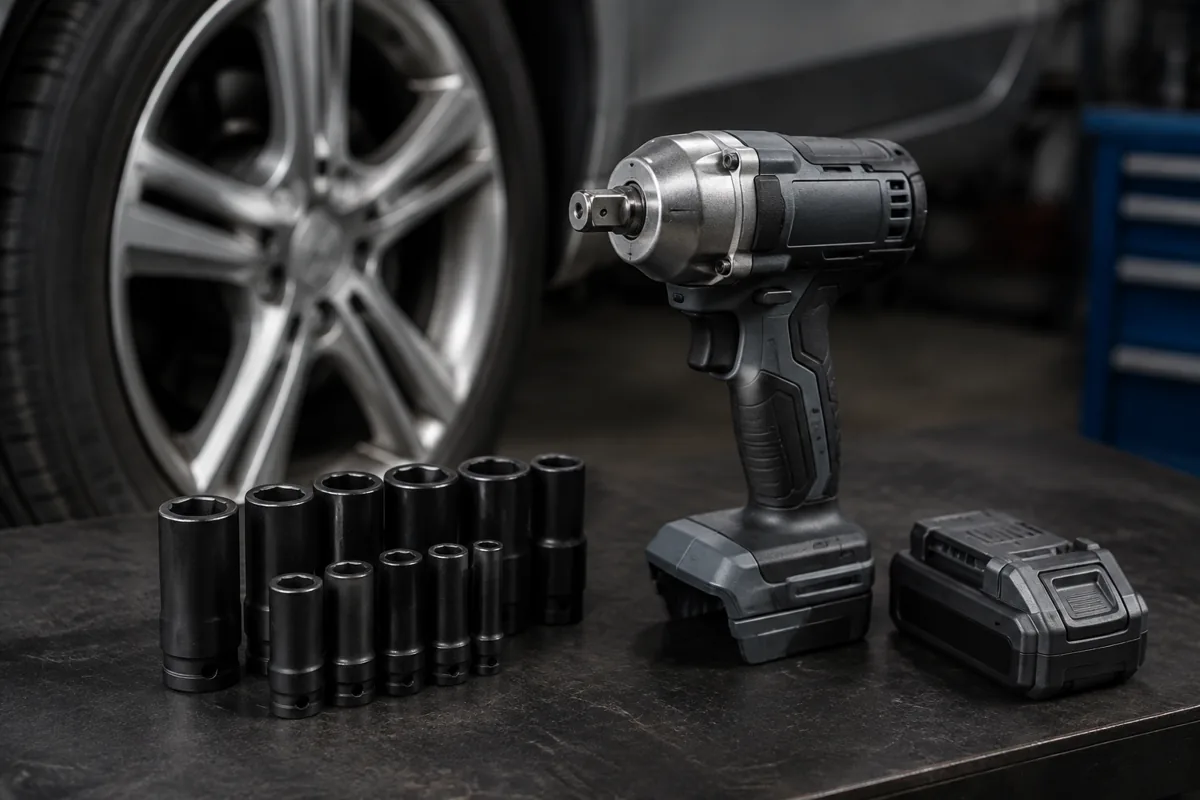
A shallow impact socket is shorter from the drive end to the working end. A deep impact socket has a longer barrel, giving it room to cover more of a stud or reach a recessed nut. Exact lengths vary by socket size and manufacturer, so check the product dimensions rather than assuming every “deep” socket is the same length.
Both are designed for use with an impact wrench or impact driver when the drive size and tool connection are compatible. Impact sockets are typically made from tougher, more ductile material than ordinary chrome hand sockets. Do not use a chrome hand socket on an impact tool: repeated hammering can crack it and send fragments flying. Wear eye protection, and keep hands clear of the rotating socket.
Access around studs: where shallow wins
When a nut is near the end of a stud, a deep socket can run into trouble before it reaches the nut. The stud may bottom out inside the socket, leaving the socket short of full engagement. This is especially common with wheel studs, exhaust hardware, and long threaded rods. A shallow socket avoids that problem when its internal depth is enough for the amount of exposed stud.
The shorter body can also help when a nearby bracket, suspension arm, or body panel limits the straight-line space available to the tool. Less socket length means less overall reach from the wrench, although the wrench itself may still be the limiting factor. If the tool cannot line up squarely with the nut, changing socket depth alone may not solve the access problem.
Shallow sockets are often the practical first choice for routine fasteners where the nut is close to the end of the stud. They are usually easier to fit in tight spaces and less likely to collide with nearby parts. But “shallow” does not mean suitable for every stud: check that the socket fully seats on the nut without the stud contacting its closed end.
When deep is better
Use a deep socket when the nut is well down a long stud, when a stud projects substantially beyond the nut, or when the fastener is recessed in a channel or bracket. The added length lets the socket reach the nut while enclosing the excess thread. If the nut is not fully seated in the socket, impact loads are concentrated on fewer flats, which can round corners or damage the fastener.
The trade-off is added bulk. A deep socket may hit a nearby component or make it harder to keep the tool straight. It also moves the working end farther from the impact wrench, increasing the chance of awkward alignment and making the setup feel less controlled. Avoid using a long extension as a casual substitute for a deep socket: it changes the reach and can add flex, though a proper extension may be necessary when access dictates.
Quick comparison
| Factor | Shallow impact socket | Deep impact socket |
|---|---|---|
| Stud clearance | Best when little thread extends past the nut | Best when the stud projects through or beyond the nut |
| Nearby obstructions | Shorter body is less likely to collide | Longer body needs more clearance |
| Reach into recesses | Limited | Usually better |
| Common failure | Stud bottoms out before the socket seats fully | Socket hits surrounding parts or prevents straight alignment |
How to choose the right one
Before buying, measure or inspect three things: the nut size across the flats, how far the stud sticks past the nut, and the available clearance from the nut to the nearest obstruction. Test-fit the socket with the tool off. It should sit fully over the nut, clear the end of the stud, and meet the fastener squarely. If the socket rocks or only catches the outer edges, stop and choose a better-fitting option.
For a vehicle wheel nut, first confirm whether the job needs a standard impact socket or a thin-wall socket. A regular deep socket can be too wide for a narrow wheel recess, while a thin-wall socket can have less material around the working end. Do not force a socket that binds against the wheel; it can damage the finish or become trapped.
If you are building a basic impact set, a shallow set covers many accessible fasteners, but it will not replace deep sockets for long studs. A shallow impact socket set is a sensible lower-cost start if your work rarely involves long exposed studs. For broader coverage, choose a set that includes both lengths or buy the sizes you use most in each depth. A deep impact socket set is worthwhile if you regularly work on studs, recessed nuts, or longer threaded fasteners.
Common mistakes and safer use
Do not choose depth by appearance alone. A deep socket that reaches the nut but cannot fit between surrounding parts is no use; a shallow one that bottoms out on the stud can leave the nut partly engaged. Check fit before applying power. If a nut is badly rusted or seized, an impact wrench may spin without loosening it or may round the fastener. Penetrating oil, the correct socket, and a controlled attempt are preferable to repeated hammering.
For final tightening on a wheel or other torque-critical fastener, use the method and torque specification provided by the equipment or vehicle maker. An impact wrench is useful for removal and snugging, but it does not reliably control final torque. A torque wrench and the specified sequence are the safer way to finish.
The practical choice
For better access around studs, choose shallow when it clears the stud and fits the surrounding space; choose deep when the stud or recess prevents the shallow socket from seating. If you work on both kinds of fasteners, owning both depths in common sizes is more useful than trying to make one do every job. The cheaper shallow-only option is fine for occasional work on short studs and open fasteners, as long as you verify full engagement before using the impact tool.