What's inside
As an Amazon Associate I earn from qualifying purchases. This post may contain affiliate links at no extra cost to you.
Our Top Picks
 Triplett TT-200 LongLockers 15-inch Extended Reach Locking Pliers15 x 2.5 x 0.75 inches1.1 poundsCheck on Amazon



Why long-reach pliers help behind an engine
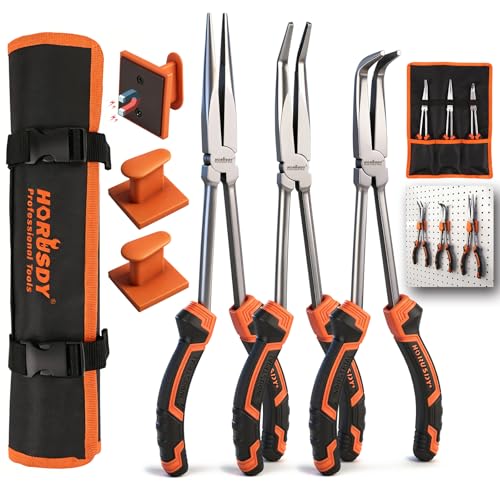
A dropped nut, washer, or hose clamp can land where fingers and standard pliers cannot reach. Long-reach pliers give you a narrower approach and more control from above the engine bay. They are useful for retrieving loose hardware, guiding a fastener toward an open space, or holding a small part while you lift it out.
They are not a substitute for a flexible pickup tool when the part has fallen deep into a gap. Pliers need a clear path to the object and enough room for their jaws to open. If the fastener is wedged, pulling hard can send it farther down or damage a nearby wire, hose, or connector.
As an Amazon Associate we earn from qualifying purchases at no extra cost to you.



What to buy for the job
For most engine-bay retrieval, start with straight, slim long-nose pliers around 11 to 13 inches long. They reach farther than standard pliers but are still manageable in tight spaces. Look for a narrow head, serrated jaws, and a return spring if you expect repeated use. A spring helps the jaws reopen, though it can make precise one-handed positioning harder for some users.
If the fastener is several inches below an obstruction, angled or bent-nose pliers can approach it without forcing the handles against the bodywork. For a part that is loose but out of sight, a flexible claw pickup tool is often the better first choice. Its three- or four-prong tip can grab small objects in places where plier jaws cannot line up.
Compare 11-inch long-nose pliers for a general-purpose option. If access is obstructed, consider long-reach bent-nose pliers instead of buying a longer straight tool that may not fit the approach angle.
Compare the main tool types
| Tool type | Best use | Typical trade-off |
|---|---|---|
| Straight long-nose pliers, 11–13 inches | Gripping a visible nut, washer, or clamp in a narrow passage | Needs a fairly direct line to the part |
| Long bent-nose pliers | Reaching around a lip or hose while keeping the handles clear | Less intuitive for precise alignment; the bend can hide the tip |
| Flexible claw pickup tool | Retrieving loose hardware from a deep, blind gap | Limited grip on heavy or tightly wedged parts |
| Magnetic pickup tool | Recovering a ferrous steel fastener from a reachable gap | Will not pick up aluminum, brass, or many stainless fasteners |
A basic pair of long-nose pliers is usually enough for visible hardware and occasional repairs. Paying more can make sense if the tool gets regular use: smoother joints, better jaw alignment, and comfortable grips reduce frustration during controlled work. For a one-time dropped washer, a budget pair may be fine, provided the jaws meet squarely and do not twist under light pressure.
Reach, jaw shape, and grip
Length is not the only measure that matters. A 13-inch tool may reach farther than an 11-inch one, but its wider handles need more swing room, and small movements at the handles can produce larger movements at the tips. In a crowded bay, that makes a longer tool harder to steer. Choose the shortest pliers that reach the fastener with a little room to maneuver.
Check the tip width against the space around the part. Slim jaws can enter tighter gaps, but they have less contact area and may bend if used to pry. Serrations help grip a round nut or smooth washer; they can also scratch soft aluminum or plastic. If the object is delicate, grip its edge lightly, or use a claw tool rather than squeezing harder.
Retrieve the fastener without making things worse
Work with the engine off and cool. Remove the key, keep loose clothing clear, and use a light to locate the fastener before reaching in. If you cannot see the tip of the tool and the part at the same time, move a hose or cover only if doing so is safe and straightforward. Do not use pliers to probe blindly around wiring or fuel lines.
Grip the fastener near its center, then lift it slowly along the path it entered. If it slips twice, stop and change the angle rather than clamping harder. A tilted washer can rotate out of the jaws; a nut caught on a ledge can wedge more tightly when pulled straight up. For hardware sitting deep below a brace, try a flexible claw pickup tool or magnetic pickup tool if the fastener is steel. Keep a magnetic tool away from sensitive components when you are unsure whether it is appropriate.
Common mistakes and when to choose another tool
Long-reach pliers are for gripping, not prying. Using them as a lever can spread the jaws, damage the pivot, or gouge a nearby surface. Avoid squeezing onto a bolt’s threads if you can reach its head or nut instead. If the fastener is trapped beneath a component, forcing it can bend a bracket or tear a hose; removing the obstructing part may be quicker and safer.
For a lost fastener that has fallen through a narrow, deep opening, a flexible claw tool is usually more forgiving than pliers. For a visible steel nut on a ledge, a magnetic pickup tool may retrieve it with less risk of knocking it away. Keep both tools, or a modestly priced pickup tool alongside ordinary long-nose pliers, if you work on vehicles regularly. If you only need to recover a small part once, buy the tool that matches the access: reach alone cannot compensate for jaws that cannot get around the object.