What's inside
As an Amazon Associate I earn from qualifying purchases. This post may contain affiliate links at no extra cost to you.
Our Top Picks


The short answer
A flex-head ratchet usually helps more with recessed bolts because its head can angle around nearby obstructions. A fixed-head ratchet is better when the fastener is accessible, the working space is consistent, and you want maximum rigidity and simplicity.
For most garages and general repairs, a fixed-head ratchet remains the better first purchase. It is cheaper, slimmer in some designs, and less likely to move unexpectedly under load. Add a flex-head ratchet when you regularly work behind brackets, under dashboards, around exhaust components, or in engine bays where a straight handle cannot line up with the bolt.
As an Amazon Associate we earn from qualifying purchases at no extra cost to you.



How the two ratchet types differ
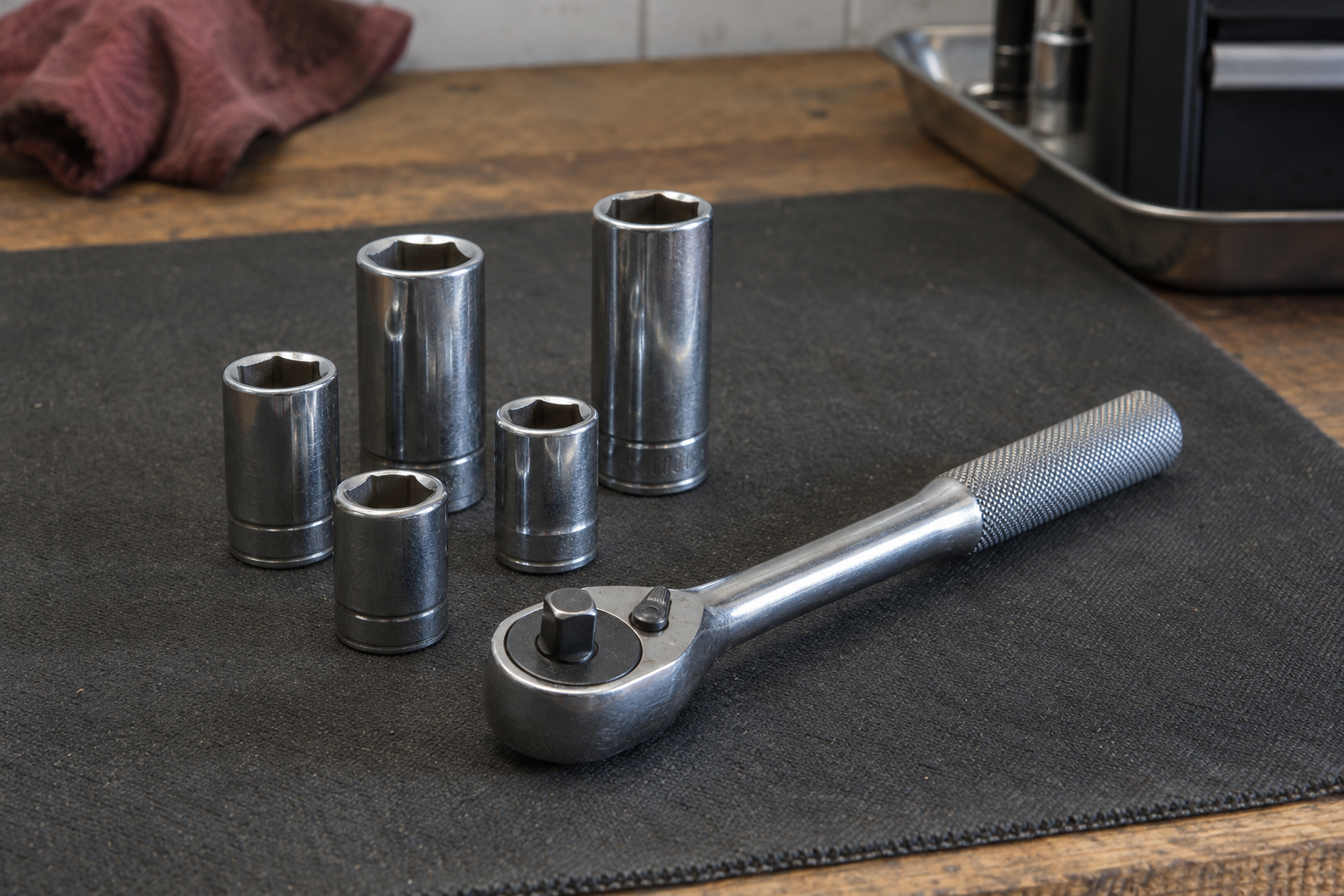
A fixed-head ratchet has a head locked at 90 degrees to the handle. Its drive square stays in a predictable position, so the tool feels solid when you pull. A flex-head ratchet uses a pivot, commonly allowing roughly 90 to 180 degrees of movement depending on the design. You can fold the handle closer to the fastener or swing it away from an obstruction.
That extra movement solves a common access problem: the socket can reach the bolt, but the handle cannot move through a useful arc. With a flex head, you can set the handle at an angle that clears a frame rail, pipe, body panel, or neighboring component.
The trade-off is that the pivot adds parts. A flex ratchet can develop looseness, and the head may fold during a pull unless it has a locking mechanism or sufficiently stiff detents. It is not automatically stronger or more compact in every position.
Flex-head vs fixed-head ratchet
| Feature | Flex-head ratchet | Fixed-head ratchet |
|---|---|---|
| Access around obstructions | Excellent; handle angle can change | Limited to the fixed handle path |
| Rigidity under load | Good to very good, depending on pivot | Usually excellent |
| Risk of unexpected head movement | Possible, especially on non-locking designs | None |
| Typical price | Higher | Lower |
| Best use | Recessed or obstructed fasteners | Open access and routine fastening |
| Maintenance concern | Pivot can collect dirt or loosen | Fewer moving parts |
When a flex head genuinely helps
A recessed bolt is not always deep; often it is simply surrounded by obstacles. For example, a bolt behind a suspension arm may accept a socket easily, but the ratchet handle hits the arm after only a few degrees of movement. A flex head lets you position the handle beside the arm, then make short strokes.
It is also useful when the fastener sits inside a narrow channel. A standard ratchet may need the handle to extend directly outward, where there is no clearance. Angling the head can move the handle into an open area. This is particularly helpful with 3/8-inch-drive tools, which are common for automotive fasteners in the roughly 8 mm to 19 mm range.
However, a flex head cannot fix every access problem. If the socket itself cannot get onto the bolt because of a wall or crossmember, you need a different solution: a shallow socket, deep socket, wobble extension, universal joint, or a combination of extensions. A flex ratchet only changes the angle between the socket and handle.
When the fixed head is the better choice
Use a fixed-head ratchet when you have a clear pull path and need controlled torque. The rigid head gives better feedback when a fastener breaks loose, and there is no pivot to fold under your hand. This matters on stubborn bolts where you are already applying substantial force.
Fixed-head models are also a sensible choice for home maintenance, furniture assembly, lawn equipment, and general mechanical work. If recessed fasteners are occasional rather than routine, buying a 3/8-inch fixed-head ratchet and adding an extension is often cheaper and more dependable than starting with a flex-head set.
A fixed ratchet is not necessarily stronger by a dramatic amount. Drive size, construction, tooth design, and the quality of the pivoting mechanism all matter. Still, the absence of a handle pivot removes one common failure point.
Features that matter on a flex-head ratchet
For recessed work, choose a flex ratchet with a locking head if possible. Locking positions prevent the head from folding when you pull, while still allowing adjustment when access changes. A non-locking flex head can be faster to position, but it demands more careful hand placement and may be frustrating in tight spaces.
Check the pivot for side-to-side play before buying. A small amount of smooth movement is normal; visible looseness or a head that flops under its own weight is a poor sign. The head should remain aligned with the drive square and should not twist noticeably relative to the handle.
Tooth count also affects access. A 72-tooth ratchet advances about 5 degrees per click, while a 90-tooth design advances about 4 degrees. That difference helps when the handle can move only a few degrees, but fine teeth should not be treated as a substitute for strength. For dirty or high-load work, a robust locking flex-head ratchet with a solid pivot is more useful than simply choosing the highest tooth count.
How to use either ratchet on a tight bolt
Keep the socket fully seated on the fastener. In a recessed location, an extension can help keep your hand away from surrounding parts, but excessive extension length increases flex and makes alignment easier to lose. Apply force in line with the handle and use steady pressure rather than jerking.
Do not use a ratchet as a substitute for a breaker bar when a bolt is seriously seized. A ratchet’s reversing mechanism and head are not designed for unlimited abuse. Break the fastener loose with a breaker bar, then switch to the ratchet for removal. If clearance is poor, a flex-head breaker bar may provide reach, but confirm that its pivot is rated for the force you plan to use.
Which should you buy?
Buy a fixed-head ratchet if price, durability, and predictable handling matter most, or if most of your fasteners are exposed. It is the cheaper option and is completely adequate for many jobs.
Buy a flex-head ratchet if you repeatedly encounter blocked handle paths and waste time repositioning extensions or removing nearby parts. For a one-tool solution, a locking flex head offers the best balance of access and control. For a two-ratchet setup, start with a fixed head and add a flex head only in the drive size you use most. That approach avoids paying for flexibility you may rarely need.