What's inside
As an Amazon Associate I earn from qualifying purchases. This post may contain affiliate links at no extra cost to you.
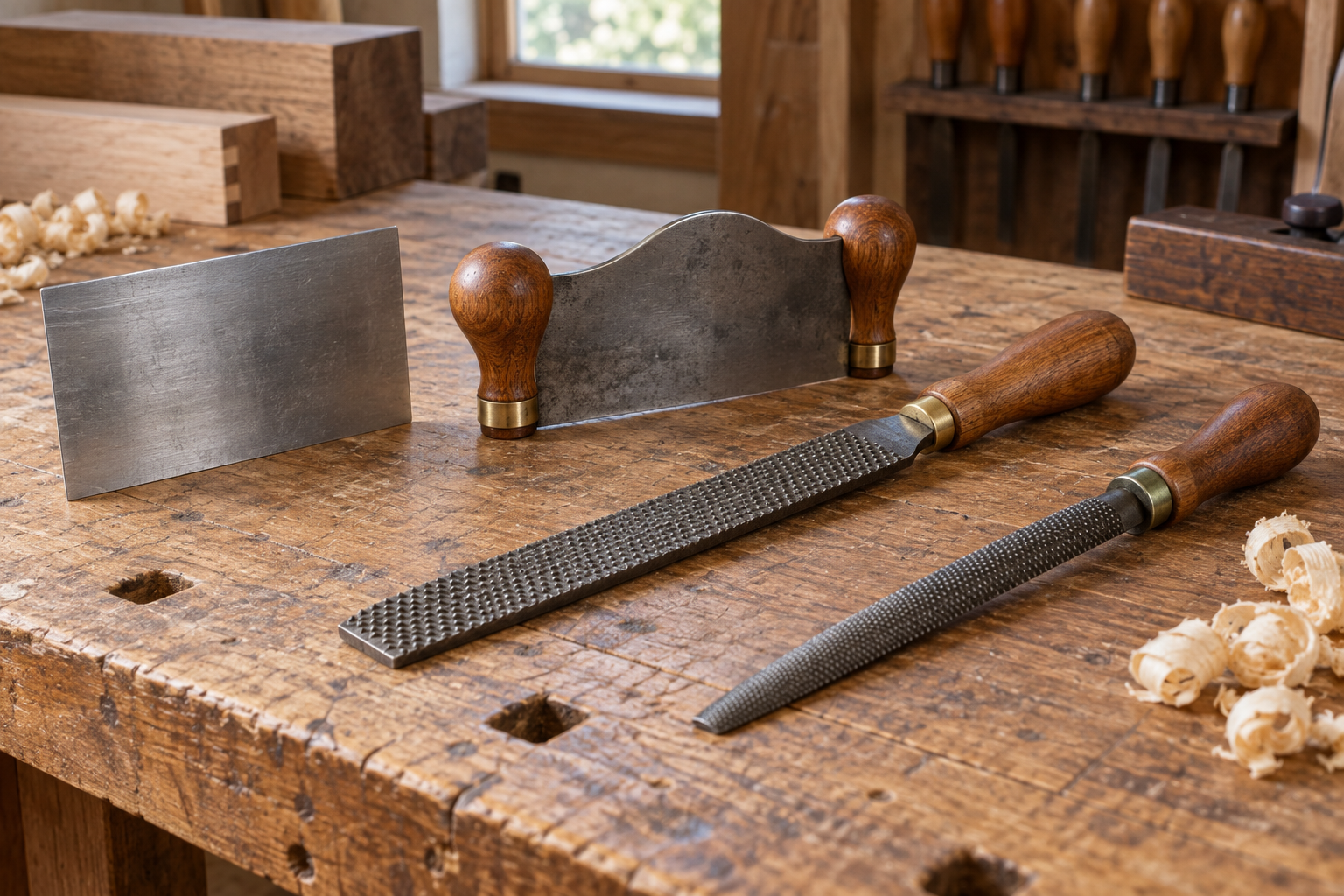
Removing old finish from molding is one of those jobs where the right hand tool beats a power sander. Molding has profiles, corners, beads, and sharp transitions that sanders flatten quickly. A cabinet scraper can lift softened paint and varnish from those details with less dust and better control—but only if the set includes useful shapes and the blades can be sharpened properly.
For most trim work, the best choice is a cabinet scraper set with a burnisher, not a packet of thin, disposable paint scrapers. Look for at least one rectangular card scraper, a gooseneck or curved scraper, and a selection of small profile scrapers. The cheaper option is fine for a few flat door panels, but a molding project exposes the limitations of a basic two-piece set quickly.
As an Amazon Associate we earn from qualifying purchases at no extra cost to you.


Our Top Picks


What to Look for in a Cabinet Scraper Set
A useful card scraper is generally around 0.8 to 1.0 mm thick. Thinner steel flexes more easily and works well on broad, slightly curved surfaces, but it can chatter and lose its edge faster. A thicker scraper is stiffer and more predictable, especially when pushing across hard old varnish.
The scraper’s edges should be straight, square, and free of deep grinding marks. Many inexpensive sets arrive with edges that are technically usable but not ready for fine work. You may need to file the edge flat, polish it with a fine stone, and turn a burr with a burnisher before the scraper produces shavings instead of dust.
For molding, shape matters more than handle design. A rectangular scraper handles wide flat faces. A gooseneck reaches shallow coves and convex curves. Small triangular, half-round, and pointed profiles get into bead detail and inside corners. Avoid sets made entirely from one flat sheet with vaguely decorative cutouts; those shapes often do not match common trim profiles closely enough to be useful.
Cabinet Scraper Set Types Compared
| Set type | Best use | Advantages | Limitations |
|---|---|---|---|
| Basic card scraper set | Flat molding faces and panels | Low cost, easy to control, good on softened finish | Limited reach in coves and beads; needs sharpening |
| Profile scraper set | Decorative molding and detailed trim | Matches curves and grooves better than cards | Shapes may not fit your exact molding; slower to sharpen |
| Handled carbide scraper set | Small repairs and stubborn spots | Ready to use, rigid, long-lasting edges | Can gouge soft wood; less effective on broad surfaces |
| Premium steel scraper set | Large restoration projects | Better steel, cleaner burr, more consistent control | Higher price and still requires technique |
For a whole room of painted molding, a mixed set is the most practical choice. Use the rectangular scraper on the broad faces, then switch to profiles for the detail. If the old finish is thick and brittle, a handled carbide tool can remove the first layer, but it should not be your only scraper.
Best Overall: A Mixed Steel Profile Set
The best cabinet scraper set for removing old finish from molding is a mixed steel set containing three to six shapes, plus a burnisher or clear sharpening instructions. A set such as this costs more than a basic paint scraper, but the extra shapes reduce the temptation to force one tool into every groove.
Choose one with comfortable edges and enough steel around the profiles to prevent bending. A scraper that flexes uncontrollably is difficult to keep flat against a molding edge. Finger pressure should be light; if you have to lean hard on the tool, the edge is dull or the finish has not been softened enough.
Profile sets are not automatically better. A scraper’s shape must match the trim. Before ordering, measure the width of the cove, the radius of the bead, and the depth of the recess. A woodworking profile cabinet scraper set with several narrow shapes is usually more useful than a three-piece set with only large decorative profiles.
When a Cheap Scraper Set Is Enough
A low-cost card scraper set is a sensible buy if you are stripping a small amount of flat trim or testing whether scraping suits the job. You can remove finish from a 6-foot piece of flat casing with one rectangular scraper, a file, a sharpening stone, and a burnisher. There is no reason to buy a large profile set for a single plain baseboard.
Cheap sets become frustrating when the steel is too soft. The burr may disappear after only a few minutes, forcing repeated sharpening. Some bargain scrapers also have rounded corners that cannot reach into a square inside corner. These are acceptable shortcomings for occasional work, but poor value if you are restoring several rooms.
If the set costs less than a comparable single quality scraper, check the edges immediately. Lay each scraper on a flat surface and look for warping. Hold it against a straightedge; a small bow is manageable, but a twisted scraper will leave uneven tracks.
How to Strip Molding Without Gouging It
Start by testing the finish in an inconspicuous area. If a chemical stripper is appropriate for the coating, apply it according to the label and wait until the finish wrinkles or softens. Do not scrape aggressively while the coating is still hard. On painted trim, a heat gun can work, but keep the temperature moving and stay below the point where the wood darkens or the paint smokes.
Hold the scraper at roughly 30 to 45 degrees and push with both hands when possible. Work with the grain on flat sections. On a profile, make short passes that follow the shape rather than trying to clear the entire length in one stroke. Keep the corners of a card scraper slightly lifted; digging a corner into soft pine creates a gouge that sanding may not remove cleanly.
Remove finish in layers. A 2-inch-wide section may need two or three light passes, with a quick brush or vacuum between them. If the scraper skips, leaves shiny strips, or produces powder instead of curled shavings, stop and refresh the burr. For intricate molding, a small detail scraper set for woodworking can reach spots that sandpaper folded around a stick cannot.
Sharpening, Safety, and Final Sanding
Cabinet scrapers cut with a tiny turned hook, not a conventional bevel. File the edge square, polish it, then press a burnisher along the edge with firm, even strokes. A properly turned burr should catch your fingernail lightly. Expect to refresh it every 10 to 20 minutes when removing finish, depending on the coating and wood.
Wear eye protection and a respirator rated for the dust or coating involved. Old paint may contain lead, especially on pre-1978 trim; scraping can create hazardous chips even when it creates less airborne dust than sanding. Collect waste rather than sweeping it into the room.
After scraping, sand only enough to remove remaining finish and scraper marks. Start around 120 grit and move to 150 or 180 grit if the wood will be painted or clear-coated. Excessive sanding rounds over molding profiles—the exact problem the scraper was meant to prevent.