What's inside
As an Amazon Associate I earn from qualifying purchases. This post may contain affiliate links at no extra cost to you.
If you need workholding that you can fold up, throw in a truck, and actually work on away from a bench, the Triton SuperJaws and the Bessey Multi-Purpose Table are two of the most common answers. They solve the same problem in completely different ways: one is a portable clamping jaw, the other is a portable clamping table. Choosing the wrong one means you’ll be fighting your setup on every cut.
As an Amazon Associate we earn from qualifying purchases at no extra cost to you.

What Each Tool Actually Is
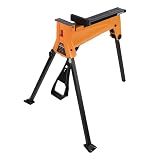
The Triton SuperJaws is a collapsible tripod stand with a foot-pedal-operated jaw. Think of it as a portable vise without a bench. You step on the pedal, the jaws close, and they stay locked until you release them. The SJA100XL version opens to about 39-3/8 inches (1,000mm) wide and clamps with up to 2,200 lbs of force according to Triton. Jaws are steel with rubber faces, and the whole unit folds to roughly 33 x 12 x 10 inches for transport. Weight is about 32 lbs.
The Bessey Multi-Purpose Table (often listed as the BHK 180 or WNS Set) is a folding steel-frame table with a perforated particleboard or MDF top. It’s 40 x 30 inches of work surface that folds flat like an ironing board. Instead of a built-in vise, it relies on Bessey auto-adjust toggle clamps and bench dogs that fit the 20mm holes in the top. Clamping is horizontal and vertical against the top, not between two vertical jaws. Weight is similar at 30-33 lbs depending on version, but folded it’s flat and bulky – about 40 x 30 x 5 inches – not a tripod shape.
How Clamping Works in Practice
With the SuperJaws, you get one-handed (actually, no-handed) clamping. Put your material between the jaws, tap the foot pedal, and it grips. The pedal gives you leverage that a hand screw can’t match, and you can reposition without bending over. It will hold doors, posts, 2x material on edge, even irregular shapes like handrails because the jaws pivot slightly. The downside is that everything is held vertically between two jaws. If you want to rout, sand, or saw flat across a panel, you’re holding it on edge or bridging it awkwardly.
The Bessey holds work flat on the table. You drop in two bench dogs, push your workpiece against them, and clamp from the opposite side with the auto-adjust clamps. Those clamps self-adjust to material thickness from about 0 to 2-3/4 inches and deliver roughly 250-300 lbs of clamping force each. For panel work, trim, or small assemblies, this is far more natural. You have a true reference surface. But you’re limited by the table’s surface and the clamp throat – you can’t clamp a 36-inch door vertically or hold a 4×4 post for planing like the Triton can.
Clamping Force and Capacity Compared
On paper and in the shop, the Triton is much stronger. Bessey’s clamps are fast but light-duty. If you need to hold something immobile for aggressive hand planing, sawing, or drilling with a hole saw, that difference matters.
| Feature | Triton SuperJaws SJA100XL | Bessey Multi-Purpose Table |
|---|---|---|
| Clamping Method | Foot-pedal jaw vise, vertical | Bench dogs + auto-adjust toggle clamps, horizontal |
| Max Opening / Capacity | 39-3/8 in (1,000mm) between jaws | ~2-3/4 in clamp capacity; unlimited length if work sits on table |
| Clamping Force | Up to ~2,200 lbs (foot leverage) | ~250-330 lbs per clamp |
| Ideal Workpiece | Doors, posts, lumber on edge, pipes, long stock | Panels, cabinet parts, trim, flat stock for sawing/routing |
| Work Height | ~32-35 in jaw height | ~32 in table height |
| Collapsed Size | Tripod bundle, easy in narrow van/truck | Flat 40×30 in slab, needs wall or bed space |
| Weight | ~32 lbs | ~30-33 lbs |
For sheer holding power, the Triton wins. For flat-work precision, the Bessey wins. If you try to hand-plane a door edge clamped in Bessey’s horizontal clamps, it will creep. If you try to crosscut a plywood panel held vertically in the Triton, you’ll hate it.
Portability and Setup Time
Both fold in under 30 seconds once you’ve done it a couple times. The Triton’s tripod legs snap open and lock; the jaws stay attached. You can set it up one-handed while holding material in the other. It’s stable on uneven ground because three legs don’t rock. On soft ground or gravel, the feet can sink under heavy load, so put a scrap of plywood under it.
The Bessey table unfolds like a pasting table and locks with side latches. It’s also quick, but you need to store the clamps and dogs separately. They rattle around if you don’t bag them. Four legs make it wobbly on uneven floors, and the particleboard top is sensitive to moisture. Leave it in a damp van overnight and the holes start to swell. Neither tool is truly one-person easy up stairs – both are awkward carries.
Versatility and What You Can Actually Do
The SuperJaws is a single-purpose tool that is very good at that purpose. Triton sells log jaws and other jaw faces, but most people never buy them. You can clamp a 2×10 vertically and saw it, hold a door for hinge mortising, or grip a handrail for sanding. You cannot easily use it as an outfeed table or assembly table – the jaws are in the way.
The Bessey is more of a system. The 20mm hole grid accepts standard bench dogs, and you can add Bessey auto-adjust clamps or any 20mm accessories. It works as a small assembly table, a miter saw stand in a pinch, and a finishing table. You can clamp two or three small parts at once. Maximum workpiece weight is about 150-200 lbs distributed, so don’t use it as a full sheet goods cutting table – it will bow in the center under 3/4 plywood if you don’t support the overhang.
Durability and Failure Modes
The Triton’s weak points are the foot pedal cable and the jaw chain. If you overload it or drop it hard, the cable stretches and the jaws won’t fully close. Keep the mechanism clean – sawdust in the pedal pivot makes it stick open. The steel jaws will rust if left wet, but the frame is powder-coated steel and lasts.
The Bessey’s weak point is the top itself. It’s not marine plywood. Water, polyurethane, or prolonged clamp pressure in the same holes will deform the top. The holes elongate over time if you hammer dogs in and out. The steel frame is solid, but the latches that lock it open can bend if you force it. Replacement tops are available but cost nearly half the table.
Neither tool replaces a real shop vise or a solid workbench for heavy chopping with a chisel or mallet. Both will flex and bounce. If you do that work regularly, bolt a vise to something heavy.
Which Should You Buy?
Buy the Triton SuperJaws if your work is mostly long, heavy, or vertical: hanging doors, installing trim on site, holding posts for notching, or working with 8-foot lumber where you need a vise that goes anywhere. It’s also better if you work alone and need hands-free clamping. The foot pedal is genuinely faster than any F-clamp setup when you’re holding a door with your shoulder.
Buy the Bessey Multi-Purpose Table if your work is mostly flat: cutting cabinet parts, routing small panels, sanding doors flat, or assembling boxes and drawers on site. If you already own Bessey clamps, the system makes more sense, and you get a usable table surface out of it.
For many finish carpenters and remodelers, the cheaper option is actually to keep what you have. If you already own a decent pair of sawhorses and a few good F-clamps, the Bessey doesn’t add much except the perforated top and fast clamps. If you already have a Workmate-style bench, the Triton is a real upgrade in force, but not in versatility.
If you can only own one portable workholding solution and you do mixed site work, the Triton covers more awkward situations that have no other fix. If you do mostly shop-style tasks but need them to be portable – like a small cabinet installer or a flooring trim crew – the Bessey will get used every day. Where budget allows, the two complement each other well, with the Triton holding and the Bessey supporting.