What's inside
As an Amazon Associate I earn from qualifying purchases. This post may contain affiliate links at no extra cost to you.
End-grain trimming is where a block plane either feels like a precision tool or turns into a frustrating wedge. The cut is short, the fibers offer more resistance than long grain, and a plane that works well on edge grain can still tear out, chatter, or bruise the workpiece. The main choice is between a low-angle block plane and a standard block plane.
For most end-grain work, a low-angle block plane is the safer buy. Its lower bed angle produces a lower cutting angle, which lets the blade slice across the fibers with less levering and crushing. A standard block plane is still useful, usually costs less, and is perfectly adequate for occasional trimming of softwood or small, clean-grained parts.
As an Amazon Associate we earn from qualifying purchases at no extra cost to you.


Our Top Picks
 Rockler Bench Dog No. 60-1/2 Low Angle Block60-1/2 Block Plane6.25 x 1.6 x 6.25 inches0 PoundsCheck on Amazon
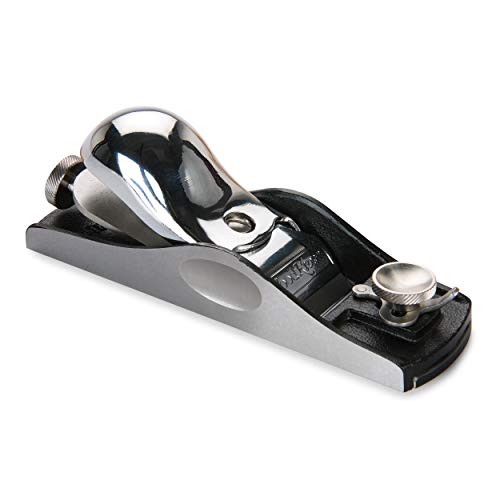 Woodriver Low Angle Block Plane With Adjustable Mouth7.85 x 3.15 x 2.75 Inches2.04 poundsCheck on Amazon


What the Cutting Angle Changes
A block plane’s cutting angle is the combination of the bed angle and the blade bevel. A typical low-angle plane has a bed around 12 degrees and a blade beveled at roughly 25 degrees, producing a cutting angle near 37 degrees. A standard block plane commonly uses a bed around 20 degrees with a similar 25-degree bevel, giving a cutting angle near 45 degrees.
That difference matters at the edge of a board. The lower angle presents the blade more like a knife slicing into the end grain. The higher angle pushes and compresses the fibers before separating them. On straight-grained pine, you may notice little difference. On hard maple, oak, beech, or reversing grain, the low-angle design usually starts easier and leaves fewer torn fibers.
Do not confuse a low-angle block plane with a high-bevel “York pitch” setup. The relevant figure is the final cutting angle, not just the plane’s bed angle.
Low-Angle vs. Standard Block Plane
| Feature | Low-angle block plane | Standard block plane |
|---|---|---|
| Typical cutting angle | About 37 degrees | About 45 degrees |
| End-grain performance | Easier slicing, less effort | Works, but needs a sharp blade and lighter cuts |
| Tear-out resistance | Generally better on difficult grain | More dependent on grain direction and technique |
| Softwood trimming | Very good, though it can dig in if set aggressively | Very good for routine work |
| Hardwood trimming | Better choice for repeated work | Capable, but slower and less forgiving |
| General-purpose use | Excellent for end grain and edge work | Good all-rounder for light chamfers and fitting |
| Typical cost | Often somewhat higher | Often the cheaper option |
When a Low-Angle Plane Is Worth Buying
Choose a low-angle block plane if you regularly trim the ends of shelves, rails, drawer parts, doors, or small boxes. It is particularly useful when the cut runs directly across the board and you need to remove only a few thousandths of an inch without splitting the corner.
The lower cutting angle also helps when grain direction changes within a short workpiece. A standard plane may cut cleanly for half an inch and then lift a chip as the grain reverses. A low-angle plane does not eliminate tear-out, but it reduces the severity and makes it easier to take a controlled shaving.
Look for a solid sole, a blade that can be sharpened accurately, and an adjustment mechanism with little side-to-side play. A comfortable mouth adjustment is useful: close the mouth for fine finishing cuts, then open it slightly if the shaving starts to clog. If you are buying specifically for this work, compare low-angle block planes rather than choosing solely by the plane’s advertised weight.
When a Standard Block Plane Is Enough
A standard block plane is fine for occasional end-grain trimming, especially on pine, spruce, fir, poplar, and other relatively forgiving woods. It is also a reasonable choice if your main jobs are removing sharp edges, fitting a door, trimming plugs, or making quick chamfers. For those tasks, the higher cutting angle is not a serious limitation.
It can also be the better bargain for a first plane. A cheaper plane with a flat sole and a properly sharpened blade will outperform an expensive plane used with a dull edge. If the work is limited to a few small projects each year, spend less on the plane and put time into sharpening and setup. Search for a standard block plane with a replaceable or easily removable blade and a reliable depth adjuster.
The failure mode is usually not that the standard plane cannot cut end grain. It is that the user takes too heavy a shaving, approaches from the wrong direction, or keeps working after the edge has dulled. Those mistakes cause chipping at the far corner and can make the plane feel defective.
Setup for Clean End-Grain Trimming
Sharpness matters more than the label on the plane. Hone the blade until it cleanly shaves arm hair or slices thin paper without snagging. A practical starting projection is a shaving around 0.001 to 0.003 inch for finishing. If the plane stalls or leaves rough patches, reduce the projection rather than forcing it.
Support the work firmly and trim with the grain when possible. On a board end, begin at one corner and work toward the middle, then start from the opposite corner. This “beveling in” method prevents the blade from breaking out the far edge. For a part that must remain square, check it with a small square after every few passes.
Waxing the sole can reduce effort, but it will not correct a rough sole, a loose blade, or a dull edge. Take several light passes instead of one heavy pass. A cut of 0.005 inch may feel quick, but it increases the chance of catching the corner and tearing out a chunk.
The Practical Buying Choice
Buy a low-angle block plane if end-grain trimming is a frequent part of your work, if you use hardwoods, or if minimizing tear-out is more important than saving the last part of the purchase price. It gives you a wider margin for error and is generally the more comfortable tool for repeated trimming.
Buy a standard block plane if you need an inexpensive general-purpose plane, mostly work softwood, or only trim end grain occasionally. Keep the blade sharp, take light cuts, and protect the exit corner. Those habits will solve most problems before a different plane is necessary.
If your projects include both routine fitting and difficult hardwood end grain, a low-angle block plane with an adjustable mouth is the most versatile single choice. It costs more than a basic standard plane, but the control is useful every time the grain stops behaving.