What's inside
As an Amazon Associate I earn from qualifying purchases. This post may contain affiliate links at no extra cost to you.
A 16-foot tape is a practical size for cabinet runs, door trim, and most interior layout work. It is easier to handle than a 25-foot tape, but still reaches across a typical room wall without moving the hook. For repeated measuring, the useful differences are less about maximum reach and more about how reliably the blade returns to the same mark, how easy it is to read, and whether the case gets in the way.
As an Amazon Associate we earn from qualifying purchases at no extra cost to you.



Our Top Picks


What matters for cabinet and trim layout
Look for a blade wide enough to stay extended several feet without folding over, with clear 1/16-inch marks and a standout that suits your working distance. A wider blade can be easier to read and hold straight, but it also makes a tape bulkier. For cabinet work, where measurements are often transferred to panels and filler strips, legibility and a hook that moves consistently matter more than an impressive standout claim.
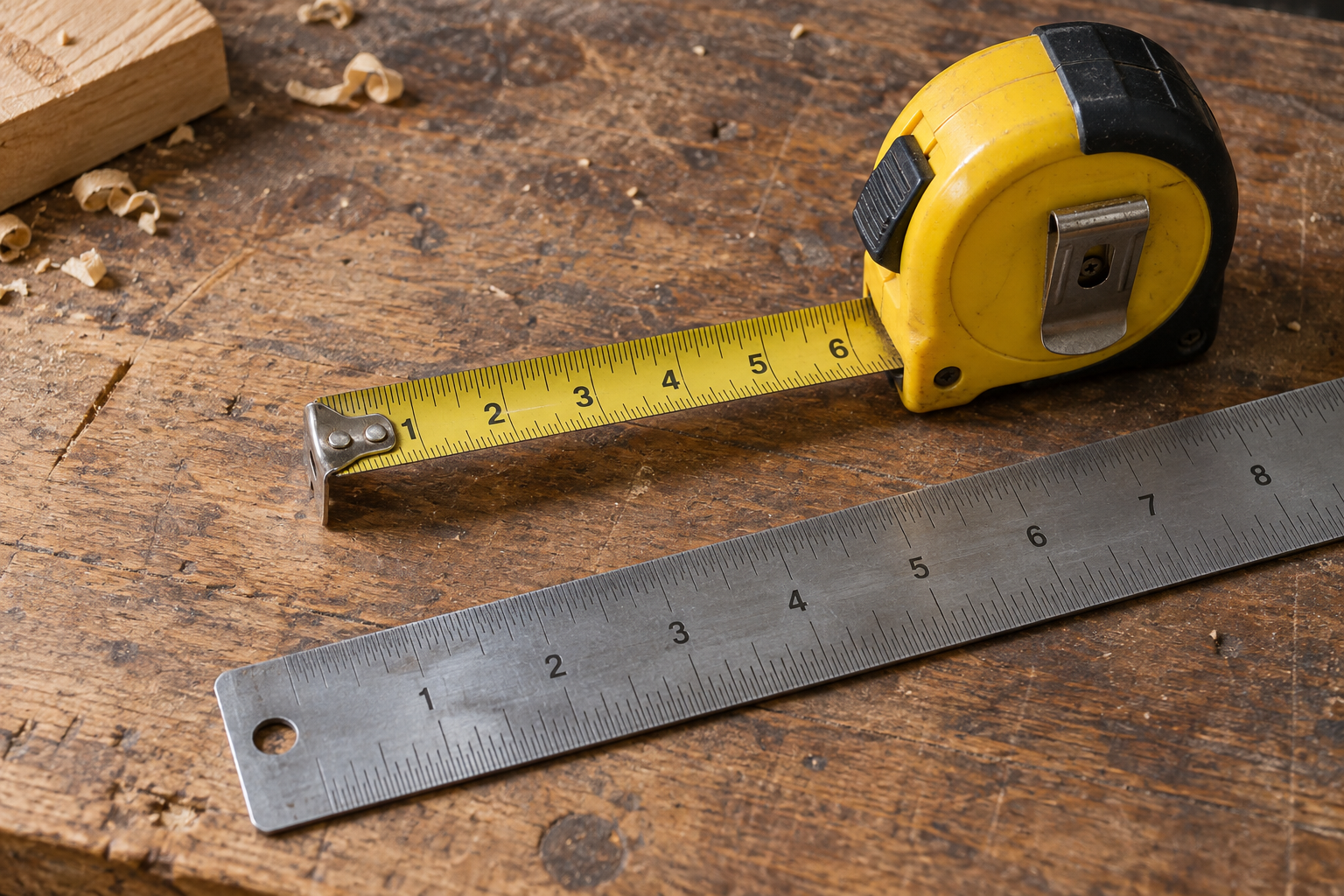
Check the end hook before trusting a measurement. It should move slightly to compensate for its own thickness: pulled outward for an outside measurement and pushed inward for an inside measurement. That small movement is normal. A hook bent sideways, loose enough to wobble, or packed with debris can introduce errors that repeat across a cabinet run.
Many tapes print both standard and metric scales. That can be handy, but a crowded blade may slow down quick reads. If you work in inches, prioritize large, high-contrast inch marks and fractions. For trim, 1/16-inch graduations are useful; finer markings are not a substitute for careful hook placement or a stable reference edge.
Tape types compared
| Type | Best use | Trade-off |
|---|---|---|
| Basic 16-foot tape | Occasional measuring and short trim runs | Often compact and inexpensive, but the blade may be harder to read or less steady when extended |
| Wide-blade 16-foot tape | Repeated cabinet and trim layout | Stiffer blade is easier to manage, though the case is bulkier |
| Dual-scale 16-foot tape | Jobs that switch between inches and metric | Versatile, but extra markings can clutter the blade |
| Self-locking 16-foot tape | One-person measuring and marking | Convenient for holding a length, but the lock mechanism adds parts that can wear or collect dust |
For most repeated layout, a wide-blade tape with a conventional manual lock is the sensible middle ground. A self-locking design is worth considering if you often measure alone, but try the release in person if possible: a button that is hard to reach or easy to bump can be more nuisance than help.
What to buy for repeated work
A solid wide-blade 16-foot tape measure is the strongest general choice. The wider blade is easier to keep upright while measuring a cabinet opening, and high-contrast markings reduce misreads when you are transferring several dimensions. If you work in metric as well, compare the printed scales before buying rather than assuming dual units will be easy to read.
A cheaper basic tape is fine if you mostly measure short pieces on a bench, use a straightedge for layout, or only take a few measurements per day. It is also a reasonable spare for a tool bag. You do not need premium coatings or a special case to measure a cabinet accurately. Spend extra only if the blade, markings, hook, or lock make your actual workflow easier.
For frequent solo work, a self-locking 16-foot tape measure can keep the blade extended while you mark. The trade-off is that the tape must retract smoothly and the lock must release predictably. Fine dust and plaster can foul moving parts; if the blade starts snapping back or the lock slips, stop relying on it for repeated dimensions.
How to keep repeated measurements consistent
Use the same reference point for every cabinet dimension. Hook the tape on the same end of the run, keep it parallel to the floor or cabinet edge, and read at eye level to avoid parallax. On a long run, mark each cabinet location from one fixed datum rather than measuring from the previous mark. Small errors accumulate: four successive 1/16-inch errors can leave the final position 1/4 inch off.
For inside measurements, note whether the tape has a printed case length for adding to the reading. If not, use a separate method: hold the tape against one side, measure to the case, then measure the case width and add it. Do not guess at the case dimension. For a tight opening, a folding rule or a direct measurement with a known spacer can be less awkward.
When cutting trim, mark the measurement with a sharp pencil and identify the waste side of the line. A tape measure tells you the distance; it does not account for the saw kerf. For repeated pieces, cut one test piece, fit it, and use it as a pattern only after confirming the wall or opening is consistent.
Signs the tape is no longer trustworthy
Replace a tape if its hook is bent, the blade has a sharp crease, the lock slips, or the blade no longer retracts evenly. A kink can make the tape fold during extension and damage the blade further. Compare the tape against a known ruler over 12 inches; if the hook or printed scale produces a visible mismatch, do not use it for finish layout. A low-cost tape that reads consistently is better than an expensive one with a damaged end.
For cabinet and trim work, choose a readable 16-foot tape with a stable blade and sound hook. The premium option is justified when it saves handling time every day; for occasional projects, a basic tape and careful measuring technique are usually enough.